In a nutshell
Automated tests are small programs that check your real program still does what it should. Testing in CI just means the pipeline runs all of them, by itself, every time anyone changes the code — and turns the result into a yes/no the merge button can obey. If the tests pass, the change is probably safe. If they fail, the pipeline says “not yet” before a human wastes time reviewing it or a user ever hits the bug.
Think of it like the checks a restaurant kitchen runs before a dish leaves the pass. A quick taste of the sauce is a unit test — fast, cheap, catches most mistakes, done constantly. Plating the full dish and checking it looks right is an integration test — a few real parts together. Sending a waiter to eat an entire meal as a customer would is an end-to-end (e2e) test — the most realistic, but slow and expensive, so you do it rarely. A good kitchen does lots of quick tastes and only a few full meals — never the other way around. That shape is the test pyramid, and flipping it upside-down (mostly full-meal checks) is the classic mistake this lesson teaches you to avoid.
The other half of the lesson is the gate: how CI turns “the tests failed” into “you literally cannot merge this yet,” how it measures how much of your code the tests actually exercised (coverage) without being fooled by a shiny percentage, and how to keep the whole thing fast and trustworthy — so your team believes the green tick instead of re-running the pipeline until it happens to go green.
Level: Intermediate · Time: ~45 min · You’ll need: basic familiarity with a CI pipeline (build → test → package) and having seen a YAML pipeline once. New to those? Start with DevOps Fundamentals and CI/CD Pipeline Design (both linked again below), then come back.
A continuous-integration pipeline that builds and packages your code but does not test it is just an expensive way to ship bugs faster. The entire value of CI — the reason teams pay for runners and wait for green ticks — is the automated test suite that runs on every change and answers one question before a human ever reviews it: did this change break anything we already knew worked? Get testing right and the pipeline becomes a safety net that lets a team merge dozens of times a day with confidence. Get it wrong — slow suites, flaky tests, vanity coverage numbers, gates that block everything or nothing — and developers learn to distrust the pipeline, re-run it until it goes green, or quietly route around it. This lesson is about building the kind of test discipline that makes CI trustworthy.
This is a foundational, vendor-neutral lesson. It complements the course’s DevSecOps pipeline lesson — which covers security testing (SAST, DAST, SCA, IaC scanning) — by concentrating on functional testing: does the software do the right thing. It also complements the hands-on SonarQube quality-gate guide by explaining the concepts behind a quality gate, what coverage really tells you, and where gates belong in the flow. By the end you will be able to design a test strategy, run it fast and reliably in CI, measure it honestly, and gate merges on it without making your colleagues hate you.
Learning objectives
After working through this lesson you will be able to:
- Explain the test pyramid (unit → integration → end-to-end), why the proportions matter, and recognise the ice-cream-cone and hourglass anti-patterns — plus where contract tests fit.
- Run tests fast and reliably in CI using parallelism, sharding, and test selection, and fix or contain flaky tests with retries, quarantine and de-flaking discipline.
- Describe what code coverage does and does not measure (line vs branch vs statement vs mutation), and avoid the coverage-gate trap by gating on the diff rather than a global percentage.
- Build quality gates that fail the build on real regressions — coverage thresholds, SonarQube quality gates, required status checks and branch protection.
- Produce machine-readable test reports (JUnit XML, SARIF) that surface as PR annotations, inline comments and trend dashboards.
- Apply shift-left thinking and the testing trophy, and decouple deploy from release so a bad change is caught before it reaches users.
- Provision test data and environments — fixtures, factories, service virtualisation/mocks, and ephemeral preview environments — and run smoke and synthetic checks after deploy.
Prerequisites
You should be comfortable with the idea of a CI/CD pipeline — that code is built, tested and packaged automatically on every push — and have seen a basic YAML pipeline before. If those are new, read DevOps Fundamentals and CI/CD Pipeline Design first; this lesson assumes that vocabulary (stage, job, step, artifact, gate) and builds the testing discipline on top of it. You do not need to be an expert in any one test framework — examples use JavaScript (Jest/Playwright) and Python (pytest), but every concept is language-neutral and the matrices below name the equivalents across ecosystems. This lesson sits in the CI/CD module of the DevOps Zero-to-Hero ladder, immediately after secrets and configuration management and immediately before deployment strategies — because you cannot deploy safely until you can test reliably.
Core concepts: what “testing in CI” actually means
A few mental models carry the whole lesson, so it is worth fixing the vocabulary before the detail.
A test is code that exercises your software and asserts an expected outcome; if the assertion fails, the test fails. Test automation means those tests run by themselves — no human clicking — so they can run on every change. Testing in CI means the automated suite runs inside the pipeline, triggered by a push or pull request, and its result becomes a signal the pipeline (and the merge button) can act on.
Tests are classified by scope — how much of the system one test touches — and that scope is the single most important property, because it determines the test’s speed, reliability, and what kind of bug it can catch:
| Property | Narrow scope (unit) | Wide scope (end-to-end) |
|---|---|---|
| Speed | Milliseconds | Seconds to minutes |
| What it touches | One function/class, in memory | The whole stack: UI, network, DB, services |
| Failure localisation | Pinpoints the exact line | “Something, somewhere, broke” |
| Reliability | Deterministic | Prone to flakiness (timing, network) |
| What bug it catches | Logic errors in a unit | Integration & wiring errors, real user flows |
| Cost to write/maintain | Cheap | Expensive |
The art of a test strategy is choosing the right mix of scopes so you get fast, precise feedback for most failures and broad confidence for the few that matter — which is exactly what the test pyramid prescribes.
Two more distinctions you will meet throughout:
- Functional vs non-functional. Functional tests check behaviour (“login returns a token”). Non-functional tests check qualities — performance/load, security, accessibility, resilience. This lesson is mostly about functional testing; security testing lives in the DevSecOps lesson.
- Verification vs validation. Verification = “did we build the thing right” (it meets the spec — unit/integration tests). Validation = “did we build the right thing” (it solves the user’s problem — acceptance/e2e, and ultimately production feedback). CI excels at verification; validation needs real environments and real users, which is where preview environments and post-deploy synthetics come in.
The test pyramid
The test pyramid (Mike Cohn, popularised by Martin Fowler) is the foundational model for how much of each kind of test to write. Picture a triangle: a wide base of many fast tests, a narrower middle, and a thin peak of a few slow tests.
| Layer | Proportion (rough guide) | Scope | Speed | Example |
|---|---|---|---|---|
| Unit (base) | ~70% | One function/class, dependencies faked | ms | “calculateTax(100, 0.2) returns 20” |
| Integration (middle) | ~20% | Several real components together (code + DB, two services) | 10s–100s ms | “saving an order writes the right rows to Postgres” |
| End-to-end / UI (peak) | ~10% | The whole system through its real interface | seconds+ | “a user can add to cart and check out in the browser” |
The proportions are not dogma — the exact numbers depend on your system — but the shape is the point. Why a pyramid rather than, say, equal thirds?
- Speed and feedback. Unit tests run in milliseconds, so thousands of them finish in seconds. If most of your confidence comes from the fast layer, developers get an answer almost immediately and run tests constantly. Push confidence up into the slow layers and the suite takes 40 minutes, so people stop running it locally and the feedback loop collapses.
- Failure localisation. A failing unit test tells you the exact function that broke. A failing e2e test tells you a user journey broke — somewhere across the front end, the API, three services and a database. Debugging the second is dramatically more expensive.
- Reliability. Narrow tests are deterministic. Wide tests depend on timing, network, browser rendering and shared state, so they flake. A suite that is mostly e2e is a suite that is mostly flaky.
- Cost of maintenance. A small UI change can break dozens of brittle e2e tests that asserted on exact pixels or DOM structure. Unit tests, scoped to behaviour, survive refactors.
The thin top is not optional, though — it is the only layer that proves the wired-together whole actually works for a real user. The pyramid says few but high-value e2e tests covering critical journeys (sign-up, checkout, the money path), not zero.
Test doubles: how the lower layers stay fast
To test a unit in isolation you replace its real collaborators (the database, an HTTP client, the clock) with test doubles. Knowing the vocabulary precisely is a common interview ask:
| Double | What it does | Use it when |
|---|---|---|
| Dummy | A placeholder passed but never used (fills a parameter) | An argument is required but irrelevant to the test |
| Stub | Returns canned answers to calls | You need the collaborator to return something |
| Spy | A stub that also records how it was called | You need to assert a call happened (and a return value) |
| Mock | Pre-programmed with expectations; fails if they are not met | The interaction is what you are verifying |
| Fake | A working but lightweight implementation (in-memory DB) | You want real-ish behaviour without the real cost |
Over-using mocks is its own anti-pattern: a test that mocks everything verifies that your code calls the mocks the way the test said it would — it can pass while the real integration is broken. That is precisely the gap integration and contract tests close.
Anti-patterns: the ice-cream cone and the hourglass
| Anti-pattern | Shape | What’s wrong | Symptom |
|---|---|---|---|
| Ice-cream cone | Inverted pyramid — lots of manual + e2e, few unit | Slow, flaky, expensive; feedback in tens of minutes; manual QA is the real safety net | “We re-run the pipeline until it’s green”; releases gated on a manual test pass |
| Hourglass | Fat unit + fat e2e, starved integration middle | Units pass, e2e pass intermittently, but wiring bugs between components slip through | “All green but it broke when service A called service B” |
| Cupcake | Duplicated coverage at every layer testing the same thing | Slow and wasteful; a single logic change breaks tests at three levels | Every small change reddens dozens of tests |
The ice-cream cone is the most common and the most damaging. It usually grows by accident: e2e tests are easy to start with (“just script the browser”) and writing unit tests requires designing testable code. Teams that never invest in the base end up with a top-heavy suite that is slow, flaky, and trusted by no one — so a human QA pass becomes the real gate, and you have re-invented pre-DevOps testing with extra YAML.
Contract tests: the middle layer for microservices
When your system is split into services, a classic gap opens: service A’s unit tests mock service B, service B’s unit tests mock A, both are green — and they disagree about the API. Contract testing (e.g. Pact) closes it. The consumer (A) writes the requests it makes and the responses it expects; that contract is shared with the provider (B), whose CI replays it to prove it still honours the shape. Neither side has to spin up the other in full; you get integration-level confidence at near-unit speed and cost. Contract tests live in the middle of the pyramid and are the right tool for “did we break a downstream consumer?” without a fragile, all-services-up e2e environment.
Running tests in CI: fast, parallel, selective
A correct suite that takes 40 minutes is, in practice, a broken suite — people stop waiting for it. Wall-clock time is a first-class concern. The levers:
| Technique | What it does | Trade-off / gotcha |
|---|---|---|
| Parallelism (within a job) | Test runner uses all CPU cores on the runner | Tests must be isolated — shared DB rows/files cause cross-talk |
| Sharding (across jobs/runners) | Split the suite into N groups, one runner each, then merge results | Need balanced shards (by timing, not file count) or one shard dominates |
| Matrix builds | Run the suite across versions/OSes (Node 18/20/22, Linux/Win) | Multiplies minutes; reserve wide matrices for main/nightly |
| Test selection / affected-only | Run only tests impacted by the diff (Nx, Bazel, --changed) |
Must be sound or you skip a test that should have run; keep a full run on main |
| Fail-fast vs run-all | Stop on first failure (fast feedback) vs run everything (full picture) | Fail-fast hides other failures; run-all costs minutes. Use fail-fast on PRs, run-all on main |
| Caching | Restore dependencies/build outputs keyed on the lockfile | Caches are a speed optimisation; must be safe to miss, never trusted for correctness |
| Splitting the pipeline by layer | Unit on every push; integration/e2e on PR or pre-merge | Slow layers do not block the inner loop, but run before merge |
A pragmatic layout that most teams converge on:
- On every push (fast lane, < 5 min): lint + unit tests + a coverage report. This is the inner-loop signal.
- On pull request (before merge): the above plus integration tests, contract tests, a focused e2e smoke set, and the quality gate. This is the gate that protects
main. - On
main/ nightly (full lane): the complete e2e suite, the full matrix, performance/load tests, and the full (not diff-only) coverage and security scans.
Here is the parallel/sharded shape in GitHub Actions, using a matrix to split e2e across four runners:
jobs:
  unit:
    runs-on: ubuntu-latest
    steps:
      - uses: actions/checkout@v4
      - uses: actions/setup-node@v4
        with: { node-version: '20', cache: 'npm' }
      - run: npm ci
      - run: npm test -- --coverage --reporters=default --reporters=jest-junit
      - uses: actions/upload-artifact@v4          # publish report for downstream merge
        if: always()                              # upload even when tests fail
        with: { name: junit-unit, path: junit.xml }

  e2e:
    runs-on: ubuntu-latest
    strategy:
      fail-fast: false                            # let every shard report, don't cancel siblings
      matrix:
        shard: [1, 2, 3, 4]                        # 4-way split
    steps:
      - uses: actions/checkout@v4
      - uses: actions/setup-node@v4
        with: { node-version: '20', cache: 'npm' }
      - run: npm ci
      - run: npx playwright install --with-deps
      - run: npx playwright test --shard=${{ matrix.shard }}/4
Note fail-fast: false on the e2e matrix: with it set to the default true, one shard failing cancels the other three and you lose visibility into all the failures — you want every shard to finish so you see the full damage in one run.
Flaky tests: the silent killer of CI trust
A flaky test is one that passes and fails on the same code depending on run-to-run luck. Flakiness is the single fastest way to destroy trust in a pipeline: once “just re-run it” becomes the team reflex, a real failure gets re-run away too, and the safety net is gone. Treat flakiness as a defect, not a nuisance.
Where flakiness comes from (so you can prevent it):
| Cause | Mechanism | Fix |
|---|---|---|
| Timing / race conditions | sleep(500) then assert; the UI/async op wasn’t actually ready |
Wait for a condition (element visible, response received), never a fixed sleep |
| Test order dependence | Test B relies on state test A left behind; reorder and it breaks | Isolate state; fresh fixtures per test; randomise order to flush these out |
| Shared mutable state | Parallel tests hit the same DB row, file, or global | Unique data per test (namespaced keys, per-test schema/transaction) |
| External dependencies | A real third-party API is slow/down/rate-limited | Mock/stub it; or use a recorded fixture; keep live calls out of the gate |
| Non-determinism | Math.random(), Date.now(), map ordering, locale |
Inject a seed/clock; sort before asserting; pin timezone/locale |
| Resource limits | Test passes on a fast laptop, times out on a small runner | Right-size timeouts; profile slow tests; give runners enough CPU/RAM |
| Animation / network in e2e | Element not yet painted; request still in flight | Framework auto-waiting (Playwright), disable animations, await network idle |
A disciplined flaky-test workflow — the part most teams skip:
- Detect. Track per-test pass/fail history over time (many CI platforms and tools — e.g. test analytics, BuildPulse, Datadog CI Visibility, the framework’s own retry-report — surface a flake rate). A test that fails then passes on retry of the same commit is flaky by definition.
- Quarantine, don’t ignore. Move a known-flaky test into a quarantine set that still runs and reports but does not fail the build/gate. This keeps the signal honest (the suite is green for real reasons) without deleting coverage or losing the test.
- Retry — narrowly and visibly. Allow a small number of automatic retries (e.g.
retries: 2in Playwright,pytest-rerunfailures,flakyplugin) only for genuinely flaky layers (e2e), and surface that a retry happened — a test that “passed on attempt 3” must show up in the report, or you are just hiding flakiness. Never blanket-retry unit tests; a flaky unit test is a real bug. - De-flake on a clock. Quarantine is a holding pen with a deadline, not a graveyard. Track quarantined tests as work, fix the root cause, and return them to the gating suite. A quarantine that only grows means your real coverage is silently shrinking.
The crucial nuance: retries are damage control, not a cure. They keep the pipeline moving while you fix the root cause, but a high retry rate is itself a metric to alarm on. The goal is a low, tracked flake rate and a shrinking quarantine — not a pipeline that passes because it tried five times.
Code coverage: what it measures, and what it doesn’t
Code coverage is the percentage of your code that was executed while the tests ran. It is reported by an instrumentation tool (Istanbul/nyc for JS, coverage.py for Python, JaCoCo for Java, gcov, Go’s -cover) that watches which lines/branches the test run touched. There are several kinds, and conflating them is a common mistake:
| Coverage type | Measures | Strength | Weakness |
|---|---|---|---|
| Statement / line | % of executable lines run | Simple, ubiquitous | A line can run without its logic being asserted |
| Branch / decision | % of if/else/switch branches taken |
Catches untested conditional paths | Doesn’t check combinations of conditions |
| Function / method | % of functions called at least once | Quick “is this even tested” view | Coarse |
| Condition / MC-DC | Each boolean sub-condition independently true/false | Rigorous (used in avionics/DO-178C) | Hard and slow; rarely needed outside safety-critical |
| Mutation | % of injected bugs (“mutants”) your tests catch | Measures assertion quality, not just execution | Slow; needs a mutation tool (Stryker, PIT, mutmut) |
The single most important truth about coverage: it tells you what code your tests ran, not what your tests verified. Consider:
function divide(a, b) {
  return a / b;          // a test that calls divide(10, 2) gives 100% line coverage…
}
test('divide', () => {
  divide(10, 2);         // …but asserts nothing. Coverage 100%, value ~0.
});
This is why branch coverage is more honest than line coverage (it forces you to exercise the b === 0 path), and why mutation testing is the gold standard for assertion quality: it deliberately mutates your code (changes > to >=, deletes a line) and checks whether a test fails in response. If no test fails when the code is broken, your tests do not actually verify that behaviour, regardless of the coverage number. Mutation testing is too slow to run on every commit on a large codebase, but running it nightly or on changed files is a powerful way to expose “coverage theatre”.
The coverage-gate trap
The most seductive and most counter-productive policy in all of testing is “the build fails if total coverage is below X%.” It feels rigorous. It backfires in specific, predictable ways:
- It optimises the wrong thing. Coverage is a proxy for “well-tested”. Make the proxy a target and people hit the proxy without the substance — they write tests that execute code to bump the number while asserting nothing (Goodhart’s Law: when a measure becomes a target, it ceases to be a good measure).
- It punishes the wrong people. A developer adds 200 lines of well-tested code to a legacy module that sits at 40% coverage. The global percentage might tick down (their tested code is dwarfed by the untested legacy they didn’t touch), so a global gate blocks a good PR for a problem it did not cause.
- It encourages deleting code instead of testing it. The fastest way to raise a percentage is to delete untested code — sometimes fine, often not, and a perverse incentive either way.
- It creates a cliff. At 79.9% against an 80% gate, the team’s energy goes into gaming the last 0.1% (testing trivial getters), not into testing the gnarly logic that actually carries risk.
The fix that actually works: gate on the diff, not the global total. The right policy is “new and changed code must be ≥ X% covered.” This is exactly what SonarQube’s default quality gate (coverage on new code) and tools like Codecov/diff-cover/Coveralls patch coverage implement. It is fair (you are responsible only for what you wrote), it is effective (it stops new untested code without demanding you retroactively test a legacy mountain), and it lets a codebase improve monotonically — the old untested code stays as a tracked backlog while everything new arrives tested.
What is a “good” percentage? There is no universal number, and chasing 100% is usually waste — the last 10–15% is often generated code, trivial accessors, defensive branches that can’t occur, and framework glue, where the test cost exceeds the value. Sensible defaults:
| Code | Sensible target | Why |
|---|---|---|
| Core business / money logic | 90%+ branch | High risk; bugs are expensive |
| Typical application code | ~80% line, ~70% branch | Diminishing returns above this |
| Generated / boilerplate / DTOs | Exclude from the metric | Testing it measures nothing |
| New code in the diff | A gate (e.g. 80%) | Where enforcement belongs |
| Overall total | A tracked trend, not a hard gate | Watch the direction, not a magic line |
The mature stance: coverage is a conversation-starter, not a finish line. A line at 0% coverage is a useful red flag worth a look; a global gate at 80% is a blunt instrument that breeds gaming. Gate the diff, watch the trend, and reserve human judgement for whether the right things are covered.
Quality gates: failing the build on regressions
A quality gate is a pass/fail decision the pipeline makes about a change before it is allowed to proceed (merge or deploy). A test result is the most basic gate — any failing test fails the build — but a real quality gate aggregates several conditions. Where this lesson focuses (functional testing), the gate conditions are:
| Gate condition | Typical rule | Where evaluated |
|---|---|---|
| Tests pass | Zero failing tests (the non-negotiable) | The test job’s exit code |
| Coverage on new code | New/changed code ≥ threshold | SonarQube / Codecov / diff-cover |
| No new bugs / code smells above severity | Zero new blocker/critical issues | SonarQube / static analysis |
| No coverage regression on the diff | Patch coverage ≥ project target | Codecov / Coveralls |
| Flake budget respected | Quarantine set within agreed size | Test analytics |
| Required checks green | All named checks reported success | The SCM’s branch protection |
The crucial mechanism that makes a gate enforceable rather than advisory is branch protection / required status checks. A test job that “fails” but that nobody is required to wait for is just a dashboard. You make it real at the source-control layer:
- GitHub: Branch protection rule (or a ruleset) on
main→ Require status checks to pass before merging, listing your test and coverage check names → optionally Require branches to be up to date so the check ran against the latestmain. The merge button is disabled until they are green. - GitLab: Merge request approvals + pipelines must succeed + coverage check in the project’s merge-request settings; Code Quality and coverage widgets render on the MR.
- Azure DevOps / Bitbucket: Branch policies → build validation (the pipeline must pass) + status checks.
The SonarQube quality gate is the canonical aggregated gate and is covered hands-on in the SonarQube guide; conceptually it bundles “coverage on new code”, “no new bugs/vulnerabilities/smells above your severity”, and “duplication on new code” into one Passed/Failed the pipeline reads and branch protection enforces. The defining design choice — and the reason it avoids the coverage-gate trap — is that the default gate evaluates new code (the Clean as You Code model), so legacy debt never blocks today’s PR while new debt is stopped at the door.
A non-negotiable rule of gate design, borrowed straight from the DevSecOps lesson and applied to functional testing: roll a new gate out in warn mode first. Turning on a strict gate against a legacy codebase overnight blocks every PR and the team’s first move is to disable it. Start by reporting the metric, give people time to clear or quarantine the worst, then flip it to blocking — and gate on the diff, not the whole repository, so you are never asking a developer to fix a problem they did not create.
Test reporting: making results legible
A test run that only prints to a log is nearly useless — when 4,000 tests run across 4 shards and one fails, nobody is going to scroll terminal output to find it. Machine-readable test reports turn raw runs into something the platform can surface where developers actually are.
| Format | What it is | Consumed by |
|---|---|---|
| JUnit XML | The de-facto standard XML schema for test results (despite the name, every framework emits it) | CI test tabs, PR annotations, dashboards |
| SARIF | Static Analysis Results Interchange Format — for analysis findings (lint, SAST) | GitHub code scanning, PR annotations |
| Cobertura / LCOV / Clover | Coverage report formats | Codecov, Coveralls, SonarQube, CI coverage widgets |
| TAP | Test Anything Protocol — simple line-based output | Older/Unix-y toolchains |
| HTML report | Human-readable run report (Playwright, Allure, pytest-html) | Humans, attached as a build artifact |
Almost every framework can emit JUnit XML with a reporter or plugin — jest-junit, pytest --junitxml=report.xml, Maven Surefire, Go’s gotestsum --junitfile, .NET’s --logger trx (then convert). Once you have it, you wire it to surface in three increasingly useful ways:
- A test tab / summary on the run, listing passed/failed/skipped with the failure message and stack — so a failure is one click, not a log scroll.
- PR annotations / inline comments — the failing test (and the line it failed on) appears as a comment on the diff, where the reviewer and author are already looking. (
dorny/test-reporter,mikepenz/action-junit-report, GitLab’s MR test widget, the SonarQube/Codecov PR comment.) - Trends over time — flake rate, suite duration, pass rate, coverage trend on a dashboard, so you can see the suite getting slower or flakier before it becomes a crisis.
A small but important detail seen in the lab YAML above: upload the report with if: always(). By default a step is skipped when an earlier step failed — but the report is most valuable exactly when tests fail, so the upload/report step must run regardless of the test step’s outcome.
Shift-left and the testing trophy
Shift-left is the principle of moving testing (and quality activity generally) earlier — to the left on the timeline from idea to production. The economics are stark: a bug caught in the developer’s editor costs minutes; the same bug caught in code review costs hours; in QA, days; in production, potentially an incident, a rollback, lost customers and an emergency fix. Every shift left is a shift cheaper.
In practice, shift-left means pushing checks toward the developer:
| Position (left → right) | Check | Feedback time |
|---|---|---|
| In the editor | Type-checking, linting, fast unit tests on save | Seconds |
| Pre-commit hook | Lint, format, unit tests, secret scan on changed files | Seconds (local) |
| Pull request / CI | Full unit + integration + e2e smoke + coverage gate | Minutes |
| Pre-merge | Contract tests, quality gate, preview-env deploy | Minutes |
| Post-deploy | Smoke + synthetic monitoring (shift-right) | Continuous |
A nuance worth holding: shift-left is not “run everything as early as possible”. Slow e2e tests do not belong in a pre-commit hook — they would make commits unbearable and people would bypass the hook. Put each check at the earliest point where its signal-to-noise ratio is still good: fast deterministic checks in the inner loop, slow broad checks at the PR/pre-merge gate. (This is exactly the placement logic the DevSecOps lesson applies to security scans.)
There is also shift-right: testing in (or against) production — smoke tests after deploy, synthetic monitoring, canary analysis, feature-flag experiments, and observability that catches what no pre-prod test could. The modern view is both: shift-left to catch bugs cheaply before release, and shift-right to catch what only production reveals. The two are complementary, not competing.
The testing trophy
For applications dominated by integration concerns — typical of modern web/back-end services that are mostly glue between a database, an API and third parties — Kent C. Dodds proposed the testing trophy as a refinement of the pyramid. From base to top:
| Trophy layer | Weight | Rationale |
|---|---|---|
| Static (types, lint) | Foundation | Catches a whole class of bugs (typos, type errors) for free, before any test runs |
| Unit | Some | Pure logic, edge cases |
| Integration | The most | “Write tests. Not too many. Mostly integration.” — the highest confidence-per-effort for glue-heavy code |
| End-to-end | A few | Critical journeys only |
The trophy is not a contradiction of the pyramid — it is the same advice (few slow tests, many fast ones) with the centre of gravity moved toward integration for a class of software where most bugs are wiring bugs rather than logic bugs, and where over-mocked unit tests give false confidence. Pick the model that matches your system: a library with rich algorithms leans pyramid (fat unit base); a service that mostly orchestrates calls leans trophy (fat integration middle). Both reject the ice-cream cone.
Test data and environments
Tests need something to run against, and how you provision it determines whether the suite is fast, isolated and trustworthy.
Test data — the records a test reads and writes:
| Approach | What it is | Strength | Watch out |
|---|---|---|---|
| Fixtures | Predefined data loaded before a test | Explicit, repeatable | Brittle if shared/large; drift from schema |
| Factories / builders | Code that generates valid objects on demand (Factory Bot, factory_boy, Faker) | Flexible, readable, only set what matters | Can hide what the test actually needs |
| Seed scripts | A known dataset loaded into a DB | Realistic for integration | Must reset between tests or order-dependence creeps in |
| Property-based | Generate many random valid inputs, assert invariants (Hypothesis, fast-check, QuickCheck) | Finds edge cases you’d never hand-write | Failures need shrinking to a minimal case to debug |
| Production-like / anonymised | Scrubbed copy of real data | Catches real-world shapes | Never use raw PII — must be anonymised/synthetic |
The cardinal rule: each test owns its data and cleans up after itself (or runs in a transaction rolled back at the end). Tests that depend on data another test created are order-dependent and flaky by construction.
Faking external services so tests stay fast and deterministic:
| Technique | What it does | Use when |
|---|---|---|
| Mocks/stubs (in-process) | Replace the client object with a canned one | Unit tests; you control the boundary |
HTTP interception (WireMock, MSW, nock, responses) |
Intercept network calls, return scripted responses | Integration tests against an “API” without the real one |
| Service virtualisation | A simulated stand-in for a whole external system (records/replays, models latency/errors) | A dependency is slow, costly, rate-limited, or not yet built |
| Contract tests (Pact) | Verify your stub matches the real provider’s shape | Microservices — to stop mocks drifting from reality |
| Containers for real deps (Testcontainers) | Spin up a real Postgres/Kafka/Redis in a throwaway container per test run | Integration tests where you want the real engine, not a fake |
Testcontainers deserves a special mention: instead of mocking the database, it starts a real disposable database in a container for the duration of the test run and tears it down after. You get genuine integration confidence (real SQL, real constraints) with full isolation and no shared staging DB to corrupt — it has largely become the default for integration testing where a real backing service matters.
Ephemeral and preview environments
The highest-fidelity test is against a running deployment of your change — but a single shared “staging” environment is a bottleneck (everyone queues for it) and a lie (it drifts from production and accumulates everyone’s half-finished changes). The modern answer is the ephemeral preview environment (a.k.a. review app, PR environment, on-demand environment).
The pattern: when a pull request opens, CI provisions a complete, isolated, short-lived copy of the application — its own URL, its own database, seeded with test data — deploys the PR’s code into it, runs e2e tests against it, posts the URL as a PR comment for humans to click and explore, and then destroys the whole thing when the PR merges or closes. Each change gets its own pristine world.
| Property | Shared staging | Ephemeral preview env |
|---|---|---|
| Isolation | Everyone shares one | One per PR — no cross-talk |
| Drift | Accumulates; “works on staging” lies | Built fresh from the PR; matches that change |
| Bottleneck | Queue for the one environment | Unlimited parallel |
| Lifetime | Permanent (and slowly rots) | Created on open, destroyed on close |
| Cost | One always-on environment | Pay only while PRs are open (scale to zero) |
| Realism for reviewers | Stale | A live URL of this exact change |
This is the gold standard for validation in CI — reviewers and product owners click a real, working version of the change, and e2e tests run against a true deployment rather than a mocked stack. It is enabled by infrastructure-as-code and ephemeral compute (Kubernetes namespaces, Vercel/Netlify previews, Heroku Review Apps, Argo CD ApplicationSet with PR generators, or Terraform per PR). The two engineering disciplines that make it affordable and reliable: scale-to-zero / aggressive teardown (an orphaned preview env is pure cost — always destroy on PR close, and reap stale ones on a schedule) and fast, automated data seeding (an env nobody can log into is useless).
Smoke and synthetic checks after deploy
Passing CI proves the change is good; it does not prove the deployment worked — config can be wrong, a secret missing, a dependency unreachable in the real environment. So testing continues after deploy (the shift-right side):
- Smoke tests — a tiny set of “is it alive and serving?” checks run immediately after a deploy: the health endpoint returns 200, the homepage loads, a login succeeds, the DB is reachable. They are the deploy gate: if the smoke test fails, the deploy is considered failed and you roll back automatically (redeploy last-good, or shift traffic back for blue-green/canary). This is the Verify stage of pipeline design and the thing that drives MTTR down.
- Synthetic monitoring — scripted user journeys (the same e2e flows, or curl probes) run continuously against production from outside, on a schedule, from multiple regions. They catch outages and regressions that only manifest in production, before a real user reports them, and they feed your SLO/error-budget alerting (see the observability lesson).
Smoke and synthetic checks are where pre-deploy testing hands off to production observability — the right-hand half of “shift-left and shift-right”.
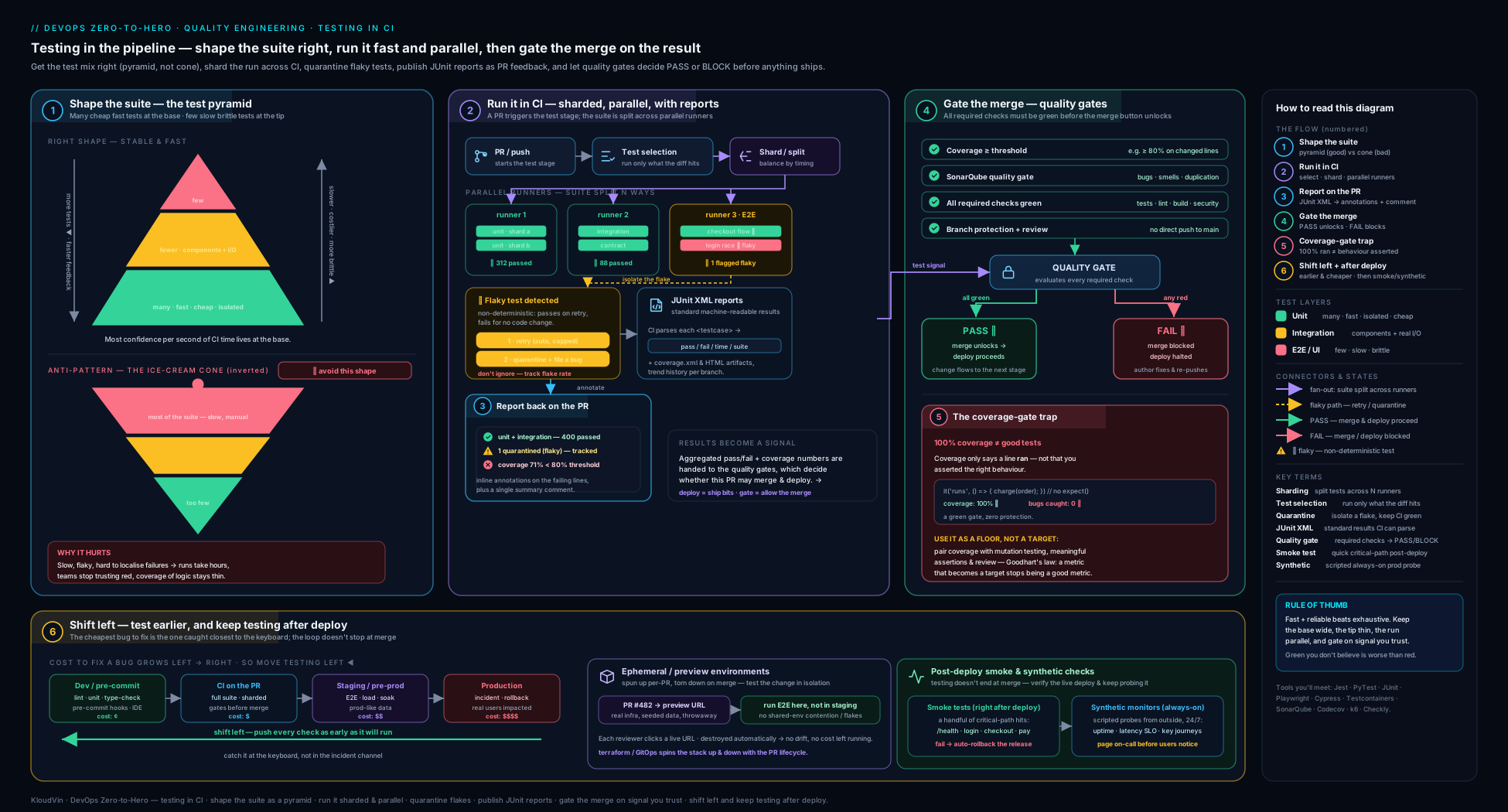
The diagram above ties the pieces together: the pyramid (unit → integration → e2e) on the left feeding the CI lanes (fast push lane → PR gate with coverage-on-diff and quality gate → full nightly lane), an ephemeral preview environment spun up per pull request for e2e and human review, and the shift-right tail of smoke and synthetic checks after deploy — showing exactly where in the flow each kind of test runs.
Hands-on lab
We will build a real test-and-gate pipeline on GitHub Actions (free tier, hosted runners — nothing to install but Git) for a tiny app, exercising the core ideas: unit tests with branch coverage, a diff-aware coverage gate, JUnit reporting that surfaces on the PR, a sharded e2e job, and a quarantined flaky test. Everything here is free on a public repo.
1. Scaffold a tiny app + tests. In a new GitHub repo, add a trivial Node app with a function and tests. Configure Jest for JUnit + coverage output. package.json (excerpt):
{
  "scripts": { "test": "jest --coverage --reporters=default --reporters=jest-junit" },
  "jest": {
    "coverageReporters": ["text", "lcov", "json-summary", "cobertura"],
    "coverageThreshold": { "global": { "branches": 70, "lines": 80 } }
  },
  "devDependencies": { "jest": "^29", "jest-junit": "^16" }
}
The coverageThreshold makes Jest itself fail the run if local coverage drops below the floor — a gate the framework enforces before CI even reasons about it.
2. Add the pipeline. Create .github/workflows/test.yml:
name: test
on:
  push: { branches: [main] }
  pull_request:
permissions:
  contents: read
  checks: write          # for the test-report annotations
  pull-requests: write   # for the PR comment
jobs:
  unit:
    runs-on: ubuntu-latest
    steps:
      - uses: actions/checkout@v4
      - uses: actions/setup-node@v4
        with: { node-version: '20', cache: 'npm' }
      - run: npm ci
      - run: npm test                       # runs Jest with coverage + junit + threshold
      - name: Publish test report
        uses: dorny/test-reporter@v1
        if: always()                         # report even (especially) on failure
        with:
          name: unit-tests
          path: junit.xml
          reporter: jest-junit
      - name: Diff-aware coverage gate
        if: github.event_name == 'pull_request'
        run: |
          # Fail if any line CHANGED in this PR is not covered (the right gate).
          npx diff-cover coverage/cobertura-coverage.xml \
            --compare-branch=origin/${{ github.base_ref }} \
            --fail-under=80

  e2e:
    runs-on: ubuntu-latest
    strategy:
      fail-fast: false
      matrix: { shard: [1, 2] }              # 2-way shard for speed
    steps:
      - uses: actions/checkout@v4
      - uses: actions/setup-node@v4
        with: { node-version: '20', cache: 'npm' }
      - run: npm ci
      - run: npx playwright install --with-deps
      - run: npx playwright test --shard=${{ matrix.shard }}/2 --retries=2
        #     ^ narrow, visible retries for the flaky-prone e2e layer only
3. Run it. Push to main, then open a PR with a change. In the Actions tab and on the PR you should see: the unit job, two e2e shards running in parallel, a test report with pass/fail counts, and (on the PR) the diff-aware coverage gate.
4. Validate each idea.
- Tests gate the merge: add a deliberately failing test on a branch, open a PR — the
unitjob goes red and the test report names the failing test inline. - Coverage gate is diff-aware: add a new function with no test in a PR —
diff-coverfails because the new lines are uncovered, even though global coverage barely moved. Then add a test for it — it passes. (Contrast: a global gate would behave erratically here.) - Sharding/parallelism: the run graph shows
e2e (1)ande2e (2)side by side; total e2e time is roughly halved versus one shard. - Flaky handling: write a test that fails ~50% of the time (
expect(Math.random()).toBeLessThan(0.5)), give the e2e step--retries=2, and observe it “passed on attempt 2/3” in the report — proof a retry happened and was surfaced rather than hidden. - Reporting on failure: confirm the
Publish test reportstep ran even when tests failed (because ofif: always()).
5. Enforce the gate. In Settings → Branches → Add branch protection rule for main: tick Require status checks to pass before merging and select unit-tests (and the e2e checks). Now the Merge button is disabled until they are green — the gate is enforced, not advisory.
Validation checklist: green run on a good PR; red unit (with the failing test named inline) on a bad one; the diff-aware coverage gate failing on new untested code and passing once tested; two e2e shards in parallel; a retried flaky test visible in the report; the merge button blocked until checks pass.
Cleanup. Delete the branch protection rule if it was throwaway, and delete the repository (Settings → Delete this repository) if it was a scratch project. Public-repo Actions minutes are free, so there is nothing to switch off.
Cost note. Public-repo Actions minutes are free; private repos get a monthly free allotment then bill per minute (Linux cheapest; e2e/browser jobs and wide matrices burn the most). The cost levers for testing specifically: shard only as wide as the time saving justifies (each shard is a billed runner), reserve full matrices/e2e for main/nightly rather than every push, cache dependencies, and use test selection to skip unaffected tests on large monorepos. Ephemeral preview environments cost real compute while open — make teardown automatic so orphans don’t accrue.
Common mistakes & troubleshooting
| Symptom | Likely cause | Fix |
|---|---|---|
| Suite takes 30+ min; devs stop running it locally | Ice-cream cone (too many e2e), no parallelism/caching | Invert toward a unit base; shard e2e; cache deps; split fast/slow lanes |
| “Just re-run it and it goes green” is the team reflex | Flaky tests treated as noise, not defects | Track flake rate, quarantine (run-but-don’t-fail), retry narrowly+visibly, de-flake on a deadline |
| Coverage is 90% but bugs still ship | Tests execute code without asserting (line-coverage theatre) | Use branch coverage; add mutation testing nightly to expose weak assertions |
| A new gate gets disabled within a week | Strict gate flipped on against a legacy repo overnight | Roll out in warn mode; gate the diff, not the whole repo |
| A well-tested PR is blocked by the coverage gate | Gating on global coverage, which legacy debt drags down | Gate on coverage of new/changed code (SonarQube new-code / diff-cover) |
| A failing test is invisible in 4,000 lines of log | No machine-readable report | Emit JUnit XML; surface as a test tab + PR annotation; upload with if: always() |
| Tests pass alone but fail when run together | Order dependence / shared mutable state | Isolate data per test (transaction rollback, per-test schema); randomise order to flush it out |
| “Green in CI, broken in prod” | No post-deploy verification; staging drift | Add smoke tests as a deploy gate with auto-rollback; use ephemeral envs that match the change |
| One e2e shard fails and cancels the rest | fail-fast: true (default) on the matrix |
Set fail-fast: false so every shard reports |
| Microservices: both sides green, integration breaks | Each service mocks the other; mocks drifted | Add contract tests (Pact) so the stub is verified against the real provider |
Common beginner mistakes
These are misconceptions — wrong mental models that lead people astray — as opposed to the symptom→fix table above. Fix the model and the symptoms stop appearing.
-
“More tests = better quality.” A thousand over-mocked unit tests can still miss the one wiring bug that takes production down, while costing you hours every time you refactor. It is the shape of the suite and the quality of the assertions that protect you, not the raw count. Right model: tests are a portfolio — buy the cheapest test that can catch each class of bug, not the most tests.
-
“100% coverage means the code is fully tested / bug-free.” Coverage measures which lines ran, not whether anything was asserted — you can hit 100% while verifying nothing (see the
divideexample earlier). Right model: coverage reliably tells you what you didn’t test (a 0% file is a genuine red flag); it cannot tell you that what you did test is correct. Branch and mutation coverage get closer to that. -
“A red test is the test’s fault — just re-run it.” Re-running to green trains the whole team to treat red as noise, and the day a real regression turns the build red, it gets re-run away too. The safety net is gone precisely when you needed it. Right model: a flaky test is a defect in the test; quarantine it (run-but-don’t-fail) and fix the root cause — never launder failures through blind retries.
-
“e2e tests are the most valuable because they’re the most realistic.” They are the most realistic and the slowest, flakiest, and worst at telling you what broke — lean on them and you build the ice-cream cone. Right model: realism has a price; buy a little of it (a few critical journeys — sign-up, checkout, the money path) and get the rest of your confidence from the fast, precise layers below.
-
“Coverage should be a hard 80% gate on the whole repository.” A global gate punishes a developer for legacy debt they never wrote (their well-tested PR can lower the total) and rewards tests that execute without asserting. Right model: gate the diff — new and changed code must be covered — and track the global total only as a trend.
-
“If it’s green in CI, it’s safe to release.” CI proves the code is correct in a test harness; it does not prove the deployment works — a missing secret, wrong config, or unreachable dependency all pass CI and fail in production. Right model: pair shift-left (pre-merge gates) with shift-right (post-deploy smoke + synthetic checks and automatic rollback).
-
“Integration tests are just slow unit tests, so we can skip the middle.” They answer a different question — do these real components actually agree? — which unit tests structurally cannot, because they mock the very boundary that breaks. Right model: each layer catches a different class of bug; a starved middle (the hourglass) is exactly where “all green, still broke in prod” lives, and contract tests are the cheap way to fill it.
Practice challenges
Work these top to bottom — they escalate from “read the pyramid” to “close a microservice gap.” Try each before opening the solution.
1. (Beginner) Put each test on the pyramid. Label these three as unit / integration / e2e and give the rough proportion each layer should be: (a) asserts formatCurrency(1000) returns "₹1,000"; (b) posts an order and checks the row appears in a real Postgres started by Testcontainers; © drives a browser to sign up, add to cart, and pay.
<details><summary>Solution</summary>
(a) unit (~70% of the suite) — one function, no I/O. (b) integration (~20%) — your code plus a real database. © e2e (~10%) — the whole system through its real UI. Why: a test’s scope (how much of the stack it touches) decides its layer, and the pyramid wants many narrow tests, few wide ones. </details>
2. (Beginner) Spot the coverage lie. This test gives 100% line coverage. What is wrong, and which coverage type would expose it?
function divide(a, b) { return a / b; }
test('divide', () => { divide(10, 2); });   // asserts nothing
<details><summary>Solution</summary>
The line executes but nothing is asserted, so coverage is 100% and the test’s value is ~0. Add expect(divide(10, 2)).toBe(5), and use branch coverage to force the b === 0 path; mutation testing would flag it outright (no test fails when you break the code). Why: coverage measures execution, not verification.
</details>
3. (Intermediate) De-flake a timing-dependent test. Rewrite this Playwright step so it is deterministic instead of racing a fixed sleep:
await page.waitForTimeout(500);
await expect(page.getByRole('button', { name: 'Submit' })).toBeVisible();
<details><summary>Solution</summary>
Drop the sleep and wait for the condition — Playwright’s assertion already auto-waits:
await expect(page.getByRole('button', { name: 'Submit' })).toBeVisible();
Why: wait for a state (element visible, response received), never a fixed duration — a hard-coded sleep is the number-one source of timing flakiness (too short → flake, too long → slow).
</details>
4. (Intermediate) Make the coverage gate fair. A well-tested 200-line PR to a legacy module stuck at 40% coverage is blocked by an 80% global gate, even though every new line is tested. Change the policy so this PR passes while genuinely-untested new code is still stopped. Give a concrete command.
<details><summary>Solution</summary>
Gate the diff, not the total:
diff-cover coverage/cobertura-coverage.xml \
  --compare-branch=origin/main --fail-under=80
(or SonarQube’s coverage on new code gate). Why: developers should be accountable for the code they wrote, not for legacy debt they merely stood next to — and the codebase still improves monotonically. </details>
5. (Advanced) Shard e2e without losing failures or reports. Write a GitHub Actions job that splits the e2e suite across 3 runners, does not cancel the other shards when one fails, and still uploads each shard’s JUnit report even on failure.
<details><summary>Solution</summary>
jobs:
  e2e:
    runs-on: ubuntu-latest
    strategy:
      fail-fast: false            # a failing shard must not cancel the others
      matrix:
        shard: [1, 2, 3]
    steps:
      - uses: actions/checkout@v4
      - uses: actions/setup-node@v4
        with: { node-version: '20', cache: 'npm' }
      - run: npm ci
      - run: npx playwright install --with-deps
      - run: npx playwright test --shard=${{ matrix.shard }}/3 --reporter=junit
        env:
          PLAYWRIGHT_JUNIT_OUTPUT_NAME: results-${{ matrix.shard }}.xml
      - uses: actions/upload-artifact@v4
        if: always()              # upload the report even when tests fail
        with:
          name: junit-e2e-${{ matrix.shard }}
          path: results-${{ matrix.shard }}.xml
Why: fail-fast: false keeps all shard failures visible in one run, and if: always() guarantees the report exists exactly when you need it most — when tests fail.
</details>
6. (Advanced) Close the microservice “both green, still broke” gap. Service A’s tests mock B, B’s tests mock A, both pipelines are green — yet in production A’s call to B fails. Name the test type that prevents this and describe the flow.
<details><summary>Solution</summary>
Consumer-driven contract testing (e.g. Pact). The consumer A publishes a contract — the requests it sends and the responses it expects — and the provider B’s CI replays that contract and fails if it no longer honours the shape. Why: it verifies each side’s assumption against the real counterpart’s behaviour, so mocks on both sides can no longer silently drift apart — integration-level confidence without standing up every service. </details>
Best practices
- Shape like a pyramid (or trophy): a wide fast base, a thin slow peak; reject the ice-cream cone. Pick the model that matches your system — algorithmic code leans pyramid, glue-heavy services lean trophy.
- Keep the inner loop fast. Lint + unit + coverage on every push in under five minutes; push slow e2e to the PR/pre-merge gate, not the editor or pre-commit hook.
- Gate the diff, not the repo. Enforce coverage and quality on new/changed code; track the global total as a trend, never as a hard cliff.
- Treat flakiness as a defect. Track flake rate, quarantine (run-but-don’t-fail) rather than ignore, retry narrowly and visibly, and de-flake on a deadline so the quarantine shrinks.
- Each test owns and cleans up its data. Transaction rollback or fresh fixtures per test; never depend on another test’s state. Randomise order to surface hidden dependencies.
- Make results legible. Emit JUnit XML, surface failures as PR annotations on the diff, upload reports with
if: always(), and watch duration/flake/coverage trends. - Enforce at the SCM layer. Required status checks + branch protection are what turn a “failing” job into a merge blocker. A gate nobody must wait for is a dashboard.
- Roll out new gates in warn mode, then flip to blocking once the team has cleared/quarantined the backlog.
- Use real dependencies where it matters (Testcontainers, contract tests) instead of over-mocking, which gives green tests over a broken integration.
- Verify after deploy with smoke + synthetic checks and automatic rollback — shift-left and shift-right.
Security notes
This lesson is about functional testing, but a few security points sit squarely in the testing layer. Never put real production data — especially PII — into tests or preview environments; use synthetic or properly anonymised data, because test databases and review apps are far less protected than production and are a classic leak vector. Ephemeral preview environments are publicly reachable URLs by default — gate them behind authentication or IP allow-listing, never seed them with real secrets, and make teardown reliable so a forgotten environment is not left exposed. Untrusted (fork) PR code must never run tests on a persistent self-hosted runner with access to secrets or your network — it could exfiltrate credentials and poison the cache; require approval for fork PRs and run them on ephemeral runners (this mirrors the pipeline-security guidance in the CI/CD design lesson). Keep test fixtures and recorded API responses free of real tokens — scrub recorded HTTP interactions before committing them. And remember the division of labour: functional gates prove the code works, but the SAST/SCA/DAST/secret-scan gates that prove it is safe belong in the same pipeline — see the DevSecOps lesson.
Interview & exam questions
-
What is the test pyramid and why is the shape important? A model for the mix of test scopes: a wide base of fast unit tests, fewer integration tests, a thin peak of e2e tests. The shape matters because lower layers are faster, more reliable, cheaper to maintain and localise failures precisely — so most confidence should come from the fast base, with a few high-value e2e tests for critical journeys.
-
What is the ice-cream-cone anti-pattern? An inverted pyramid: lots of manual and e2e tests, few unit tests. It produces slow, flaky, expensive suites with poor failure localisation, so the team ends up relying on manual QA as the real gate — pre-DevOps testing in disguise.
-
Does 100% code coverage mean the code is well tested? No. Coverage measures what code your tests ran, not what they verified — a test can execute a line and assert nothing. Branch coverage is more honest than line coverage, and mutation testing is the real measure of assertion quality. Chasing 100% is usually waste on trivial/generated code.
-
What is the coverage-gate trap and how do you avoid it? Failing the build on a global coverage percentage backfires: it rewards executing-without-asserting (Goodhart’s Law), blocks well-tested PRs when legacy debt drags the total down, and incentivises deleting code. Avoid it by gating on coverage of new/changed code (the diff), tracking the global total only as a trend.
-
Line vs branch vs mutation coverage — what’s the difference? Line/statement: % of lines executed. Branch: % of conditional paths (
if/else) taken — catches untested decision paths. Mutation: % of injected bugs your tests catch — measures whether assertions actually verify behaviour, the gold standard for test quality. -
What is a flaky test and how should a team handle one? A test that passes/fails on the same code run-to-run (timing, order dependence, shared state, external deps). Handle it by detecting it (track flake rate), quarantining it (run-but-don’t-fail so the signal stays honest), retrying narrowly and visibly on flaky-prone layers only, and de-flaking on a deadline. Retries are damage control, not a cure.
-
How do you make a test suite run fast in CI? Invert toward a unit-heavy pyramid; parallelise within a job and shard across runners; cache dependencies; split fast (push) and slow (PR/nightly) lanes; use test selection to run only affected tests on large repos; use fail-fast on PRs and run-all on
main. -
What makes a quality gate enforceable rather than advisory? Branch protection / required status checks at the source-control layer — the merge button is disabled until the named checks (tests, coverage-on-diff, the quality gate) report success. Without that, a “failing” job is just a dashboard people can ignore.
-
What is shift-left, and is earlier always better? Moving testing/quality earlier (editor → pre-commit → CI → pre-merge) because bugs are exponentially cheaper to fix the earlier they’re caught. But not everything belongs at the far left — slow e2e tests in a pre-commit hook make commits unbearable and get bypassed. Put each check at the earliest point where its signal-to-noise is still good, and pair shift-left with shift-right (post-deploy smoke + synthetic monitoring).
-
What is an ephemeral preview environment and why use one over shared staging? A complete, isolated, short-lived copy of the app spun up per pull request (own URL + DB), torn down on merge/close. Versus a single shared staging it removes the queue bottleneck and the drift problem, gives reviewers a live URL of that exact change, and lets e2e tests run against a true deployment in parallel.
-
What is contract testing and which problem does it solve? For microservices: a consumer-defined contract (the requests it makes, responses it expects) is verified against the real provider’s CI, so the two sides cannot drift apart even though neither runs the other in full. It fills the integration gap that mutual mocking leaves — integration confidence at near-unit cost.
-
What’s the difference between a smoke test and the full e2e suite? A smoke test is a tiny “is it alive?” check run immediately after deploy (health endpoint, homepage, login) used as a deploy gate with auto-rollback. The full e2e suite is broader behavioural coverage run pre-merge. Smoke = fast post-deploy sanity; e2e = thorough pre-merge validation.
-
Why emit JUnit XML and upload it with
if: always()? JUnit XML is the machine-readable format CI uses to render a test tab and PR annotations so failures are legible instead of buried in logs.if: always()ensures the report step runs even when tests fail — which is exactly when you need the report most. -
Mock vs stub vs fake — define each. Stub: returns canned answers. Mock: pre-programmed with expectations and fails if they’re not met (verifies the interaction). Fake: a real but lightweight implementation (in-memory DB). Over-mocking risks tests that pass while the real integration is broken.
Quick check
- In the test pyramid, which layer should there be most of, and why?
- True or false: 90% line coverage means the tested code’s behaviour is verified.
- What is the recommended way to gate coverage so you don’t punish well-tested PRs on a legacy codebase?
- A test passes on re-run of the same commit. What is it called, and what should you do instead of just re-running?
- What source-control mechanism turns a failing test job into an actual merge blocker?
Answers
- Unit tests (the base) — they are fast, deterministic, cheap to maintain and localise failures to the exact function, so most confidence should come from them; e2e tests are slow and flaky, so kept few.
- False. Line coverage means those lines ran, not that anything was asserted. Branch coverage is more honest, and mutation testing actually measures assertion quality.
- Gate on coverage of new/changed code (the diff) — e.g. SonarQube’s new-code gate or
diff-cover— and treat the global total as a tracked trend, not a hard threshold. - A flaky test. Detect and track its flake rate, quarantine it (run-but-don’t-fail) so the signal stays honest, retry narrowly and visibly only on flaky-prone layers, and fix the root cause on a deadline.
- Branch protection with required status checks (GitHub) / branch policies (Azure DevOps) / “pipelines must succeed” (GitLab) — the merge button is disabled until the named checks are green.
Exercise
Harden the lab pipeline into a realistic test-and-gate setup:
- Add an integration layer using Testcontainers (or a service container) — start a real Postgres, run a test that writes and reads a row, and confirm it tears down. Put this between the unit and e2e jobs.
- Add a contract test (Pact) between two tiny services in the repo: a consumer that declares its expectations and a provider job that verifies them. Break the provider’s response shape and watch the provider’s verification fail.
- Wire a real diff-aware quality gate. Either point the pipeline at a SonarQube/SonarCloud project with the default new-code quality gate (see the SonarQube guide), or extend
diff-coverto also fail on new lint findings — and make it a required status check in branch protection. - Build an ephemeral preview environment. On PR open, deploy the change to an isolated target (a free static/preview host, or a Kubernetes namespace via Argo CD
ApplicationSet), seed test data, run the e2e suite against that deployment, post the URL as a PR comment, and destroy it on PR close. - Add post-deploy smoke + rollback. After a
maindeploy, run a curl smoke test against the health endpoint that, on failure, redeploys the last-good version — and capture the run showing the rollback firing.
In your notes, capture: the run graph showing the integration → e2e order and parallel shards; a diff-aware gate failing on new untested code then passing; the preview-env URL posted on a PR and the env being destroyed on close; and a quarantined flaky test reported as “passed on retry”.
Certification mapping
| Exam / certification | Relevant objectives |
|---|---|
| Microsoft Azure DevOps Engineer Expert (AZ-400) | Designing a build & test strategy; running tests in pipelines; code coverage and quality gates; SonarQube/SonarCloud integration; test reporting; branch policies & required validation |
| AWS Certified DevOps Engineer – Professional (DOP-C02) | Automated testing in CodePipeline/CodeBuild; test reports; quality/approval gates; deployment validation and automated rollback (CodeDeploy hooks) |
| Google Cloud Professional DevOps Engineer | Building CI with Cloud Build; automated testing & quality gates; release validation; SRE testing practices |
| DevOps Foundation / DevSecOps Foundation | Continuous testing, shift-left, the test pyramid, quality gates, feedback loops in the value stream |
| ISTQB Foundation / Certified Tester | Test levels (unit/integration/system/acceptance), test types, coverage, test design — the testing theory underpinning this lesson |
| GitHub Actions / GitLab certifications | Test jobs, matrices/sharding, status checks, required reviews, MR/PR test & coverage widgets |
Glossary
- Test pyramid — the model prescribing many fast unit tests, fewer integration tests, few slow e2e tests.
- Ice-cream cone — the inverted-pyramid anti-pattern: too many e2e/manual tests, too few unit tests.
- Testing trophy — a pyramid variant weighting integration tests most, plus a static-analysis foundation; suited to glue-heavy services.
- Unit / integration / e2e test — tests scoped to one unit / several real components / the whole system through its real interface.
- Contract test — a consumer-defined agreement verified against the real provider, giving integration confidence without running both in full.
- Test double — a stand-in for a real collaborator: dummy, stub, spy, mock, or fake.
- Flaky test — a test that passes/fails non-deterministically on the same code.
- Quarantine — isolating known-flaky tests so they run and report but do not fail the build.
- Code coverage — the percentage of code executed by the tests (line, branch, statement, function, condition, or mutation).
- Mutation testing — injecting bugs to check whether tests catch them; measures assertion quality.
- Coverage-gate trap — failing the build on a global coverage percentage, which incentivises gaming and blocks good PRs; fixed by gating the diff.
- Quality gate — an aggregated pass/fail decision (tests, coverage-on-diff, code issues) the pipeline enforces before merge/deploy.
- Required status check / branch protection — the SCM mechanism that blocks merging until named checks pass.
- JUnit XML / SARIF — machine-readable formats for test results / static-analysis findings, surfaced as PR annotations.
- Shift-left / shift-right — moving quality checks earlier (toward the developer) / continuing to test in production (smoke, synthetic).
- Fixture / factory — predefined test data / code that generates valid test objects on demand.
- Service virtualisation — a simulated stand-in for an external system used in tests.
- Testcontainers — a library that starts real disposable dependencies (DB, queue) in containers for integration tests.
- Ephemeral / preview environment — an isolated, short-lived deployment created per pull request and destroyed on close.
- Smoke test — a tiny post-deploy “is it alive?” check used as a deploy gate with auto-rollback.
- Synthetic monitoring — scripted user journeys run continuously against production to catch issues before users do.
- Parallelism — running several tests at once on one runner’s CPU cores; requires tests to be isolated (no shared rows/files).
- Sharding — splitting one suite into N groups run on N runners in parallel, then merging the results; balance shards by timing, not file count.
- Matrix build — running the same suite across a grid of versions/OSes (e.g. Node 18/20/22 × Linux/Windows); reserve wide matrices for
main/nightly. - Test selection (affected-only) — running only the tests impacted by a diff (Nx, Bazel,
--changed) to save time; must fall back to a full run onmain. - Fail-fast — cancelling the remaining work on the first failure; good for fast PR feedback, bad when you want every shard’s failures in one run (
fail-fast: false). - Branch coverage — the percentage of conditional branches (
if/else/switch) exercised; more honest than line coverage because it forces the untaken path. - Diff / patch coverage — coverage measured only on the lines a change added or modified; the fair thing to gate on (
diff-cover, SonarQube new-code, Codecov patch). - Goodhart’s Law — “when a measure becomes a target, it ceases to be a good measure” — why a global coverage gate gets gamed into assert-nothing tests.
- Clean as You Code — SonarQube’s model of gating only new code, so accumulated legacy debt never blocks today’s pull request.
- Property-based testing — generating many random valid inputs and asserting invariants hold (Hypothesis, fast-check), surfacing edge cases you’d never hand-write.
- Verification vs validation — “did we build it right” (unit/integration) vs “did we build the right thing” (acceptance/e2e and real users).
- Pact — the de-facto consumer-driven contract-testing framework used to keep a consumer’s expectations and a provider’s responses in sync.
- MTTR (mean time to recovery) — how fast you detect and recover from a bad change; smoke tests plus automatic rollback are what drive it down.
Next steps
You can now build a test suite shaped like a pyramid, run it fast and reliably in CI, measure it honestly, and gate merges on it without blocking good work. Next, learn how a tested artifact reaches production safely in Deployment Strategies: Rolling, Blue/Green, Canary, Progressive Delivery & Rollback — where your smoke tests become the deploy gate and your e2e suite validates each canary step. Then put the quality gate into practice hands-on with Set Up SonarQube on Kubernetes with PostgreSQL and Quality Gate Enforcement in CI, add the security half of testing in Building a DevSecOps Pipeline: Wiring SAST, SCA, Secrets and IaC Scanning with Risk-Based Gates, and revisit how all the gates fit together in CI/CD Pipeline Design: Stages, Gates and Artifacts.