In a nutshell
A self-healing script watches your systems and fixes common problems on its own — restarts a stuck worker, clears a full disk, reboots a wedged service — without waking a human at 3 a.m. It runs the same three steps over and over: detect a problem, decide what to do, act on it. That loop is the easy 10%.
The hard 90% — what this lesson is really about — is making that automation safe to point at production. An unsupervised script that can restart services is also a script that can restart every service, in a tight loop, until the whole site is down. Almost every “the auto-remediation made the outage worse” post-mortem is exactly that story.
Think of it as a smoke detector wired to a sprinkler. Detect = smell smoke. Decide = is this a real fire? Act = spray water. Wonderful when the kitchen is genuinely on fire. A disaster if it empties the whole building’s water tank every time someone burns toast — or keeps spraying a fire it can’t put out while the correct fix is to phone the brigade. So you bound it: spray only the room that’s actually burning (a blast-radius limit), and if you’ve sprayed three times and it’s still on fire, stop and call a human (a circuit breaker plus escalation). Those guardrails — not the detection — are what separate a healer that has saved sites from one that has nuked them.
The whole lesson rests on one sentence: automation that can act on prod must be bounded by design.
Level: Advanced · Time: ~45 min
Prerequisites: you can write bash functions and set -euo pipefail scripts; you’ve met idempotency and dry-run in Idempotency, State Files & Reconciliation, and heartbeats / textfile exporters in Monitoring Agents, Exporters & Watchdogs. Basic awk, jq, systemd, and redis-cli / pgrep familiarity helps, but every command here is explained.
After this you can:
- Split any healer into testable detect → decide → act functions where detect emits a fact and decide emits an intent.
- Cap a healer’s blast radius with a token bucket — per-host and fleet-wide — so a bug can’t cascade.
- Add a circuit breaker (closed → open → half-open) that stops the healer after repeated failures instead of flailing.
- Dedupe with idempotency keys, add hysteresis so it doesn’t flap, and escalate to a human on circuit-open.
- Ship safely with a dry-run → canary → gradual rollout and a JSONL audit log that answers “why did it do that?”.
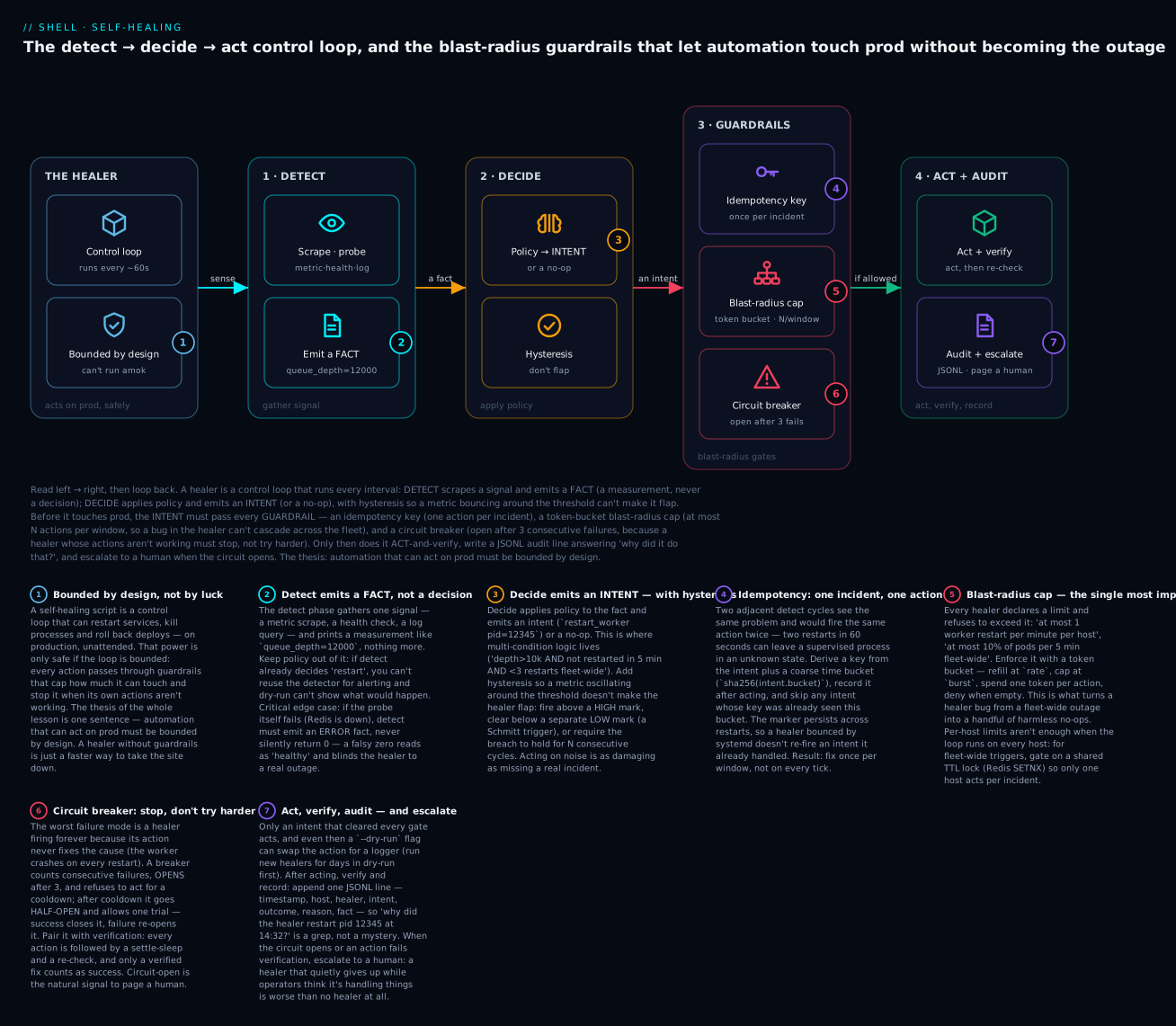
Read the diagram left → right, then loop back: the healer senses a signal and emits a fact, decides on an intent (with hysteresis so it won’t flap), and — only if that intent clears every guardrail (idempotency key, blast-radius token bucket, circuit breaker) — it acts, verifies, audit-logs, and escalates to a human when the breaker trips.
The Cardinal Rule of Auto-Remediation
A self-healing script that runs without guardrails is just a faster way to take production down. Every public post-mortem you have read where “the auto-remediation made it worse” follows the same script: the healer detected a symptom, took an action, the action made the symptom look like it cleared, the underlying cause was still there, the symptom returned, the healer fired again — and the resource it was “healing” entered a restart loop, depended-on services started failing, the healer started firing on those, and within 4 minutes a single bad pod became a regional outage.
The discipline that prevents this:
| Layer | What it stops |
|---|---|
| Explicit Detect-Decide-Act loop | Conflating “broken” with “looks broken” |
| Idempotency keys | The same incident triggering the same fix multiple times in parallel |
| Blast-radius limits | A bug in the healer cascading across the fleet |
| Circuit breakers | The healer continuing to fire when its own actions are failing |
| Dry-run mode | Shipping un-tested healer logic to production |
| Audit log | “Why did the healer do that?” being unanswerable |
This lesson teaches each layer with shell scripts, a lib/heal.sh you can source, and two worked examples: a good healer that has saved sites, and a structurally identical bad one that nuked them.
The Detect-Decide-Act Loop
Every healer has three explicit phases:
┌──────────┐    ┌──────────┐    ┌──────────┐
│  DETECT  │───▶│  DECIDE  │───▶│   ACT    │
└──────────┘    └──────────┘    └──────────┘
     ▲                                │
     └────────────────────────────────┘
              loop interval
- Detect: gather signal (metric scrape, health check, log query). Output: a fact like “queue_depth=12000”.
- Decide: apply policy. Output: an intent like “restart worker pid 12345” — or “no action”.
- Act: perform the intended action with idempotency, rate limit, and audit log.
The phases are separate functions, callable independently. This matters for testing: you can unit-test Decide with synthetic facts without ever Acting, and you can dry-run by replacing Act with a logger.
Why the Loop Must Have Three Phases (Not Two)
The naive form is “if condition then action” which collapses Detect and Decide into a single test. This works for trivial healers but fails as soon as policy gets non-trivial:
- “Restart worker if queue depth > 10000 and worker hasn’t been restarted in last 5 minutes and less than 3 workers are restarting fleet-wide right now.”
The three conditions are Decide logic. Forcing them into the Detect phase means you can’t reuse the detector for monitoring alerts; forcing them into Act means dry-run can’t show what would happen. Keep them separate.
Skeleton
#!/usr/bin/env bash
# heal-worker.sh — example healer skeleton
set -euo pipefail

source /usr/local/lib/heal.sh

readonly NAME=worker-restarter
readonly INTERVAL=60   # seconds

while true; do
  fact=$(detect)
  intent=$(decide "$fact")
  if [[ -n "$intent" ]]; then
    act "$intent"
  fi
  sleep "$INTERVAL"
done

detect() {
  # Returns a fact line. Empty = no signal.
  local depth
  depth=$(redis-cli LLEN myapp:queue 2>/dev/null || echo 0)
  printf 'queue_depth=%s\n' "$depth"
}

decide() {
  local fact="$1"
  local depth
  depth=$(echo "$fact" | awk -F= '/queue_depth=/ {print $2}')
  if (( depth > 10000 )); then
    # Find the oldest stuck worker
    local pid
    pid=$(pgrep -of myapp-worker)
    [[ -n "$pid" ]] && printf 'restart_worker pid=%s\n' "$pid"
  fi
}

act() {
  heal_act_with_guardrails "$1"
}
The heal_act_with_guardrails wraps idempotency + rate limit + circuit breaker + audit log. It’s what lib/heal.sh provides.
Idempotency Keys: One Incident, One Action
Without idempotency keys, two consecutive Detect cycles that observe the same problem trigger the same Act twice. For “restart worker”, that’s two restarts in 60 seconds — which can confuse a process supervisor and leave the worker in an unknown state.
The fix is an idempotency key derived from the incident not the cycle:
# Compute idempotency key from intent + a coarse time bucket
# Two identical intents in the same 5-minute bucket are deduped.
heal_idempotency_key() {
  local intent="$1"
  local bucket
  bucket=$(( $(date +%s) / 300 ))
  printf '%s\n' "$intent.$bucket" | sha256sum | cut -d' ' -f1
}
The key is then used to gate execution:
heal_act_with_guardrails() {
  local intent="$1"
  local key
  key=$(heal_idempotency_key "$intent")
  local marker="/var/lib/heal/$NAME/keys/$key"

  if [[ -f "$marker" ]]; then
    heal_log "SKIP duplicate intent: $intent (key=$key)"
    return 0
  fi

  mkdir -p "$(dirname "$marker")"
  : > "$marker"
  # ...continue to act
}
Two adjacent cycles that observe the same problem hit the same key and the second is silently skipped. After the bucket rolls (5 minutes later), the key changes and the healer can fire again — which is the desired property: “fix once per 5 min, not on every cycle.”
Idempotency Across Restarts
The marker file persists across script restarts. This is on purpose: if your healer is restarted by systemd at 14:32 and saw an intent at 14:31, it shouldn’t re-fire that same intent in the same bucket. Persisted markers give you crash-safety.
GC the markers nightly:
# tmpfiles.d/heal.conf
d /var/lib/heal/*/keys 0750 heal heal -
e /var/lib/heal/*/keys - - - 7d
tmpfiles.d e directive deletes files older than 7 days. Sufficient for any sensible bucket size.
Blast-Radius Limits: The Rate Limit That Saves The Fleet
This is the most important guardrail in the entire lesson. Every healer must declare a blast-radius limit and refuse to exceed it.
Examples:
- “Restart at most 1 worker per minute, per host.”
- “Disable at most 3 services per 10 minutes, fleet-wide.”
- “Roll back at most 10% of pods per 5 minutes.”
The limit is enforced via a token bucket:
# heal_rate_limit_check NAME RATE BURST
# Returns 0 (allow) if a token is available, 1 (deny) otherwise.
heal_rate_limit_check() {
  local name="$1" rate="$2" burst="$3"
  local state="/var/lib/heal/$NAME/rate-$name"
  local now last_refill tokens elapsed

  now=$(date +%s)
  if [[ -f "$state" ]]; then
    last_refill=$(awk '{print $1}' "$state")
    tokens=$(awk '{print $2}' "$state")
  else
    last_refill=$now
    tokens=$burst
  fi

  elapsed=$(( now - last_refill ))
  tokens=$(awk -v t="$tokens" -v e="$elapsed" -v r="$rate" -v b="$burst" \
    'BEGIN { v = t + e * r; if (v > b) v = b; print v }')

  awk -v t="$tokens" 'BEGIN { exit !(t >= 1) }' || {
    printf '%d %s\n' "$now" "$tokens" > "$state"
    return 1
  }

  tokens=$(awk -v t="$tokens" 'BEGIN { print t - 1 }')
  printf '%d %s\n' "$now" "$tokens" > "$state"
  return 0
}
Usage:
# Allow 1 restart per minute, with burst of 3 (catches up during quiet periods)
if heal_rate_limit_check "worker-restart" "0.0167" "3"; then
  # Allowed — proceed with restart
  systemctl restart myapp-worker.service
else
  heal_log "Rate-limited: skipping worker restart"
fi
The token bucket auto-recovers: if the healer doesn’t fire for 10 minutes, the bucket refills to burst, ready for a small flurry. But sustained firing can’t exceed rate per second.
Fleet-Wide Rate Limits via a Shared Lock
Per-host limits aren’t enough when the healer runs on every host. If 100 hosts each “rate-limit to 1/min” and the trigger condition is fleet-wide, you get 100 actions per minute fleet-wide. Solution: a central coordinator (Redis, Consul KV, etcd) that issues fleet-wide tokens:
# Use Redis SETNX as a distributed lock. The lock has a TTL so it auto-expires.
heal_fleet_lock_acquire() {
  local key="$1" ttl="$2"
  local token
  token=$(uuidgen)
  if redis-cli SET "heal:lock:$key" "$token" EX "$ttl" NX | grep -q OK; then
    printf '%s\n' "$token"
    return 0
  fi
  return 1
}

heal_fleet_lock_release() {
  local key="$1" token="$2"
  # Lua: only release if we own the lock (avoids releasing someone else's lock if we're slow)
  redis-cli EVAL "if redis.call('GET', KEYS[1]) == ARGV[1] then return redis.call('DEL', KEYS[1]) else return 0 end" 1 "heal:lock:$key" "$token"
}

# Usage: only one host fleet-wide can act on this incident
if token=$(heal_fleet_lock_acquire "kafka-broker-restart" 300); then
  systemctl restart kafka.service
  heal_fleet_lock_release "kafka-broker-restart" "$token"
fi
The Lua script in release ensures we don’t accidentally delete someone else’s lock if we held ours past TTL. This is the classic correct Redis distributed lock pattern (Redlock without quorum, sufficient for healer coordination).
Circuit Breakers: Stop When Your Actions Aren’t Working
A circuit breaker disables the healer after N consecutive failed actions. This prevents the worst failure mode: the healer firing repeatedly because its actions don’t actually fix the problem (the worker keeps crashing on restart, but the healer keeps trying to restart it).
heal_circuit_breaker_check() {
  local name="$1" max_failures="$2" cooldown="$3"
  local state="/var/lib/heal/$NAME/cb-$name"
  local now failures last_failure

  now=$(date +%s)
  if [[ ! -f "$state" ]]; then
    return 0   # closed, allow
  fi

  failures=$(awk '{print $1}' "$state")
  last_failure=$(awk '{print $2}' "$state")

  if (( failures >= max_failures )); then
    if (( now - last_failure < cooldown )); then
      heal_log "Circuit OPEN for $name (failures=$failures, cooldown=$((cooldown - (now - last_failure)))s remaining)"
      return 1
    else
      # Cooldown expired — half-open: allow one trial
      heal_log "Circuit HALF-OPEN for $name"
      return 0
    fi
  fi
  return 0
}

heal_circuit_breaker_record() {
  local name="$1" outcome="$2"   # success | failure
  local state="/var/lib/heal/$NAME/cb-$name"
  local now=$(date +%s)
  if [[ "$outcome" == "success" ]]; then
    rm -f "$state"   # reset on success (half-open → closed)
  else
    local failures=0
    [[ -f "$state" ]] && failures=$(awk '{print $1}' "$state")
    failures=$((failures + 1))
    printf '%d %d\n' "$failures" "$now" > "$state"
  fi
}
Usage with verification:
heal_act_with_circuit_breaker() {
  local intent="$1"
  if ! heal_circuit_breaker_check "worker-restart" 3 600; then
    return 1   # circuit open, skip
  fi

  systemctl restart myapp-worker
  sleep 10   # give it time to start
  if systemctl is-active --quiet myapp-worker; then
    heal_circuit_breaker_record "worker-restart" success
  else
    heal_circuit_breaker_record "worker-restart" failure
    return 1
  fi
}
After 3 consecutive failures, the circuit opens and stays open for 10 minutes. After cooldown, one trial action is allowed (half-open); success closes the circuit, failure re-opens it for another 10 minutes.
The numbers come from production experience: 3 failures means “this isn’t a transient — we’re in a real failure mode.” 10 minutes cooldown is enough for a human to investigate (and for monitoring alerts to wake someone).
Hysteresis, Escalation & “Do No Harm”
The three guardrails so far bound how often and how much a healer acts. Three more disciplines bound whether it should act at all — and what it does when it decides it shouldn’t. These are the ones beginners skip, and they are exactly the ones that turn a healer from a hair-trigger into a good operator.
Hysteresis: Don’t Let The Healer Flap
A raw threshold (depth > 10000) is a landmine when the metric hovers near the threshold. Picture queue depth oscillating 9,800 → 10,200 → 9,900 → 10,100 every few cycles. A naive healer fires, un-fires, fires, un-fires — flapping — restarting a worker every couple of minutes for a queue that is basically fine. Each restart drops in-flight work and nudges the metric, so the healer is now causing the oscillation it’s reacting to.
Hysteresis breaks the loop by making “start acting” and “stop acting” use different thresholds — a Schmitt trigger. Fire only above a HIGH mark; only consider the incident cleared below a separate, lower LOW mark; in the dead-band between them, hold the previous state:
HYS_STATE="$HEAL_STATE_DIR/hys/queue"; HIGH=10000; LOW=2000
_firing() { [[ -f "$HYS_STATE" ]]; }

decide_with_hysteresis() {   # arg: current depth -> prints intent or nothing
  local depth="$1"
  if (( depth > HIGH )); then
    mkdir -p "$(dirname "$HYS_STATE")"; : > "$HYS_STATE"      # enter/stay firing
    printf 'restart_worker\n'
  elif (( depth < LOW )); then
    rm -f "$HYS_STATE"                                        # incident cleared
  else
    _firing && printf 'restart_worker\n'                     # dead-band: hold
  fi
}
Now the queue has to genuinely blow past 10,000 to trigger, and genuinely drain below 2,000 to be declared healthy — noise in between changes nothing. The alternative (or complement) is a consecutive-breach counter: only act after the condition has held for N detect cycles, so a single spiky sample is ignored. Both approaches share a rule of thumb: the gap between fire and clear should be wider than the metric’s normal jitter.
Escalation: The Healer Is Triage, Not A Cure
A healer’s job is to buy time on known, boring, safe-to-automate incidents — not to be an all-knowing AIOps brain. The moment it hits something it doesn’t understand or can’t fix, the correct action is to hand off to a human, loudly. Escalate when:
- The circuit breaker opens — the fix isn’t working; a person needs to look.
- An action fails verification — you restarted the service and it didn’t come back.
- Detect returns an unknown or error fact — you can’t measure, so you can’t safely decide.
- The intent would exceed the blast-radius budget — the blast is bigger than this healer is allowed to handle alone.
The anti-pattern is the silent give-up: the healer quietly stops (breaker open, or it crashed) while operators — who trust it — have retired the manual runbook. That is worse than never having a healer. Escalation is a first-class action, so make it observable:
heal_escalate() {   # reason -> audit + a metric an alert can watch
  local reason="$1"
  heal_log "ESCALATE: $reason"
  heal_audit "escalate" "handoff" "$reason"
  # Bump a textfile-collector metric; a Prometheus alert pages on it > 0.
  printf 'heal_escalation_total{healer="%s"} 1\n' "$NAME" \
    > "/var/lib/node_exporter/textfile/heal_${NAME}_escalation.prom.$$" \
    && mv "/var/lib/node_exporter/textfile/heal_${NAME}_escalation.prom.$$" \
          "/var/lib/node_exporter/textfile/heal_${NAME}_escalation.prom"
}
That .prom file feeds the same exporter you built in Monitoring Agents, Exporters & Watchdogs; a human is paged the moment the healer raises its hand.
“Do No Harm”: Prefer Inaction Under Uncertainty
Borrow the physicians’ rule. When the healer is uncertain, the correct default is do nothing — an unnecessary restart is a real cost, and an action taken on bad data can be catastrophic. Concretely:
-
Never restart the last healthy replica. A quorum guard refuses to act if acting would drop you below a safe floor:
heal_quorum_ok() { # args: healthy_count min_keep -> 0 if safe to take one down local healthy="$1" min_keep="$2" (( healthy > min_keep )) } # if healthy=1 and min_keep=1, this returns 1 (refuse) — don't nuke the last one. -
Never act on a stale fact. If detect is older than a cycle or two (a slow probe, a cached value), discard it rather than act on a stale reading — the world may have moved on.
-
Gate destructive actions behind an explicit confirm. Restarting a worker can be fully automatic; deleting data, force-terminating a node, or scaling to zero should require a human confirm token or be out of a healer’s remit entirely.
-
Ship a global kill switch. One file (or one KV flag) that disables every healer instantly, checked at the top of every loop, so an on-call engineer can stop the fleet without hunting down units:
[[ -f /etc/heal/DISABLED ]] && { heal_log "kill-switch set — no action"; sleep "$INTERVAL"; continue; }
The through-line: a healer should be conservative. Under doubt it declines, records why, and pages a human — because the cost of a missed auto-fix is minutes of degraded service, while the cost of a confident wrong action is the outage you were trying to prevent.
Dry-Run Mode: The Discipline That Catches The Bad Healer Before It Lives
Every healer must have a --dry-run flag that runs Detect+Decide but replaces Act with a logger:
DRY_RUN=${DRY_RUN:-false}

heal_act() {
  local intent="$1"
  if $DRY_RUN; then
    heal_log "DRY-RUN: would have acted on: $intent"
    return 0
  fi
  # ...real action
}
Every new healer should run for 7 days in dry-run before live mode. Compare:
- Number of intents emitted in dry-run.
- Severity of each (read the audit log).
- Whether the count looks reasonable for known incidents.
If your healer dry-runs at 200 actions/day on a 50-host fleet, that’s almost certainly a bug — real healers fire 0-5 actions/day. Tune detection thresholds before going live.
The Three-Stage Rollout
- Dry-run, dev fleet (1 day) — catch logic bugs in your decide phase.
- Dry-run, prod fleet (7 days) — see real production patterns.
- Canary live, 1 host (3 days) — actually fire on one host, watch for unintended consequences.
- Live, full fleet — gradual rollout, 10% → 25% → 50% → 100% over a week.
This is overkill for trivial healers (e.g., “remove core files older than 7 days”) but it’s exactly right for anything that mutates running services.
Audit Log: The Question Is Always “Why?”
Every action must produce an audit record with enough context to answer “why did the healer do that?” three months from now.
heal_audit() {
  local intent="$1" outcome="$2" reason="$3"
  local audit_file="/var/log/heal/audit.jsonl"
  mkdir -p "$(dirname "$audit_file")"
  jq -nc \
    --arg ts "$(date -Iseconds)" \
    --arg host "$(hostname)" \
    --arg name "$NAME" \
    --arg intent "$intent" \
    --arg outcome "$outcome" \
    --arg reason "$reason" \
    --arg fact "$LAST_FACT" \
    '{ts:$ts, host:$host, healer:$name, intent:$intent, outcome:$outcome, reason:$reason, fact:$fact}' \
    >> "$audit_file"
}
Sample output:
{"ts":"2026-06-22T14:32:01+00:00","host":"web-07","healer":"worker-restarter","intent":"restart_worker pid=12345","outcome":"success","reason":"queue_depth=12450 > 10000","fact":"queue_depth=12450,workers_alive=8"}
JSONL (one JSON object per line) is the right format because it streams to log shippers and indexes well in Loki / OpenSearch / CloudWatch. Always include:
- Timestamp (ISO 8601 with timezone).
- Hostname.
- Healer identifier.
- The intent (what was decided).
- The outcome (what happened).
- The reason (the fact that triggered the decide).
- The full fact (for after-the-fact analysis).
When a post-incident review asks “why was worker pid 12345 restarted at 14:32?” you grep the audit log and have a complete answer.
The Drop-In lib/heal.sh
# lib/heal.sh — sourced helpers for self-healing scripts.
#
# Required env:
#   NAME          — short healer identifier (lowercase, no spaces)
#
# Optional env:
#   DRY_RUN       — true|false, default false
#   HEAL_STATE_DIR — default /var/lib/heal/$NAME
#   HEAL_AUDIT_FILE — default /var/log/heal/audit.jsonl

set -o errexit -o nounset -o pipefail

: "${NAME:?NAME must be set}"
: "${DRY_RUN:=false}"
: "${HEAL_STATE_DIR:=/var/lib/heal/$NAME}"
: "${HEAL_AUDIT_FILE:=/var/log/heal/audit.jsonl}"

heal_log() {
  printf '[%s] [%s] %s\n' "$(date -Iseconds)" "$NAME" "$*"
}

heal_init() {
  mkdir -p "$HEAL_STATE_DIR/keys" "$HEAL_STATE_DIR/rate" "$HEAL_STATE_DIR/cb"
  mkdir -p "$(dirname "$HEAL_AUDIT_FILE")"
}

heal_audit() {
  local intent="$1" outcome="$2" reason="${3:-}"
  jq -nc \
    --arg ts "$(date -Iseconds)" \
    --arg host "$(hostname)" \
    --arg name "$NAME" \
    --arg intent "$intent" \
    --arg outcome "$outcome" \
    --arg reason "$reason" \
    '{ts:$ts, host:$host, healer:$name, intent:$intent, outcome:$outcome, reason:$reason}' \
    >> "$HEAL_AUDIT_FILE"
}

# Idempotency: same intent + 5min bucket = same key
heal_idem_key() {
  local intent="$1"
  local bucket=$(( $(date +%s) / 300 ))
  printf '%s.%d' "$intent" "$bucket" | sha256sum | cut -d' ' -f1
}

heal_idem_seen() {
  local key="$1"
  [[ -f "$HEAL_STATE_DIR/keys/$key" ]]
}

heal_idem_mark() {
  local key="$1"
  : > "$HEAL_STATE_DIR/keys/$key"
}

# Token-bucket rate limit. Args: name, rate (per sec), burst
heal_rate_check() {
  local name="$1" rate="$2" burst="$3"
  local state="$HEAL_STATE_DIR/rate/$name"
  local now last_refill tokens elapsed

  now=$(date +%s)
  if [[ -f "$state" ]]; then
    last_refill=$(awk '{print $1}' "$state")
    tokens=$(awk '{print $2}' "$state")
  else
    last_refill=$now
    tokens=$burst
  fi

  elapsed=$(( now - last_refill ))
  tokens=$(awk -v t="$tokens" -v e="$elapsed" -v r="$rate" -v b="$burst" \
    'BEGIN { v = t + e * r; if (v > b) v = b; print v }')

  awk -v t="$tokens" 'BEGIN { exit !(t >= 1) }' || {
    printf '%d %s\n' "$now" "$tokens" > "$state"
    return 1
  }
  tokens=$(awk -v t="$tokens" 'BEGIN { print t - 1 }')
  printf '%d %s\n' "$now" "$tokens" > "$state"
}

# Circuit breaker. Args: name, max_failures, cooldown_sec
heal_cb_check() {
  local name="$1" max="$2" cooldown="$3"
  local state="$HEAL_STATE_DIR/cb/$name"
  local now=$(date +%s) failures last_fail
  [[ -f "$state" ]] || return 0
  failures=$(awk '{print $1}' "$state")
  last_fail=$(awk '{print $2}' "$state")
  if (( failures >= max )); then
    if (( now - last_fail < cooldown )); then
      heal_log "CIRCUIT-OPEN $name (failures=$failures)"
      return 1
    fi
    heal_log "CIRCUIT-HALF-OPEN $name"
  fi
}

heal_cb_record() {
  local name="$1" outcome="$2"
  local state="$HEAL_STATE_DIR/cb/$name"
  if [[ "$outcome" == "success" ]]; then
    rm -f "$state"
  else
    local f=0
    [[ -f "$state" ]] && f=$(awk '{print $1}' "$state")
    printf '%d %d\n' "$((f + 1))" "$(date +%s)" > "$state"
  fi
}

# All-in-one wrapper. Args: intent_string, action_function, success_check_function, reason
heal_act_with_guardrails() {
  local intent="$1" action_fn="$2" check_fn="$3" reason="${4:-}"
  local key

  heal_init
  key=$(heal_idem_key "$intent")
  if heal_idem_seen "$key"; then
    heal_log "SKIP idempotent: $intent"
    return 0
  fi

  if ! heal_rate_check "$intent" "${HEAL_RATE:-0.0167}" "${HEAL_BURST:-3}"; then
    heal_log "SKIP rate-limited: $intent"
    return 0
  fi

  if ! heal_cb_check "$intent" "${HEAL_CB_MAX:-3}" "${HEAL_CB_COOLDOWN:-600}"; then
    return 0
  fi

  if $DRY_RUN; then
    heal_log "DRY-RUN: $intent"
    heal_audit "$intent" dry-run "$reason"
    heal_idem_mark "$key"
    return 0
  fi

  heal_log "ACTING: $intent"
  if "$action_fn"; then
    sleep 5   # let action settle
    if "$check_fn"; then
      heal_audit "$intent" success "$reason"
      heal_cb_record "$intent" success
      heal_idem_mark "$key"
      heal_log "OK: $intent"
    else
      heal_audit "$intent" verify-failed "$reason"
      heal_cb_record "$intent" failure
      heal_log "FAIL verify: $intent"
      return 1
    fi
  else
    heal_audit "$intent" action-failed "$reason"
    heal_cb_record "$intent" failure
    heal_log "FAIL action: $intent"
    return 1
  fi
}
Worked Example: A Worker-Queue Healer
#!/usr/bin/env bash
# heal-worker-queue.sh — restart workers when queue depth exceeds threshold
set -euo pipefail

NAME=worker-queue-healer
HEAL_RATE=0.0167   # 1 per minute
HEAL_BURST=3
HEAL_CB_MAX=3
HEAL_CB_COOLDOWN=600

source /usr/local/lib/heal.sh

readonly INTERVAL=60
readonly THRESHOLD=10000

detect() {
  local depth alive
  depth=$(redis-cli LLEN myapp:queue 2>/dev/null || echo 0)
  alive=$(pgrep -c -f myapp-worker 2>/dev/null || echo 0)
  printf 'queue_depth=%s,workers_alive=%s\n' "$depth" "$alive"
}

decide() {
  local fact="$1"
  local depth alive
  depth=$(echo "$fact" | sed 's/.*queue_depth=\([0-9]*\).*/\1/')
  alive=$(echo "$fact" | sed 's/.*workers_alive=\([0-9]*\).*/\1/')

  if (( depth > THRESHOLD )) && (( alive > 0 )); then
    local pid
    pid=$(pgrep -of myapp-worker)
    [[ -n "$pid" ]] && printf 'restart_worker pid=%s' "$pid"
  fi
}

action_restart_worker() {
  systemctl restart myapp-worker.service
}

check_worker_alive() {
  systemctl is-active --quiet myapp-worker.service
}

heal_init

while true; do
  fact=$(detect)
  intent=$(decide "$fact")
  if [[ -n "$intent" ]]; then
    heal_act_with_guardrails "$intent" action_restart_worker check_worker_alive "$fact"
  fi
  sleep "$INTERVAL"
done
This healer will:
- Fire at most once per minute (rate limit).
- Skip duplicate intents within a 5-minute bucket (idempotency).
- Open the circuit after 3 consecutive failed restarts and stay open for 10 min.
- Verify the worker is alive after restart before declaring success.
- Audit-log every decision and outcome.
A Tale of Two Healers
The Good Healer (saved a site)
Site has Redis-backed queue. Workers occasionally OOM-kill, leaving queue stuck. Symptoms: queue_depth spikes, no workers consume.
The healer above runs once a minute. When queue exceeds 10k AND alive_workers > 0 (workers exist but stuck), it restarts the worker service. Rate limit ensures at most 1 restart per minute; circuit breaker opens after 3 fails (which would indicate a deploy-broken binary, not a stuck worker — needs human intervention). In 18 months, it has fired ~40 times, every fire was correct, MTTR for the stuck-worker class went from 25 minutes to under 2 minutes.
The Bad Healer (nuked a site)
Same site, earlier version. The healer was: “if queue_depth > 10000, restart worker.” No rate limit, no idempotency, no circuit breaker.
Real incident timeline:
- 14:30:00 — workers genuinely OOM. Queue starts climbing.
- 14:30:30 — queue_depth = 10500. Healer restarts workers.
- 14:30:45 — workers come up, start draining, but a coordinator dependency (database connection pool) is now exhausted because new workers each open a fresh pool.
- 14:31:00 — queue is still > 10000 (drain rate slow due to pool exhaustion). Healer restarts again. Database pool further hammered.
- 14:31:30 — pool exhaustion causes worker startup to time out. Workers crash on boot. Healer restarts again.
- 14:32:00 — every worker restart fails to come up. queue still > 10000. Healer fires every cycle.
- 14:35:00 — coordinator service falls over from connection storm. Site is down.
- 14:50:00 — engineer notices, kills the healer, resets the database, brings workers up cleanly. Site recovers at 15:05.
What the good healer would have done differently:
- Rate limit kicks in at 14:31. No further action.
- Circuit breaker opens at 14:31:30 after 3 fails. Healer stops firing.
- Audit log shows “verify-failed” outcomes — engineer is paged because monitoring alerts on circuit-open.
- Site degraded but not down. MTTR ~5 min instead of 35.
The same code, with guardrails, has a different outcome. This is the entire reason lib/heal.sh exists.
Healer Liveness: The Healer Itself Must Be Monitored
A healer that crashes and stops running is silently worse than no healer because operators may have removed manual procedures. Every healer must:
- Emit a heartbeat to the textfile collector (covered in L34).
- Have a Prometheus alert if the heartbeat stops.
- Run under systemd with
Restart=on-failure.
[Unit]
Description=Worker queue healer
After=network.target

[Service]
Type=simple
ExecStart=/usr/local/bin/heal-worker-queue.sh
Restart=on-failure
RestartSec=10
WatchdogSec=120
NotifyAccess=main

[Install]
WantedBy=multi-user.target
WatchdogSec=120 requires the script to call systemd-notify WATCHDOG=1 at least every 2 minutes; if it stops, systemd kills and restarts. Combined with Restart=on-failure, the healer self-recovers from script bugs.
The 8 Footguns
1. No Idempotency Means Multiple Fires Per Incident
Two cycles 60 seconds apart see the same incident, fire twice. Workers get restart-restarted in 60 seconds, often confusing the supervisor. Fix: idempotency keys with coarse buckets.
2. No Rate Limit Means Cascading Damage
Already covered in the bad-healer example. Fix: every healer declares a rate limit; every action goes through heal_rate_check.
3. No Circuit Breaker Means Infinite Loop Of Failure
Action fails, problem persists, healer fires again. Logs fill, the audit log fills, eventually disk fills. Fix: circuit breaker with explicit max-failures + cooldown.
4. Action Verification Skipped
You restart the service but never check it came back up. The healer thinks it succeeded but the service is dead. Fix: every action has an explicit verification function called after a settling sleep.
5. Detect Phase Includes Decide Logic
Detect is redis-cli LLEN; if redis-cli itself is failing because Redis is down, Detect returns “0” (a falsy value), and Decide concludes “no problem.” But there is a problem — Redis is down! Fix: Detect must return errors as facts, not silently return zero. local depth=$(redis-cli LLEN myapp:queue) || depth="ERROR".
6. Forgetting To heal_init
The heal_init function creates the state directories. Forgetting it means file writes fail silently (errexit catches them, but error is “no such directory” which is opaque). Fix: heal_init at the top of every healer’s main, before the loop.
7. Running Two Instances Of The Same Healer
Without a PID file or systemd lock, an admin running a manual instance of heal-worker-queue.sh while the systemd one is also running gives you 2× the actions. Fix: flock-based singleton:
exec 200>/var/run/heal-worker-queue.lock
flock -n 200 || { heal_log "Already running"; exit 1; }
8. Using bash Math On Floats For Token Bucket
bash arithmetic (( ... )) is integer-only. Trying (( tokens >= 0.5 )) is a syntax error or comparison fail. Fix: use awk for float math (as in lib/heal.sh above) or use millisecond-resolution integer tokens.
Going deeper
The shell healer you’ve built is a real one — but it is a point on a spectrum. Knowing where it sits, and where it breaks, is what separates “I copied a lib” from “I own this in production.”
It’s a control loop — recognise the lineage, know when to graduate
Detect → decide → act is not a shell idiom; it’s a closed-loop controller, the same shape as a thermostat, a Kubernetes controller’s reconcile loop, and IBM’s MAPE-K autonomic-computing model (Monitor, Analyze, Plan, Execute, over shared Knowledge). Seeing that lineage buys you two things. First, the failure modes of control theory apply: a controller with too tight a threshold and no damping oscillates — which is exactly the flapping that hysteresis and rate limits damp. Second, it tells you when to stop using shell. A handful of independent, well-understood remediations on plain hosts? Shell is perfect: transparent, no runtime, greppable. But once healers start interacting (one scales up while another scales down), or the desired state is a rich data model, or you need leader election and reconciliation across a cluster, you’ve outgrown cron-and-flock — that’s when you move to a Kubernetes operator, a real controller, or a policy engine. Shell healers are the right tool for the first 80% and an honest liability for the last 20%.
The distributed-lock caveat: TTL locks are not fencing
The Redis SET … NX EX fleet lock in this lesson is the correct simple pattern, but understand its edge: it is not a fencing lock. If host A acquires the lock, then suffers a GC pause / STW / scheduling stall longer than the TTL, the lock expires, host B acquires it, and now both believe they hold it — right as A wakes up and acts. For merely coordinating who runs a restart, that double-act is bounded by your other guardrails (rate limit, idempotency) and is acceptable. For anything genuinely destructive (fencing a node, deleting a volume), a TTL lock is not enough: you need a fencing token — a monotonically increasing number handed out with the lock, which the target resource checks and rejects if it’s lower than one it has already seen (Martin Kleppmann’s canonical critique). In practice that means a real coordinator with leases (etcd, ZooKeeper, Consul sessions), not redis-cli SETNX. Rule: a TTL lock reduces the probability of concurrent action; it does not make it impossible.
Security: a healer is a high-value confused deputy
A healer runs with enough privilege to restart services — often root — and its inputs come from the very systems it might act on. Two concrete risks:
- Command injection via the intent. If you ever
eval "$intent"or interpolate an intent field into a shell string, an attacker who can influence a process name, a metric label, or a log line the detector reads can inject commands that run as the healer. Neverevalan intent. Pass structured, quoted fields; allowlist the set of actions (case "$verb" in restart_worker|clear_tmp) … ;; *) heal_escalate "unknown verb";; esac); treat every detected value as untrusted input, exactly as you would in Security: Injection, Quoting & Input Validation. - Audit-log integrity. The audit log is your only account of what the healer did — so it cannot live only on the host the healer might have broken (or that an attacker controls). Ship it off-box, append-only, to a log store the healer’s own credentials can’t rewrite. A tamper-evident audit trail is the difference between a clean post-mortem and a guess.
And apply least privilege: a healer that only restarts myapp-worker.service needs a narrow sudoers/polkit rule for exactly that unit, not blanket root. The smaller the grant, the smaller the blast radius when — not if — the healer has a bug.
Testing healers without touching prod
The three-phase split exists so you can test the scary part safely. decide is a pure function — fact in, intent out, no side effects — so you can capture real facts from prod, replay them through decide, and assert the intents with bats/shunit2 (see Testing: bats, shunit2, Mocking & Fixtures). Property-test the guardrails: “N rapid calls yield ≤ burst actions”, “the breaker opens on the Nth failure”, “the same intent in one bucket fires once”. Then chaos-test the whole loop on a canary by injecting synthetic incidents (push 20k fake items into a scratch queue) and watching the audit log. A healer you can’t test on demand is a healer you’re testing in production.
Performance & state hygiene
Each cycle forks date, awk (several times), sha256sum, and jq. At a 60-second interval on a normal host that cost is invisible. It stops being invisible if you drop the interval to 1s, run on thousands of hosts, or the box is already CPU-starved — then consider a single long-lived process, printf-based integer math instead of per-call awk, and putting the hot state dir on tmpfs. Whatever you do, GC the state: the keys/, rate/, and cb/ directories grow one file per incident-bucket forever unless a tmpfiles.d e rule (or a nightly find -mtime +7 -delete) prunes them.
Portability: the course targets Linux + GNU + systemd
Every command here assumes GNU coreutils and systemd — the standard production target. On a BSD/macOS build host (or a BusyBox container) several of them differ, so know the swaps before you copy a healer onto a non-Linux box:
| GNU / systemd (course target) | BSD / macOS / BusyBox | Used for |
|---|---|---|
sha256sum |
shasum -a 256 · openssl dgst -sha256 |
idempotency key hash |
date -Iseconds |
date -u +%Y-%m-%dT%H:%M:%SZ |
audit / log timestamp |
pgrep -c -f · pgrep -of |
pgrep -f (no -c); -o ok on macOS |
count / oldest match |
flock (util-linux) |
not installed by default | singleton lock |
systemctl · systemd-notify · WatchdogSec |
launchd / launchctl |
supervision + watchdog |
tmpfiles.d GC |
cron + find -mtime |
state cleanup |
The awk float math, jq, uuidgen, and redis-cli calls are portable as written. When a healer must run on mixed platforms, detect the tool once at startup (command -v sha256sum || alias …) rather than sprinkling if [[ $(uname) ]] through the loop.
Practice challenges
Work these in order — each builds on the last. Every solution is runnable on Linux (bash 4+/GNU); notes flag any macOS/BSD swap.
Challenge 1 — Split a one-liner into three phases (beginner)
You inherit this: if (( $(redis-cli LLEN q) > 100 )); then systemctl restart w; fi. Refactor it into detect, decide, and act functions where detect prints a fact, decide prints an intent (or nothing), and the main loop wires them. Why does this matter before you add anything else?
<details> <summary>Solution</summary>
detect() { printf 'depth=%s\n' "$(redis-cli LLEN q 2>/dev/null || echo ERROR)"; }
decide() {
  local depth; depth=$(echo "$1" | awk -F= '/depth=/{print $2}')
  [[ "$depth" == ERROR ]] && { echo "escalate probe_failed"; return; }
  (( depth > 100 )) && echo "restart_worker"
}
act() { echo "would: $1"; }   # replace with the real action later

fact=$(detect); intent=$(decide "$fact"); [[ -n "$intent" ]] && act "$intent"
Why: separating the phases is the prerequisite for everything else — you can now unit-test decide with fake facts, dry-run by swapping act, and reuse detect for alerting. It also forces the honest handling of a failed probe (ERROR, not a silent 0).
</details>
Challenge 2 — Add a dry-run gate (beginner)
Make act honour a DRY_RUN env var: when DRY_RUN=true, it logs “would act” and does nothing; otherwise it acts. Prove it with DRY_RUN=true and then unset.
<details> <summary>Solution</summary>
DRY_RUN=${DRY_RUN:-false}
act() {
  local intent="$1"
  if [[ "$DRY_RUN" == true ]]; then echo "DRY-RUN: would $intent"; return 0; fi
  echo "ACTING: $intent"   # real side effect goes here
}
DRY_RUN=true  act restart_worker   # -> DRY-RUN: would restart_worker
DRY_RUN=false act restart_worker   # -> ACTING: restart_worker
Why: a dry-run flag is how you soak a new healer for days and count intents before it can touch prod — the cheapest bug-catcher you have. </details>
Challenge 3 — Prove idempotency-key dedup (intermediate)
Write idem_key intent now_epoch that buckets time into 300-second windows and hashes intent.bucket. Show that two timestamps inside one bucket produce the same key, and one in the next bucket differs.
<details> <summary>Solution</summary>
idem_key() { local intent="$1" now="$2"; printf '%s.%d' "$intent" $(( now / 300 )) | sha256sum | cut -d' ' -f1; }
# bucket 5730226 spans 1719067800..1719068099
a=$(idem_key "restart pid=1" 1719067850)
b=$(idem_key "restart pid=1" 1719067999)   # same bucket
c=$(idem_key "restart pid=1" 1719068200)   # next bucket
[[ "$a" == "$b" ]] && echo "same bucket -> same key ✓"
[[ "$a" != "$c" ]] && echo "next bucket -> new key ✓"
Verified: same-bucket keys match, next-bucket key differs. Why: the key is derived from the incident (intent + coarse time), not the cycle, so adjacent detect cycles dedupe to one action and the healer re-arms only when the bucket rolls. (macOS: swap sha256sum for shasum -a 256.)
</details>
Challenge 4 — Cap the blast radius (intermediate)
Using the heal_rate_check-style token bucket, configure rate=0, burst=3 and fire it 5 times in a tight loop. How many are allowed, how many denied, and why? Print the running count.
<details> <summary>Solution</summary>
STATE=$(mktemp)
bucket() {  # rate burst state -> 0 allow / 1 deny
  local rate="$1" burst="$2" s="$3" now last tok el
  now=$(date +%s)
  if [[ -s "$s" ]]; then last=$(awk '{print $1}' "$s"); tok=$(awk '{print $2}' "$s"); else last=$now; tok=$burst; fi
  el=$(( now - last ))
  tok=$(awk -v t="$tok" -v e="$el" -v r="$rate" -v b="$burst" 'BEGIN{v=t+e*r; if(v>b)v=b; print v}')
  awk -v t="$tok" 'BEGIN{exit !(t>=1)}' || { printf '%d %s\n' "$now" "$tok" > "$s"; return 1; }
  printf '%d %s\n' "$now" "$(awk -v t="$tok" 'BEGIN{print t-1}')" > "$s"
}
a=0; d=0; for i in 1 2 3 4 5; do bucket 0 3 "$STATE" && a=$((a+1)) || d=$((d+1)); done
echo "allowed=$a denied=$d"   # -> allowed=3 denied=2
Verified: 3 allowed, 2 denied. Why: with rate=0 the bucket never refills, so the 3 starting tokens permit exactly 3 actions and the rest are denied — that hard cap is what turns a healer bug from a fleet-wide cascade into a couple of harmless no-ops. Raise rate to refill over time.
</details>
Challenge 5 — Drive the circuit breaker through its states (advanced)
Implement cb_check (allow/deny) and cb_record success|failure with max=3, cooldown=2s. Record 3 failures, confirm the circuit is OPEN, wait out the cooldown, confirm it goes HALF-OPEN (allows one trial), then record a success and confirm it’s CLOSED again.
<details> <summary>Solution</summary>
S=$(mktemp); MAX=3; COOL=2
cb_check() {
  local now fail last; now=$(date +%s); [[ -s "$S" ]] || return 0
  fail=$(awk '{print $1}' "$S"); last=$(awk '{print $2}' "$S")
  if (( fail >= MAX )); then
    (( now - last < COOL )) && { echo OPEN; return 1; }
    echo HALF-OPEN            # cooldown elapsed: allow one trial
  fi
}
cb_record() { local o="$1" f=0
  [[ "$o" == success ]] && { : > "$S"; rm -f "$S"; return; }
  [[ -s "$S" ]] && f=$(awk '{print $1}' "$S"); printf '%d %d\n' "$((f+1))" "$(date +%s)" > "$S"; }

cb_record failure; cb_record failure; cb_record failure
cb_check && echo allow || echo "denied (open)"   # -> denied (open)
# wait out cooldown in a fresh process, not a foreground sleep in the loop:
sleep 3
cb_check && echo "allow (half-open trial)"        # -> HALF-OPEN / allow
cb_record success
cb_check && echo "allow (closed again)"           # -> allow
Verified transitions: closed → OPEN after 3 fails → HALF-OPEN after cooldown → CLOSED on success. Why: the breaker is the guardrail that makes the healer give up and escalate instead of hammering a fix that isn’t working — the single behaviour that would have stopped the “bad healer” cascade. </details>
Challenge 6 — Stop the flap with hysteresis (advanced)
A queue oscillates around 10,000. Implement decide with a Schmitt trigger: fire above HIGH=10000, clear below LOW=2000, and hold the previous state in between. Feed it the sequence 12000, 9000, 3000, 1500, 9000 and show it does not flap.
<details> <summary>Solution</summary>
ST=$(mktemp -u); HIGH=10000; LOW=2000
firing() { [[ -f "$ST" ]]; }
decide() {
  local d="$1"
  if   (( d > HIGH )); then : > "$ST"; echo FIRE
  elif (( d < LOW  )); then rm -f "$ST"; echo CLEAR
  else firing && echo HOLD-FIRE || echo HOLD-CLEAR; fi
}
for d in 12000 9000 3000 1500 9000; do printf '%6s -> %s\n' "$d" "$(decide "$d")"; done
# 12000 -> FIRE      (crosses HIGH)
#  9000 -> HOLD-FIRE (in dead-band, still firing)
#  3000 -> HOLD-FIRE (still above LOW)
#  1500 -> CLEAR     (crosses LOW)
#  9000 -> HOLD-CLEAR(in dead-band, stays cleared)
Verified: the 9000 samples do not toggle the state — only crossing 10,000 fires and only crossing 2,000 clears. Why: a single threshold flaps on any metric that jitters across it; the dead-band between HIGH and LOW absorbs the noise, so the healer acts on genuine incidents, not on wobble. Make the gap wider than the metric’s normal jitter.
</details>
Common beginner mistakes
These are misconceptions about what a healer is for, distinct from the coding footguns above. Each is a mental-model correction.
-
“Self-healing means the script should fix everything automatically.” It shouldn’t. A healer is triage for a few known, boring, safe-to-automate incidents — restart a stuck worker, clear a full
/tmp. It is not an AIOps brain. Automate the handful of remediations whose cause and cure you understand cold; escalate everything else. A healer that tries to be clever is a healer that surprises you at 3 a.m. -
“More automation is always safer — it reduces toil.” Only if it’s bounded. An unsupervised action multiplies its own blast radius. Think of a healer’s value as benefit − (probability of a wrong action × its blast radius). Unbounded automation grows that second term without limit; the guardrails shrink it. That’s why blast-radius limits and circuit breakers are the feature, not overhead bolted on afterwards.
-
“If the action ran without an error, the problem is fixed.”
systemctl restartexiting0means “the restart command was accepted”, not “the service is healthy”. The right model: act, settle, then verify with an independent check, and only a passed verification counts as success. Skipping the re-check is how a healer cheerfully logs “fixed!” over a service that’s still down. -
“Detect returning 0 (or empty) means everything is healthy.” A failed probe usually also returns 0 or empty — and that reads as “healthy” precisely when things are at their worst (Redis down →
LLENfails →0→ “no problem”). Distinguish “measured zero” from “couldn’t measure”: on probe failure emit anERRORfact and escalate, never a silent zero. -
“Dry-run is only for big, scary healers.” Dry-run is how you learn your thresholds are wrong before production teaches you. Even a trivial healer earns a multi-day dry-run soak — you’re validating the decision rate, not the danger of one action. A healer that dry-runs at 200 actions/day when you expected 5 has a bug you just caught for free.
-
“The healer should keep retrying until it works.” Retrying a remediation that isn’t working is the cascade — each retry adds load to an already-failing system. “Try harder” is the wrong response to “the fix doesn’t fix it”. The circuit breaker exists to make the healer give up and hand off to a human, which is the correct move when your model of the incident is evidently wrong.
-
“A healer means we can retire the runbook and reduce on-call.” A healer that silently crashes while the runbook is gone is worse than no healer — the safety net is missing and nobody knows. The healer must itself be monitored (heartbeat + watchdog), and it must escalate loudly on circuit-open or verify-fail. Automation earns trust by being observable and by tapping out clearly, not by being invisible.
Glossary
- Self-healing / auto-remediation — a script that detects a known problem and applies a fix without human action, to cut mean-time-to-recovery for well-understood incidents.
- Control loop — the detect → decide → act cycle run on an interval; the same closed-loop shape as a thermostat or a Kubernetes controller’s reconcile loop.
- Detect — the phase that gathers one signal and emits a fact (a measurement, e.g.
queue_depth=12000), never a decision. - Decide — the phase that applies policy to a fact and emits an intent (a directive, e.g.
restart_worker pid=123) or nothing. - Act — the phase that performs the intent, guarded by idempotency, rate limit, circuit breaker, and verification.
- Fact — the output of detect: a raw measurement with no policy baked in.
- Intent — the output of decide: what should happen, not yet done. Dry-run logs intents without acting.
- Idempotency key — a hash of the intent plus a coarse time bucket; a marker file per key ensures one incident triggers one action, even across script restarts.
- Time bucket — flooring the epoch into fixed windows (
now / 300) so identical intents within the same window share a key. - Blast radius — the maximum amount of the system a single healer run (or a healer bug) can affect. The core thing you bound.
- Token bucket — a rate-limit algorithm: tokens refill at
rate, cap atburst, one token is spent per action, and an empty bucket denies. Enforces the blast-radius limit. - Rate / burst — tokens added per second (
rate) and the ceiling the bucket holds (burst, allowing a short catch-up flurry after a quiet period). - Circuit breaker — a guard that disables the healer after N consecutive failures so it stops firing an action that isn’t working.
- Closed / open / half-open — breaker states: closed = acting normally; open = tripped, refusing to act during cooldown; half-open = cooldown elapsed, allowing one trial (success → closed, failure → open again).
- Cooldown — how long a breaker stays open before permitting a trial action; long enough for a human to be paged and investigate.
- Hysteresis — using different thresholds to start and stop acting (a Schmitt trigger: fire above HIGH, clear below LOW) so a metric hovering near one line can’t cause flapping.
- Flapping — a healer rapidly toggling between acting and not acting because a metric oscillates across a single threshold; the harm hysteresis prevents.
- Dry-run — a mode that runs detect + decide but replaces act with a logger, so you can soak a new healer and count intents before it touches production.
- Canary — the first single host on which a healer is allowed to act live, watched closely before fleet-wide rollout.
- Audit log — an append-only, one-JSON-object-per-line (JSONL) record of every action with timestamp, host, healer, intent, outcome, reason, and fact — the answer to “why did it do that?”.
- MTTR — mean time to recovery; the metric self-healing exists to reduce for its target incident class.
- Fleet — all the hosts a healer runs on; the scope where a bug can cascade and where fleet-wide locks and limits matter.
- Escalation — handing an incident to a human (paging, an escalation metric) when the healer can’t or shouldn’t act: circuit open, verify failed, unknown fact, or over budget.
- Heartbeat / dead man’s switch — a periodic “I’m alive” signal (to a textfile collector) whose absence alerts you the healer itself has died — something an exit code can never tell you.
- Watchdog — supervision that restarts the healer if it stops responding; here, systemd
WatchdogSec+Restart=on-failure. - Fencing token — a monotonically increasing number issued with a lock and checked by the resource, so a holder that stalled past a TTL lock can’t act as if it still held it. TTL locks alone don’t provide this.
- Quorum guard — a check that refuses an action which would drop healthy replicas below a safe floor (never restart the last one).
- Kill switch — a single flag (file or KV key), checked every loop, that instantly disables all healers for an on-call engineer.
- Do no harm — the operating principle that under uncertainty a healer prefers inaction, records why, and escalates — because a confident wrong action is costlier than a missed auto-fix.
Quick-Reference Card
LOOP STRUCTURE
  Detect → fact (a measurement, not a decision)
  Decide → intent (a directive, not an action)
  Act    → operation (with guardrails)
  Each phase is a separate function.

GUARDRAILS (in order applied)
  1. Idempotency key → skip if same intent in same bucket
  2. Rate limit → token bucket, e.g. 1/min with burst 3
  3. Circuit breaker → open after 3 fails, 10min cooldown
  4. Dry-run → log instead of act if DRY_RUN=true
  5. Action with verification → action then check then record outcome
  6. Audit log → JSONL with ts, host, healer, intent, outcome, reason

ROLLOUT
  1. Dev fleet dry-run, 1 day
  2. Prod fleet dry-run, 7 days
  3. Single-host live (canary), 3 days
  4. Gradual fleet rollout 10% → 100%

LIVENESS
  Heartbeat to textfile collector
  Prometheus alert on heartbeat stale
  systemd Restart=on-failure + WatchdogSec
  flock singleton to prevent double-runs

NUMBERS THAT WORK
  Bucket size 5 min (idempotency)
  Rate 1/min, burst 3 (most healers)
  Circuit max 3 fails, cooldown 10 min
  Verification settle 5-10 sec before checking
What’s Next
You can now build healers that detect symptoms, decide on remediation, act with bounded blast-radius, and audit every action. The next operational frontier is migration scripts: scripts that transform data, move it between systems, and must be safely re-runnable when something fails midway through. Migration is the ultimate test of idempotency — a half-completed migration must complete cleanly when retried, never duplicate, never lose rows.
In the next lesson — Migration Scripts: Data Transformations, ETL From Shell & Idempotent Re-Runs — we’ll build lib/migrate.sh covering checkpoint files for resumable migrations, the watermark pattern for incremental ETL, dry-run with row-count diff, transactional staging tables, and the disciplined back-out plan every migration needs before it goes live.