In a nutshell
Think of a hospital patient wired to a vital-signs monitor. Nobody walks in once a shift to feel a pulse and scribble it on a clipboard — a machine watches the heartbeat continuously, sounds an alarm the second something drifts, and keeps a trace a doctor can review later. Cold-chain monitoring is that vital-signs monitor, but for temperature-sensitive medicine as it moves through warehouses and trucks — with one extra demand a hospital monitor never has: the recording must be tamper-evident, because a drug regulator will one day treat it as courtroom evidence.
Put plainly: a fleet of small sensors reports the temperature (plus humidity, and for trucks the GPS position) of every fridge, freezer, and refrigerated trailer, every few seconds. Those readings stream into AWS, where the platform does three jobs at once — it pages a human the instant a reading drifts out of the safe range (so the product can still be saved), it stores every reading in a form that cannot be secretly edited (so an auditor believes it), and it can reconstruct the full temperature history of any single shipment on demand (so you can prove a batch stayed cold from factory to pharmacy).
Why should a beginner care? Because this is the canonical “sensors → cloud → alerts + records” pattern, dressed in the strictest compliance rules in any industry. Learn it here — where a mistake means destroyed vaccines and a failed FDA audit — and the same shape (IoT ingestion, a rules engine that fans data two ways, a time-series store, immutable archival) transfers straight to energy meters, factory lines, and connected cars. The high stakes just make every design choice easier to reason about: when in doubt, pick the option a regulator will trust.
Level: Intermediate (with a beginner on-ramp) · Time: ~40 min
Prerequisites — helpful, not required:
- A rough idea of publish/subscribe messaging: a device publishes a small message to a named “topic,” and a broker delivers it to whoever subscribed. We re-explain it from scratch below.
- Basic AWS literacy — what an IAM role, an S3 bucket, and a Lambda function are. The IoT analytics architecture lesson is a broader companion to this one, and the SNS/SQS/EventBridge messaging lesson covers the alerting fan-out in depth.
- No refrigeration or pharmacology knowledge needed — we treat “the product” as a box with a labeled safe range (e.g. 2–8 °C) and “the sensor” as a thing that emits a temperature number.
After this lesson you will be able to:
- Trace one temperature reading from a probe in a trailer all the way to a locked audit record, naming what each AWS service does to it.
- Explain why time-in-excursion beats an instantaneous threshold, and design an alert that pages on real events without crying wolf.
- Compute a mean kinetic temperature (MKT) by hand and say why Quality trusts it over a plain average.
- Explain how S3 Object Lock, per-device X.509 certificates, and edge store-and-forward each map to a specific regulatory requirement (21 CFR Part 11, GDP, ALCOA).
- Choose deliberately between SiteWise and Timestream, and know why this architecture uses both.
- Design for the failure that actually loses product: a gateway that goes silent.
A specialty pharmaceutical distributor — picture a company that moves mRNA vaccines, insulin, and a growing book of cell-and-gene therapies across 40 distribution centers and 600 refrigerated trucks — gets a finding from an EU GDP audit that lands like a fire alarm. An inspector pulled the temperature records for a shipment of biologics and found a four-hour gap where the warehouse chiller had drifted to 9 °C against a labeled 2–8 °C range, and nobody noticed until the product was already at a hospital pharmacy. Under EU Good Distribution Practice (GDP) and the FDA’s 21 CFR Part 11, that is not a paperwork problem; it is a quarantined batch, a potential recall, and a regulator now asking to see continuous, tamper-evident temperature evidence for every consignment, for the full retention period. The mandate from the VP of Quality is blunt: “I need to know about an excursion in minutes, not at delivery, and I need an audit trail an inspector cannot argue with.” A clipboard and a once-a-shift manual reading is what got them here. This article is the reference architecture for doing cold-chain monitoring properly on AWS — a telemetry platform that a Qualified Person and an FDA investigator will both accept as evidence.
The pressures stack the way they always do in regulated logistics. Compliance means every sensor reading must be captured continuously, stored immutably for years, and reconstructable into a per-shipment record on demand. Time-to-detection means an excursion has to page a human while the product can still be saved by moving it to a working unit — minutes, not the moment of delivery. Scale means tens of thousands of sensors across fixed warehouses and moving vehicles, some of which lose connectivity for hours in a tunnel or a dead zone. And cost of being wrong is measured in destroyed biologics — a single trailer of cell therapy can be worth more than the entire year’s monitoring budget. Continuous IoT telemetry, modeled and stored correctly, is the pattern that satisfies all four at once: it turns the cold chain from a thing you sample into a thing you observe.
Why not the obvious shortcuts
The naive fixes each fail predictably, and naming why matters because someone on the project will propose all of them.
USB temperature loggers — the little data-logger pucks that travel in the box — record faithfully but are read after delivery. They prove an excursion happened; they never prevent one, because by the time you download the CSV the product is already on a shelf. A point spreadsheet of manual readings is exactly what failed the audit: discontinuous, editable, and unverifiable — which is to say worthless as 21 CFR Part 11 evidence. A vendor’s proprietary monitoring portal gives you real-time alerts but locks the raw telemetry inside a SaaS you do not control, with retention and export terms that will not survive an inspector asking for the underlying records, and no path to fold the data into your own quality systems.
Continuous IoT telemetry on infrastructure you own threads the needle. Sensors stream readings the moment they are taken; the platform models each reading against the product’s labeled range in flight, fires an alert the instant a reading breaches threshold, and writes every value to immutable storage you can query, retain, and export on your terms. Detection moves from “at delivery” to “within seconds,” and the audit trail becomes a property of the system rather than a hope about a spreadsheet.
Architecture overview
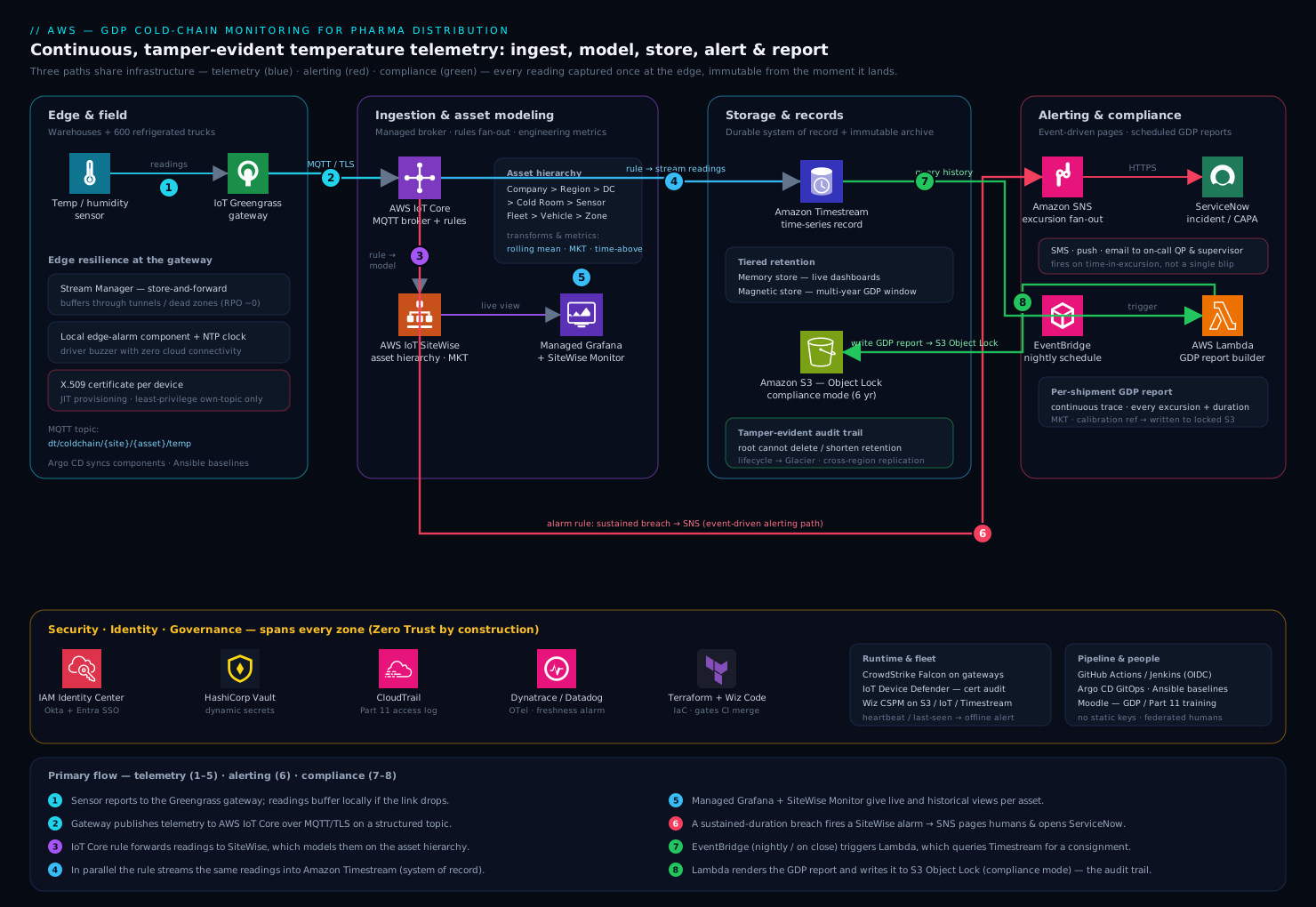
The platform runs three distinct paths that share infrastructure but live on different schedules: a high-volume telemetry path that ingests and models every reading, an event-driven alerting path that turns a breach into a paged human and a ticket, and a scheduled compliance path that assembles per-shipment records and audit reports. Keeping them separate in your head is the first step to operating this well.
The defining property of the topology is the one Quality cares about most: every reading is captured once, at the edge, and is immutable from the moment it lands. Nothing in the pipeline can silently edit history. That single invariant is what turns telemetry into evidence.
Telemetry path, following the data flow:
- A temperature/humidity sensor in a warehouse zone or a trailer reports to a local gateway — in fixed sites a small industrial PC or a virtual appliance running AWS IoT Greengrass; in vehicles a ruggedized cellular gateway. Greengrass buffers readings locally so a connectivity gap (a tunnel, a dead zone) does not lose data — it stores-and-forwards when the link returns. Each device authenticates to AWS with its own X.509 certificate, provisioned at fleet onboarding.
- The gateway publishes telemetry to AWS IoT Core over MQTT on a structured topic (
dt/coldchain/{site}/{asset}/temp). IoT Core is the managed broker and device gateway: it terminates millions of concurrent MQTT connections, enforces per-certificate authorization policies, and is the single ingress for the entire fleet. - The IoT Core rules engine routes each message two ways at once. It forwards readings into AWS IoT SiteWise, which models them against an asset hierarchy — Company → Region → Distribution Center → Cold Room → Sensor, and Fleet → Vehicle → Trailer Zone — so a raw MQTT value becomes “the 06:14 reading from Cold Room 3 at the Frankfurt DC.” SiteWise computes the engineering metrics Quality reasons in (rolling mean, time-above-threshold, mean kinetic temperature) as transforms and metrics on the model, not in bespoke code.
- In parallel, the rule streams the same readings to Amazon Timestream, the purpose-built time-series store, as the durable, queryable system of record. Timestream’s tiered storage keeps recent data in a fast memory store for live dashboards and ages older data into magnetic storage for the multi-year GDP retention window — automatically, by policy.
- An operational dashboard (a private Amazon Managed Grafana workspace, fed from Timestream and SiteWise) gives warehouse and quality teams live and historical views per asset. SiteWise’s own Monitor portals give site managers a turnkey view without building anything.
Alerting path, event-driven and the part that saves product: the IoT Core rule (or a SiteWise alarm on the modeled metric) evaluates each reading against the asset’s configured limits — and crucially against time-in-excursion, because a 30-second blip when a freezer door opens is noise, while ten minutes above 8 °C is an event. On a real breach the rule publishes to Amazon SNS, which fans out to the people and systems that must act: SMS and push to the on-call warehouse supervisor and the duty Qualified Person, an email to the quality distribution list, and an HTTPS call that opens a ServiceNow incident so there is a tracked, auditable record — not just a text someone can claim they never saw.
Compliance path, scheduled and on-demand: an AWS Lambda function — triggered nightly by EventBridge and on demand when a shipment closes — queries Timestream for a consignment’s full temperature history, renders a GDP compliance report (the continuous trace, every excursion with duration and disposition, the mean kinetic temperature, the sensor calibration reference), and writes it to Amazon S3 under Object Lock in compliance mode so the record is provably immutable for its retention period. That S3 object, plus the raw Timestream series behind it, is the audit trail.
The reading’s journey: one value from sensor to audit trail
The overview listed the paths; now follow a single reading through them, because the concepts a beginner needs — MQTT topics, device certificates, the rules engine, device shadows — are easiest to learn attached to one concrete value. Meet reading 5.2: the temperature, in Celsius, that a probe inside refrigerated trailer TRL-7731 takes at 06:14:32 on its way to a hospital pharmacy.
Step 1 — the sensor hands the number to a gateway. The probe itself is dumb: it measures 5.2 °C and passes it to the trailer’s gateway (a small rugged computer running AWS IoT Greengrass). The gateway wraps the bare number in a small JSON message carrying everything needed to make sense of it later:
{ "asset": "TRL-7731", "site": "fleet", "temp_c": 5.2, "humidity": 41,
  "lat": 50.11, "lon": 8.68, "ts": "2026-06-09T06:14:32Z", "seq": 88213 }
The ts timestamp is stamped at the edge, from the gateway’s NTP-synced clock — not when the cloud receives it. That distinction matters enormously for an audit trail, and we return to it. The seq is a monotonic counter that lets the cloud spot a gap or a duplicate.
Step 2 — the gateway proves who it is, then publishes. The gateway opens a TLS connection to AWS IoT Core and authenticates with its own X.509 certificate — a per-device cryptographic ID installed when the trailer was onboarded. No shared password, no API key: the certificate is the identity, and IoT Core checks it against the device registry on every connect. Authenticated, the gateway publishes the JSON to an MQTT topic, a slash-delimited address that encodes what the message is:
dt/coldchain/fleet/TRL-7731/temp
This is MQTT, the lightweight publish/subscribe protocol built for exactly this job: millions of small messages from flaky, low-power devices. The gateway neither knows nor cares who consumes the message — it publishes to the topic and moves on. IoT Core, the broker, is the post office in the middle; publishers and subscribers never talk directly. The publish uses QoS 1 (“at least once”): IoT Core acknowledges receipt, and if the ack is lost the gateway resends — so the cloud may occasionally see the same reading twice, a fact that shapes everything downstream (more below).
Step 3 — the rules engine fans the reading out. IoT Core’s rules engine is a SQL router: a rule subscribes to a topic pattern and, for every matching message, runs actions in parallel. One rule, several destinations, no server to run:
SELECT topic(3) AS site, topic(4) AS asset, temp_c, humidity, lat, lon, ts
FROM 'dt/coldchain/+/+/temp'
The + is a single-level wildcard, so this one rule catches every asset at every site. topic(4) pulls TRL-7731 out of the topic string itself — segments are 1-based (dt=1, coldchain=2, fleet=3, TRL-7731=4). The rule forwards our reading down two roads at once:
- into AWS IoT SiteWise, which knows that
TRL-7731is a trailer-zone asset storing a 2–8 °C product, files 5.2 °C into that asset’s history, and updates its computed metrics (rolling mean, time-above-range, MKT); - into Amazon Timestream, the time-series database that is the durable, queryable system of record — one row:
(asset=TRL-7731, measure=temperature_c, time=06:14:32, value=5.2).
Step 4 — the shadow remembers “now.” In parallel, IoT Core updates the trailer’s device shadow — a small JSON document holding the device’s last-known state: reported: { temp_c: 5.2, setpoint: 5.0, door: "closed", battery: 87 }. The shadow is not history; it is a single, always-current snapshot. Its value shows precisely when the truck goes dark: drive into a tunnel and the readings stop, but the shadow still says “last seen 06:14, 5.2 °C, door closed,” so a dispatcher’s dashboard shows the last-known truth instead of a blank. The shadow’s desired half runs the other way — set desired.setpoint = 4.0 and the trailer picks up the new setpoint the next time it reconnects.
Step 5 — 5.2 °C is inside range, so nothing pages. Our reading sits comfortably inside 2–8 °C, so the alerting path stays quiet. Had it been 9.4 °C, the reading would still travel exactly the same roads — it is never dropped — but it would also become a candidate excursion that a stateful evaluator starts timing. That timing distinction is the heart of the next section.
What just happened, in one breath: one number was stamped with trusted time at the edge, authenticated by a per-device certificate, published once to a topic, fanned by a rule into a meaning layer (SiteWise) and a record layer (Timestream), snapshotted into a shadow for last-known-state, and evaluated against a limit — and every copy that matters is now immutable. Multiply by 30,000 sensors reporting every few seconds and you have the platform.
Component breakdown
| Component | Service / tool | Role in the platform | Key configuration choices |
|---|---|---|---|
| Edge gateway | IoT Greengrass on a virtual appliance / vehicle gateway | Local protocol bridge, store-and-forward buffering, edge alarm | Stream Manager for offline buffering; component to evaluate local thresholds |
| Device identity | AWS IoT Core (X.509 + policies) | Per-device certs, fleet provisioning, MQTT authZ | Just-in-time provisioning; one cert per device; least-privilege topic policy |
| Ingestion / broker | AWS IoT Core | Managed MQTT broker and device gateway for the fleet | Rules engine fan-out; basic ingest for SiteWise |
| Asset modeling | AWS IoT SiteWise | Maps raw readings to an asset hierarchy; computes MKT/metrics | Asset models per equipment type; transforms for rolling stats; alarms |
| Time-series store | Amazon Timestream | Durable, queryable system of record for all readings | Memory store for live; magnetic for multi-year GDP retention |
| Excursion alerts | Amazon SNS | Fan-out of breaches to people and systems | Topic per severity; SMS/push/email + HTTPS to ITSM |
| Compliance reports | AWS Lambda + EventBridge | Builds per-shipment GDP reports; nightly + on close | Query Timestream; render PDF/JSON; write to locked S3 |
| Immutable archive | Amazon S3 (Object Lock) | Tamper-evident retention of records and raw exports | Compliance-mode Object Lock; lifecycle to Glacier for old years |
| Identity / SSO | Okta + Microsoft Entra ID | Workforce SSO for dashboards and consoles, federated to AWS IAM | OIDC/SAML to IAM Identity Center; group-based role mapping |
| Secrets | HashiCorp Vault | Carrier API tokens, ServiceNow creds, signing keys | Dynamic leases; agent injection on the ingestion service; no static creds |
| CSPM / data posture | Wiz + Wiz Code | Cloud posture, public-exposure and IAM drift, IaC scanning | Agentless scan of S3/IoT/Timestream; Wiz Code gates Terraform in CI |
| Runtime security | CrowdStrike Falcon | Runtime protection on gateways and processing compute | Sensor on Greengrass appliances and ECS/Lambda-adjacent hosts |
| Observability | Dynatrace / Datadog | Pipeline health, ingestion lag, device-fleet SLOs | OTel on the rules/Lambda path; synthetic checks; anomaly detection |
| ITSM / quality | ServiceNow | Excursion incidents, CAPA, change records | Auto-ticket on SNS breach; deviation workflow; audit linkage |
| CI / IaC | GitHub Actions / Jenkins + Argo CD + Terraform / Ansible | Build/test, GitOps deploy, infra and fleet config as code | OIDC to AWS; Argo CD syncs Greengrass components; Ansible for gateway baselines |
| Training | Moodle | GDP and Part 11 SOP training for warehouse + quality staff | Role-gated courses; completion records linked to the quality system |
A few of these choices deserve the why, because they are the ones teams get wrong.
Why SiteWise and Timestream, not one or the other. It is tempting to dump MQTT straight into Timestream and skip the modeling layer. Don’t — raw Timestream rows are just (asset, time, value); they have no idea that this sensor belongs to Cold Room 3, that Cold Room 3 stores a 2–8 °C product, or how to compute mean kinetic temperature. SiteWise holds that domain model and computes the engineering metrics on the hierarchy, so Quality reasons in assets and limits rather than topic strings. Timestream is the cheap, durable, SQL-queryable history that satisfies retention and feeds reports. They are complementary: SiteWise is the meaning, Timestream is the record.
Why time-in-excursion, not instantaneous threshold. The single most common false-alarm generator in cold-chain monitoring is alerting on a momentary reading. A freezer door opens, a sensor near it spikes for 20 seconds, and a naive temp > 8 rule pages the on-call at 3 a.m. for nothing — and after a week of that, people mute the alerts, which is how the real excursion gets missed. Evaluate against a sustained-duration condition (e.g., above range for ≥ N minutes, or a rolling-mean breach) modeled as a SiteWise alarm, and reserve the page for events that can actually harm product.
Why immutability lives in storage, not in the application. An audit trail that the application promises not to edit is not an audit trail; it is a configuration setting an inspector will not trust. Pin immutability to the storage layer itself — S3 Object Lock in compliance mode, which even an account root cannot delete or shorten before the retention date — so the tamper-evidence is a property of the platform, not a behavior of the code. The raw Timestream series is the working record; the locked S3 report is the legal one.
Excursion detection and mean kinetic temperature, worked
Two numbers decide whether a shipment is released or destroyed: how long it spent out of range, and its mean kinetic temperature. The architecture named both; here is how they actually work — because getting them wrong is how you either destroy good product or release bad product.
The excursion rule: it is about duration, not a single reading
A product’s label carries a safe range (say 2–8 °C) and, usually, an allowed-excursion budget established by stability testing — e.g. “may spend up to 72 cumulative hours between 8–15 °C.” So the business rule is not “was any reading above 8?” With tens of thousands of sensors, something is always momentarily above 8 when a freezer door opens. The rule is “has this asset been above range for a sustained period, or burned through its excursion budget?”
That makes the detector stateful: it must remember when the breach began and keep counting. Two clean ways to build it on AWS:
- A SiteWise metric window. Define a metric on the asset model such as
time_above_8cover a tumbling window, plus an alarm that fires when that metric crosses a threshold (e.g. > 10 minutes in any rolling hour). SiteWise computes it on the model — no standing compute fleet. - An AWS IoT Events detector model — an explicit state machine (
NORMAL → EXCURSION_PENDING → EXCURSION_CONFIRMED) with a timer: enterPENDINGon the first out-of-range reading, and transition toCONFIRMED(which publishes to SNS) only if the timer expires before an in-range reading resets it. A brief door-open blip never reachesCONFIRMED.
An instantaneous IoT-Core rule can still feed these — it is a cheap first filter — but it must never be the pager itself:
-- CANDIDATE detector only: routes out-of-range readings to the stateful evaluator.
-- It does NOT page anyone; sustained-duration logic lives in SiteWise / IoT Events.
SELECT topic(4) AS asset, temp_c, ts
FROM 'dt/coldchain/+/+/temp'
WHERE temp_c > 8 OR temp_c < 2
The payoff is the difference between a platform people trust and one they mute. Alert on the instant and you page the on-call at 3 a.m. for a 20-second door-open spike; after a week they silence notifications — and that is the night the chiller actually fails. Alert on sustained duration and the page means “go save product.”
Mean kinetic temperature: why the average lies
Suppose two shipments each record these five hourly readings, and both have an arithmetic mean of exactly 6.4 °C:
| Shipment | Hourly readings (°C) | Arithmetic mean | MKT |
|---|---|---|---|
| A (gentle drift) | 4, 5, 6, 12, 5 | 6.4 °C | 6.96 °C |
| B (one bad hour) | 2, 2, 2, 20, 6 | 6.4 °C | 10.02 °C |
Identical averages — yet Shipment B, with one hour spiking to 20 °C, is chemically far more degraded than the number 6.4 suggests. That is because a drug’s degradation rate rises exponentially with temperature (the Arrhenius relationship): an hour at 20 °C does more damage than several cool hours can undo. A plain average treats every degree equally and so hides the spike. Mean kinetic temperature (MKT) is the fix — the single steady temperature that would inflict the same cumulative chemical damage as the real, fluctuating profile. Because it is Arrhenius-weighted, MKT is always ≥ the arithmetic mean, and the gap widens with every spike — which is exactly why Quality reasons in MKT, not in averages.
The formula is the Haynes equation:
            ΔH/R
MKT  =  ----------------------------------
        -ln(  (1/n) · Σ exp(-ΔH/(R·Ti))  )
where each Ti is a reading in kelvin, n is the count, R is the gas constant (8.314 J·mol⁻¹·K⁻¹), and ΔH is the activation energy. The pharma convention (from ICH stability guidance) is ΔH = 83.144 kJ/mol, which makes the whole ΔH/R term a tidy ≈ 10 000 K. In code it is a few lines:
import math

DH_OVER_R = 10000.0   # ΔH/R in kelvin (ICH default ΔH=83.144 kJ/mol, R=8.314 J/mol·K)

def mkt_celsius(temps_c):
    kelvins   = [t + 273.15 for t in temps_c]
    mean_term = sum(math.exp(-DH_OVER_R / t) for t in kelvins) / len(kelvins)
    return DH_OVER_R / (-math.log(mean_term)) - 273.15

mkt_celsius([4, 5, 6, 12, 5])    # -> 6.96   (representative)
mkt_celsius([2, 2, 2, 20, 6])    # -> 10.02  (same 6.4 average, far worse)
Read the steps: convert every reading to kelvin (chemistry lives in absolute temperature); for each, compute exp(-10000/T) — its Arrhenius weight, a tiny number, but the hot readings are exponentially larger; average those weights; take the negative natural log and divide 10 000 by it; convert back to Celsius. The single 20 °C hour dominates the sum, which is precisely the sensitivity you want in a stability metric.
Two production notes. First, compute MKT in SiteWise on the model, not in a spreadsheet after the fact — it belongs next to the labeled range as a first-class metric, so a dashboard and a report read the same number. Second, MKT summarizes; it does not replace the excursion trace. A regulator wants both: the continuous minute-by-minute record and the MKT that certifies cumulative thermal exposure stayed within the product’s proven stability. Report the trace, the excursions with durations and dispositions, and the MKT together — that trio is the per-shipment evidence.
Implementation guidance
Provision with Terraform, and treat device identity as the first deliverable. The fleet’s trust model is the foundation; get it wrong and you either cannot onboard 30,000 devices or you authorize them too broadly.
- The IoT Core policy and provisioning template — one X.509 certificate per device, just-in-time provisioning so a gateway registers itself on first connect, and a least-privilege policy that lets a device publish only to its own topic (
dt/coldchain/${iot:Connection.Thing.ThingName}/#) and nothing else. - The SiteWise asset models — one per equipment type (cold room, freezer, trailer zone) with the labeled range, the calibration reference, and the computed metrics (rolling mean, time-above-threshold, MKT) as transforms.
- The IoT Core rules fanning out to SiteWise and Timestream, plus the alarm rule to SNS.
- Timestream databases and tables with the memory-vs-magnetic retention split sized to the GDP window.
- The Lambda + EventBridge reporting stack and the S3 bucket with Object Lock enabled at creation (it cannot be turned on later).
A minimal Terraform shape for a least-privilege device policy communicates the intent — a device speaks only for itself:
resource "aws_iot_policy" "device" {
  name = "coldchain-device-publish"
  policy = jsonencode({
    Version = "2012-10-17"
    Statement = [{
      Effect   = "Allow"
      Action   = ["iot:Publish", "iot:Connect"]
      # ${iot:Connection.Thing.ThingName} pins each cert to its own topic
      Resource = [
        "arn:aws:iot:*:*:topic/dt/coldchain/$${iot:Connection.Thing.ThingName}/*",
        "arn:aws:iot:*:*:client/$${iot:Connection.Thing.ThingName}"
      ]
    }]
  })
}
And the S3 archive that makes the audit trail defensible — Object Lock on, compliance mode, set at create time:
resource "aws_s3_bucket" "gdp_records" {
  bucket              = "coldchain-gdp-records-prod"
  object_lock_enabled = true                 # immutable: only settable on creation
}

resource "aws_s3_bucket_object_lock_configuration" "gdp_records" {
  bucket = aws_s3_bucket.gdp_records.id
  rule { default_retention { mode = "COMPLIANCE"  years = 6 } }   # GDP retention
}
The pipeline that applies this runs in GitHub Actions (or Jenkins for shops already standardized on it), authenticating to AWS via OIDC federation so there is no stored access key to leak — a hard lesson this platform team intends never to repeat. Argo CD then syncs Greengrass component versions to the fleet using GitOps, and Ansible enforces the baseline OS and agent configuration on the physical and virtual gateway appliances, so an edge device’s software state is declared in git rather than hand-tuned in the field. Wiz Code scans the Terraform in the pull request and blocks a merge that would, say, create the S3 bucket without Object Lock or open IoT to an over-broad policy.
Identity: kill the static keys, federate the humans. No human and no service uses a long-lived AWS access key. Workforce SSO flows Okta → AWS IAM Identity Center (with Microsoft Entra ID federated in for the corporate-Entra estate), so a quality reviewer logs in once with corporate credentials and conditional access, and lands in the Grafana and SiteWise consoles with a role scoped to read telemetry and acknowledge alarms — never to alter records. Service-to-service work uses IAM roles. The few residual secrets that are not IAM — carrier/telematics API tokens for vehicle gateways, the ServiceNow integration credential — live in HashiCorp Vault, leased dynamically and injected at runtime, so they are short-lived and never written to a config file or an environment baked into an image.
Edge resilience is a design requirement, not a nice-to-have. Trucks lose signal. Configure Greengrass Stream Manager to buffer readings locally and forward on reconnect, so a two-hour tunnel-and-dead-zone stretch produces a delayed but complete trace, not a hole. Push a lightweight edge alarm component to the gateway too, so the driver gets a local buzzer the instant the trailer drifts — even with no cloud connectivity at all — because the fastest way to save product is the human standing next to it.
Enterprise considerations
Security & Zero Trust. The architecture is Zero Trust by construction: every device has its own identity, every device is authorized only for its own topic, and no data-plane surface is public. Layer on top: (a) per-certificate least-privilege so a compromised gateway cannot spoof another site’s readings or subscribe to fleet-wide traffic; (b) Wiz running continuous CSPM across S3, IoT, and Timestream, alerting the moment a bucket drifts toward public access or an IAM policy widens — the posture backstop behind the controls; © CrowdStrike Falcon sensors on the Greengrass appliances and the processing compute for runtime threat detection, feeding the SOC, because an edge box in a warehouse is a physical-access risk a data center never is; (d) AWS IoT Device Defender auditing the fleet for cert anomalies and unusual publish patterns; (e) a confirmed excursion auto-raises a ServiceNow deviation so Quality has a tracked CAPA record, not just a log line. Records integrity for 21 CFR Part 11 rests on S3 Object Lock plus CloudTrail logging of every access.
Cost optimization. Telemetry volume — and therefore cost — grows with every sensor you add, so engineer for it from day one.
| Lever | Mechanism | Typical effect |
|---|---|---|
| Edge aggregation | Greengrass batches/down-samples steady-state readings before publish | Cuts IoT message count without losing excursions |
| Timestream tiering | Recent data in memory store; age into magnetic by policy | Pays fast-storage rates only for live data |
| S3 lifecycle | Locked records transition to Glacier after the active year | Multi-year retention at archive prices |
| Adaptive sampling | Report every N seconds when stable, every second near a limit | Spends bandwidth where risk is, not everywhere |
| SiteWise on the model | Compute MKT/rolling stats in SiteWise, not a standing compute fleet | No always-on processing tier to pay for |
The honest tradeoff: down-sampling at the edge saves real money but you must never down-sample through an excursion — configure the gateway to switch to full-rate reporting the moment a reading approaches the limit, so you keep fidelity exactly where an inspector will look.
Scalability. Each tier scales independently. IoT Core is managed and absorbs fleet growth with no capacity to provision — the practical ceiling is account-level message and connection limits you raise ahead of a rollout. Timestream scales ingestion and query automatically and bills on what you write and read. SiteWise scales with the number of modeled assets and properties. The parts you actually capacity-plan are the reporting Lambdas (concurrency, and Timestream query cost for a big retroactive report) and the edge fleet onboarding rate. A 600-vehicle, 40-DC rollout plans provisioning automation early so adding a site is a Terraform change, not a ticket.
Failure modes, and what each one looks like. Name them before they page you — or worse, before they don’t.
- A gateway goes offline and you don’t notice — the silent killer, because “no readings” can look like “all fine.” Mitigation: a heartbeat/last-seen check (Device Defender or a SiteWise freshness alarm) that pages when an asset stops reporting, so absence of data is itself an alert.
- Alert fatigue from instantaneous thresholds — door-open blips page the on-call until they mute everything and miss the real event. Mitigation: time-in-excursion alarms and severity tiers, covered above.
- Timestream query cost spike — a careless full-history report scan runs up a bill and slows. Mitigation: time-bounded queries, the memory/magnetic split, and pre-aggregated rollups for common reports.
- Clock drift at the edge — a gateway with a wrong clock timestamps readings incorrectly, corrupting the trace an inspector reads. Mitigation: NTP on every gateway and a SiteWise sanity check on timestamp monotonicity.
- Connectivity gap mistaken for data loss — covered by Greengrass store-and-forward; the trace fills in on reconnect rather than showing a permanent hole, with the gap itself logged.
Reliability & DR (RTO/RPO). Decide the numbers per tier. The managed services — IoT Core, Timestream, S3 — are regional and highly available by default; S3 with Object Lock is the durable source of truth, and the immutable records survive any compute failure because they are already written. A pragmatic target: RTO 30 minutes for the alerting and dashboard plane (re-point to a standby region’s stack via Route 53), and RPO near zero for captured readings, because Greengrass store-and-forward means in-flight data buffers at the edge through a regional disruption and forwards when ingestion returns. The compliance archive’s recovery guarantee is S3’s durability plus cross-region replication of the locked bucket for the records that legally cannot be lost.
Observability. Instrument the pipeline end to end in Dynatrace or Datadog with OpenTelemetry: ingestion lag (device timestamp to Timestream write), rule-engine error rate, SNS delivery success, and Lambda report-generation duration, with anomaly detection so a fleet-wide drop in reporting rate surfaces on its own. Emit the metrics the business actually cares about — percentage of fleet reporting, mean time-to-detect an excursion, excursions per 1,000 shipments, and report-generation SLA. Synthetic checks confirm the end-to-end path (inject a test reading, assert it lands in Timestream and the dashboard) so you learn the pipeline is broken before a real excursion does.
Governance & people. Records and alarm thresholds are change-controlled: a threshold change to an asset model goes through a ServiceNow change request and is captured in version control, so “who changed the limit and when” is answerable. Warehouse and quality staff complete GDP and Part 11 SOP training in Moodle, with completion records linked to the quality system — because the best telemetry in the world fails the audit if the human who got the 3 a.m. page wasn’t trained on what to do with it. The cloud edge — Greengrass component versions, gateway baselines — is managed as code through Argo CD and Ansible, so the fleet’s software state is declared, reviewable, and revertable rather than hand-tuned per truck.
Explicit tradeoffs
Accept these or do not build it. Real-time IoT monitoring adds genuine moving parts a USB logger never had — a device fleet to provision and keep online, an asset model to maintain, two storage layers, and an alerting policy you must tune so it neither cries wolf nor sleeps through the wolf. The edge complexity is real: Greengrass appliances and vehicle gateways are field hardware that needs patching, certificate rotation, and clock discipline, and CrowdStrike on a warehouse box exists precisely because it is physically reachable. The dual SiteWise+Timestream model is more to learn than a single database, and the immutability that makes Quality sign — S3 Object Lock in compliance mode — is deliberately unforgiving: you cannot shorten a retention you set, by design, so you size it carefully once.
The alternatives, and when they win. If you ship a handful of high-value parcels a month and only need proof-after-the-fact, standalone IoT data loggers with a download step are simpler and cheaper — graduate to this platform when you need prevention, not just evidence. If you are a small shop optimizing for speed over control, a turnkey cold-chain SaaS stands up alerts in a week; move to an owned platform when retention, export, Part 11 integration, or folding telemetry into your own quality systems demand data you control. And if your estate is multi-cloud or you are already deep on Azure, the same pattern maps cleanly to Azure IoT Hub + Azure Data Explorer / Time Series Insights — the architecture here is the shape, AWS is one instantiation of it.
Going deeper
This section is for the engineer who will operate the platform and sit across the table from an auditor. It assumes you followed the reading’s journey and the MKT math above.
Mapping the architecture to 21 CFR Part 11 and ALCOA+
Regulators do not grade your diagram; they grade your data integrity. The FDA’s expectations distill to the ALCOA+ principles, and each one is satisfied by a specific architectural control — which is the useful way to defend a design in an audit:
| Principle | What it demands | The control that satisfies it |
|---|---|---|
| Attributable | Every record ties to a known source | Per-device X.509 certificate as identity; CloudTrail records the human/service actor on every access |
| Legible | Records readable for their whole life | Structured JSON schema + Timestream/S3; no proprietary binary that rots |
| Contemporaneous | Recorded at the moment of the event | Timestamp stamped at the edge from an NTP-synced clock, not at cloud arrival |
| Original | The first capture is preserved | Raw readings written to S3 Object Lock; the original is never overwritten |
| Accurate | Values correct and calibrated | Sensor calibration reference on the asset model; range + timestamp-monotonicity sanity checks |
| + Complete | No data quietly dropped | Greengrass store-and-forward fills connectivity gaps; seq gaps are detectable |
| + Consistent | Ordered, coherent sequence | Monotonic seq + edge timestamps; dedup on redelivery |
| + Enduring | Survives the retention period | S3 lifecycle + Object Lock retention sized to the GDP window |
| + Available | Retrievable on demand | Timestream queries + the one-Lambda GDP report |
21 CFR Part 11 — the rule governing electronic records and signatures — then rests on three of these made concrete: an audit trail (CloudTrail + immutable storage), access controls (federated SSO with least-privilege roles; no one can alter a record), and system validation (the whole pipeline deployed as reviewed, version-controlled IaC — the computer-system-validation, “CSV,” story). Note the platform never applies a Part 11 electronic signature to a sensor reading; signatures attach to the human dispositions (release/reject) recorded in the quality system, while the telemetry’s integrity comes from immutability and attribution.
S3 Object Lock: the two modes, and the one-way door
Immutability is the load-bearing control, so know its details. Object Lock has two retention modes. Governance mode blocks deletes for most principals but lets a specially-privileged user (s3:BypassGovernanceRetention) override — useful in staging. Compliance mode blocks everyone, including the account root, until the retention date passes — nothing short of that date removes the object. Cold-chain records use compliance mode. Two gotchas bite teams: (1) Object Lock can only be enabled when the bucket is created — you cannot toggle it on an existing bucket, so it must be in the Terraform from day one (which is why the lesson’s aws_s3_bucket sets object_lock_enabled = true at creation); (2) a legal hold is separate from retention — it pins an object indefinitely (for a batch under investigation) with no expiry, and is lifted explicitly. For the durability guarantee that “legally cannot be lost” records demand, pair the lock with Cross-Region Replication; replicated objects retain their lock state. The deeper treatment of governed, at-scale S3 lives in the S3 data protection lesson.
At-least-once, duplicates, and the store-and-forward backfill
Because MQTT on IoT Core is QoS 1, a reading can arrive more than once — and Greengrass store-and-forward guarantees it will, in bursts, when a truck exits a dead zone and flushes two hours of buffered readings at once. Two consequences to design for:
- Idempotency. Every consumer must treat a redelivered reading as a no-op. Dedupe on a natural key —
(asset, seq)or(asset, ts)— so writing the same reading twice yields one row, not two. Never build a rule that counts messages (“3 breaches = alarm”) without deduping first, or a QoS-1 retransmit will trip it falsely. - Out-of-order backfill. The flushed buffer arrives late and after newer live readings. Timestream must accept it: size the memory-store retention to exceed your worst-case offline stretch (a multi-hour tunnel-and-depot gap → a memory window of, say, 12–24 h) or the late records are rejected for being older than the window. For pathologically late data, enable magnetic-store writes. The trace then fills in on reconnect — a delayed but complete record — rather than showing a permanent, audit-failing hole, and the gap itself is logged as a known connectivity event.
The failure that actually loses product: the silent gateway
The dangerous outage is not a screaming alarm; it is silence. A gateway loses power or its modem dies, readings simply stop, and “no data” masquerades as “everything’s fine” — until a delivery reveals hours of unmonitored product. The fix is to make absence of data itself an alert: a freshness/heartbeat check — a SiteWise alarm on last-report-time, or an AWS IoT Device Defender rule on the connection — that pages when an asset stops reporting for longer than its expected interval. Design the monitoring so a missing heartbeat is as loud as a temperature breach; they are equally dangerous.
Device security and identity, past “use a cert”
Per-device certs are the floor, not the ceiling. Fleet provisioning (a claim cert + provisioning template mints a unique cert on first connect) suits devices you flash at your own depot; JITP/JITR auto-registers a device whose cert is signed by a CA you have registered — handy when a hardware partner images the gateways. A gateway that must call other AWS services directly (write a file to S3, say) should carry no IAM keys: the IoT Core credentials provider trades its X.509 cert for short-lived IAM role credentials via a role alias — identity, not stored secrets, the same principle as everywhere else in AWS. And rotate: certificates expire, so certificate rotation and revocation (a compromised warehouse gateway is a physical-access risk a data center never is) must be an operational routine, backed by Device Defender Audit flagging shared certs, over-broad policies, and expiring certs across the fleet.
Quotas and cost at fleet scale
At 30,000 sensors the account-level ceilings become real: IoT Core limits on concurrent connections, connect rate, publish rate, and rules; Timestream ingestion/query throughput; SiteWise properties per asset. Most are raiseable — but raise them ahead of a rollout, not during one. The dominant cost lever is message volume: use basic ingest (publish to $aws/rules/<ruleName>/...) so routed readings skip per-message broker charges, batch/aggregate steady-state readings at the edge, and switch to full-rate reporting only as a reading approaches its limit — spend fidelity where an inspector will look, and down-sample where nothing is happening. The one rule you never break: do not down-sample through an excursion.
Practice challenges
Work these in order — they climb from beginner to advanced. Try each before opening the solution.
1. (Beginner) Write the subscription filter. Sensors publish to dt/coldchain/<site>/<asset>/temp. Write one MQTT topic filter that receives temperature from every asset at the Frankfurt site (fra), regardless of asset id.
<details> <summary>Solution</summary>
dt/coldchain/fra/+/temp — the + matches exactly one level (the asset id). dt/coldchain/fra/# also works but is broader (it would also catch deeper sub-topics like .../TRL-7731/temp/raw).
Why: + matches a single level and # matches the whole remaining subtree — pick the narrowest filter that still catches what you need.
</details>
2. (Beginner) Pick the QoS, and its consequence. You cannot afford to lose a reading, but an occasional duplicate is harmless. Which MQTT QoS do you publish with on IoT Core, and what property must every consumer therefore have?
<details> <summary>Solution</summary>
QoS 1 (at least once). IoT Core does not support QoS 2, so “exactly once” is not on the menu; you approximate it by making consumers idempotent — dedupe on (asset, seq) or (asset, ts) so a redelivered reading writes one row, not two.
Why: QoS 1 guarantees delivery but permits duplicates, and Greengrass store-and-forward makes duplicate bursts routine — idempotency is the standard substitute for the missing QoS 2. </details>
3. (Intermediate) Kill the false alarm. A naive rule temp_c > 8 → SNS pages the on-call every time a freezer door opens for 20 seconds, and the team has started muting alerts. Describe the alarm design that pages on a real 12-minute excursion but stays silent for the door blip — and name an AWS service that implements it.
<details> <summary>Solution</summary>
Make the detector stateful and duration-based: alarm only when the asset has been out of range for a sustained period (e.g. > 10 minutes in a rolling window, or a burned excursion budget). Implement with a SiteWise alarm on a time_above_8c metric window, or an AWS IoT Events detector model with a timer (NORMAL → EXCURSION_PENDING → EXCURSION_CONFIRMED, where only timer expiry publishes to SNS). An instantaneous IoT-Core rule may feed the evaluator but must never page directly.
Why: momentary spikes are physically normal; paging on the instant trains people to ignore alerts, so the real excursion is missed — reserve the page for sustained events. </details>
4. (Intermediate) Trust the average, or not? Two shipments both average 6.4 °C. Shipment A’s readings are 4, 5, 6, 12, 5; Shipment B’s are 2, 2, 2, 20, 6. Which is more chemically degraded, why, and what single metric captures it?
<details> <summary>Solution</summary>
Shipment B — its one-hour spike to 20 °C inflicts far more damage than the identical 6.4 average implies, because degradation rises exponentially with temperature (Arrhenius). The metric that captures it is mean kinetic temperature: MKT(A) ≈ 6.96 °C but MKT(B) ≈ 10.02 °C, despite the identical arithmetic mean. Quality releases on MKT-against-stability, not on the average.
Why: an arithmetic mean weights every degree equally and hides spikes; MKT is Arrhenius-weighted, so it is always ≥ the mean and grows with the spread — the whole reason it exists. </details>
5. (Advanced) Size Timestream for trucks that go dark. Reefers routinely lose signal for up to ~3 hours, then flush all buffered readings at once via Greengrass. You must not reject that backfill, must keep fast live dashboards, and must retain 6 years for GDP. Specify memory-store retention, magnetic-store retention, and how dashboards should query.
<details> <summary>Solution</summary>
Set memory-store retention comfortably above worst-case lateness — e.g. 12–24 h (well past the 3-hour flush) so backfilled readings still fall inside the memory window and are not rejected for being too old; enable magnetic-store writes for anything later still. Set magnetic-store retention to ~2190 days (6 years) for GDP. Build scheduled queries that pre-aggregate raw readings into hourly min/max/avg + MKT rollups, and point dashboards at the rollups, not raw points (fewer bytes scanned = cheaper and faster). Keep S3 + Object Lock as the true compliance archive; Timestream is the serving layer.
Why: Timestream rejects records older than the memory-store window and bills by data scanned — so the window must exceed max lateness, and dashboards must read rollups, not the firehose of raw points. </details>
6. (Advanced) Make one batch un-deletable during an investigation. A specific batch is under regulatory investigation; its records must be pinned indefinitely (no fixed expiry) while normal records keep their 6-year retention. Meanwhile a teammate proposes “just turn on Object Lock on the existing records bucket.” What do you tell them, and how do you pin the batch?
<details> <summary>Solution</summary>
Two things. First, you cannot enable Object Lock on an existing bucket — it is settable only at bucket creation, so the records bucket must have been created with object_lock_enabled = true (retention in compliance mode); if it was not, you create a new locked bucket and migrate. Second, indefinite pinning is a legal hold, which is separate from timed retention: apply a legal hold to the batch’s objects to hold them with no expiry until it is explicitly lifted, on top of the normal 6-year compliance retention. The nightly report Lambda (see the Lambda deep-dive) writes each shipment record straight into that locked bucket.
Why: Object Lock is a create-time bucket property and a legal hold is the no-expiry mechanism for “hold until I say stop” — timed retention alone always carries a date. </details>
Common beginner mistakes
These are wrong mental models, not symptom-and-fix tickets — each one quietly steers a cold-chain design off a cliff. (For operational symptom→cause→fix items, see the failure-modes list under Enterprise considerations above.)
-
“Alert the instant any reading goes out of range.” The number-one rookie error: it floods the on-call with door-open blips until they mute everything and miss the real excursion. Right model: alarm on sustained time-in-excursion (or a spent excursion budget), never on a single reading.
-
“The average temperature proves the shipment was fine.” An arithmetic mean hides spikes, and degradation is exponential in temperature. Right model: judge cumulative thermal exposure by mean kinetic temperature against the product’s proven stability — MKT is always ≥ the average and is what Quality releases on.
-
“The application promises not to edit records, so we have an audit trail.” A promise in code is not evidence; an inspector will not trust it. Right model: pin immutability to storage — S3 Object Lock in compliance mode — so tamper-evidence is a property of the platform, not a behavior of the app.
-
“Timestream (or SiteWise) is our system of record.” They are serving layers tuned for fast reads, not the legal source of truth. Right model: the Object-Locked S3 record is the original; Timestream is the working history and SiteWise is the meaning, both rebuildable from the archive.
-
“No readings coming in means everything is fine.” Silence is the most dangerous state — a dead gateway looks identical to a healthy-but-quiet one. Right model: make absence of data an alert via a freshness/heartbeat alarm; a missing device is as loud as a breach.
-
“One certificate for the whole fleet is simpler.” It is simpler until one warehouse gateway is stolen or cloned — then you cannot revoke it without bricking every device, and any device can impersonate any other. Right model: one X.509 cert per device, scoped by policy to its own topic; revocation is then a blast-radius-of-one.
-
“MQTT gives us exactly-once, so no duplicates.” IoT Core supports QoS 0 and 1 only, and store-and-forward guarantees duplicate bursts on reconnect. Right model: assume at-least-once, and make every consumer idempotent (dedupe on
asset+seq/ts). -
“We’ll timestamp readings when the cloud receives them.” Cloud-arrival time is wrong the moment a truck buffers offline and flushes hours late — the trace would place readings at the wrong minute. Right model: stamp time at the edge from an NTP-synced clock (the ALCOA contemporaneous requirement); treat cloud time only as a received-at annotation.
-
“Down-sample everything to save money.” Correct in steady state, catastrophic through an excursion — you would blur exactly the evidence an inspector examines. Right model: aggregate when stable, but switch to full-rate the instant a reading nears its limit.
Glossary
- Cold chain — the unbroken chain of temperature-controlled storage and transport that keeps a product within its labeled range from manufacture to patient.
- Excursion — a period during which a product’s temperature leaves its labeled safe range (e.g. outside 2–8 °C).
- Excursion budget — the cumulative out-of-range time/exposure a product’s stability data proves it can tolerate before it must be rejected.
- Mean kinetic temperature (MKT) — the single steady temperature that would cause the same cumulative chemical degradation as a fluctuating profile; Arrhenius-weighted, so always ≥ the arithmetic mean.
- Arrhenius relationship — the chemistry principle that reaction (degradation) rate rises exponentially with temperature; the reason MKT exists.
- GDP (Good Distribution Practice) — EU rules for how medicines must be stored and transported, including continuous temperature control and records.
- GxP — umbrella for the “Good x Practice” quality regulations (GMP manufacturing, GDP distribution, GLP laboratory).
- 21 CFR Part 11 — the US FDA regulation governing electronic records and electronic signatures: audit trails, access controls, and system validation.
- ALCOA+ — data-integrity principles: Attributable, Legible, Contemporaneous, Original, Accurate, plus Complete, Consistent, Enduring, Available.
- Qualified Person (QP) — the individual legally responsible for releasing or rejecting a pharmaceutical batch.
- CAPA — Corrective And Preventive Action: the formal quality process opened after a deviation such as a confirmed excursion.
- MQTT — a lightweight publish/subscribe messaging protocol for constrained devices and flaky networks; IoT Core speaks MQTT 3.1.1 and 5 over TLS.
- Topic — the slash-delimited address a message is published to, e.g.
dt/coldchain/fra/TRL-7731/temp. - Topic filter / wildcards — a subscription pattern:
+matches one level,#matches the entire remaining subtree. - QoS (Quality of Service) — MQTT delivery guarantee. QoS 0 = at most once; QoS 1 = at least once (may duplicate). IoT Core does not support QoS 2.
- AWS IoT Core — the managed MQTT broker, device gateway, and rules engine; the single ingress for the whole fleet.
- Rules engine — IoT Core’s SQL router (
SELECT/FROM/WHEREper message) that fans one message out to multiple actions in parallel. topic(n)— a rules-engine function returning the n-th topic segment, 1-based, counting the literal root segment.- Basic ingest — publishing to
$aws/rules/<ruleName>/...to feed rules while skipping per-message broker charges. - X.509 certificate — the per-device cryptographic identity used for mutual-TLS auth; revocable instantly in the registry.
- Fleet provisioning / JITP / JITR — ways to mint a unique per-device certificate at first connect (from a claim cert + template, or auto-registered from a trusted CA).
- Device shadow — a small JSON document IoT Core keeps per device holding last-known
reportedstate anddesiredstate; the source of “last seen” when a device is offline. - AWS IoT Greengrass — the edge runtime on the gateway: local compute (components), Stream Manager store-and-forward buffering, a local broker/shadow, and edge alarms during connectivity loss.
- Store-and-forward — buffering readings locally during an outage and forwarding them when the link returns, so a gap becomes delayed-but-complete data, not a hole.
- AWS IoT SiteWise — industrial service that maps raw readings onto an asset model/hierarchy and computes engineering metrics (rolling mean, time-above-range, MKT) with alarms and Monitor portals.
- AWS IoT Events — a managed detector-model (state-machine) service, used here for stateful, timer-based time-in-excursion alarms.
- Amazon Timestream (for LiveAnalytics) — serverless time-series database with a fast memory store and cheap magnetic store; rejects records older than the memory window unless magnetic-store writes are enabled; billed by data scanned.
- Scheduled query — a Timestream query that runs on a schedule to pre-aggregate raw readings into small rollup tables for dashboards.
- Amazon S3 Object Lock — write-once-read-many (WORM) retention; governance mode allows a privileged override, compliance mode blocks everyone (even root) until the date; enabled only at bucket creation.
- Legal hold — an Object Lock feature that pins objects indefinitely (no expiry) until explicitly lifted, independent of timed retention.
- Amazon SNS — pub/sub notification service that fans an excursion alert out to SMS, push, email, and HTTPS/ITSM endpoints.
- Device Defender — IoT security service: Audit (misconfig / shared-cert / expiring-cert checks) and Detect (behavioral anomalies, with mitigation actions).
- Credentials provider (role alias) — exchanges a device’s X.509 cert for short-lived IAM role credentials so a gateway calls other AWS services without static keys.
- Idempotency — designing a consumer so processing the same reading twice yields the same result as once; the standard defense against QoS-1 duplicates.
- RPO / RTO — Recovery Point Objective (how much data you can lose) and Recovery Time Objective (how fast you recover).
The shape of the win
For the distributor’s Quality function, the payoff is not “a dashboard.” It is that the duty Qualified Person gets an SMS at 02:14 that Cold Room 3 in Frankfurt has been above 8 °C for eleven minutes, moves the product to a working unit before any of it is harmed, and — because every reading was captured continuously, modeled against the labeled range, stored immutably, and is one Lambda away from a per-shipment GDP report — when the next inspector asks for the evidence, it is produced in minutes and cannot be argued with. That last sentence is the one that funds the platform. Everything upstream — the per-device certs, the Greengrass store-and-forward, the Vault-held carrier tokens, the Wiz posture scanning, the SiteWise time-in-excursion alarms, the Object-Locked archive, the Dynatrace freshness checks — exists to make a Qualified Person, a CISO, and an FDA investigator each say yes. The architecture here is the destination; start narrower if you must, but this is where regulated, at-scale cold-chain monitoring has to land.