In a nutshell
Think of an Azure landing zone the way a city planner thinks about a new neighbourhood. Before a single house goes up, the planner pours the foundations and lays the utilities — the roads, the water mains, the power grid, the zoning rules about what may be built where. Only then do individual builders arrive and put houses on their plots, confident the land is safe, connected and inspected. A landing zone is that groundwork for cloud: you lay the management-group hierarchy, the Azure Policy guardrails, the networking and the identity model first, so that every workload anyone deploys afterwards lands on prepared, governed ground instead of an empty muddy field.
This lesson is the capstone that pours those foundations with Terraform. You take the modules, remote state and Terragrunt you met in earlier lessons and assemble them into a real platform: a reusable module library, per-environment root configs (dev/uat/prod) each isolated by its own state, management-group policy that every subscription inherits, and SRE — tags, diagnostics, alerts, budgets, least-privilege RBAC, drift detection — baked into the code so reliability comes for free with every resource. The payoff is being able to answer the one question that separates a config from a platform: “prove dev and prod are built from the same code, and prove prod can’t be changed by accident.”
Level: Advanced · Time: ~65 min
Before you start, you should be comfortable with: writing a resource, a variable and a reusable module; what remote state and locking are; the basics of Terragrunt; and enough Azure to know what a subscription, a resource group and Azure Policy are. If any of those are shaky, the companion lessons linked under Prerequisites & where this fits below fill the gaps — this lesson assembles those parts rather than re-teaching them.
After this lesson you will be able to:
- Explain, in plain terms, what a landing zone is and why the foundations go down before any workload does.
- Lay out a platform repository where a versioned module library is consumed by per-environment roots, each with its own remote-state key.
- Put management-group Azure Policy guardrails over subscriptions so non-compliance fails at
apply, not in a code reviewer’s memory. - Decide when to hand-roll the hierarchy versus adopt
caf-enterprise-scale, the newer ALZ provider/AVM modules, or AVM resource modules. - Bake SRE into every module — diagnostics, alerts, budgets, least-privilege RBAC — and run a scheduled drift plan per environment.
There is a moment on every serious Azure programme where a single main.tf stops being infrastructure and becomes a liability. It happened for one client the week their auditor asked a simple question — “show me that dev and prod are built from the same code, and prove prod can’t be changed by accident” — and the answer was a shrug, three folders of copy-pasted resources that had quietly drifted apart, and one state file on a build agent nobody wanted to touch. Nothing was wrong with the HCL. What was wrong was that there was no platform: no reusable module library, no per-environment isolation, no guardrails, no observability that came for free with every resource. This lesson is how you build that platform on Azure, and it is the capstone that ties the whole course together.
You already know the parts. You can write a resource, a variable, a module; you know what remote state and locking are; you have met Terragrunt. Here we assemble them into an enterprise landing zone: a versioned modules/ library (network, compute, aks, data) that many teams consume, per-environment root configurations (dev, uat, prod) that compose those modules and pass outputs between them, each environment with its own remote-state key in an Azure Storage Account, promotion that walks a change dev → uat → prod, management-group Azure Policy guardrails stamped over subscriptions used as blast-radius boundaries, and SRE baked into the code — standardised tags and names, a diagnostic setting to Log Analytics on every resource, metric alerts, cost budgets, least-privilege RBAC, and drift detection. Every pattern is shown twice where it matters (raw tfvars-per-env and Terragrunt), with real azurerm HCL you can paste and run.
This is deliberately opinionated because a platform is a set of decisions, not a pile of options. Read the prose once for the reasoning; then the tables — the repo layout, the modules-vs-Terragrunt matrix, the ALZ/AVM decision grid, the SRE-controls catalogue and the troubleshooting map — are the reference you keep open while you build. By the end you will be able to stand up a landing zone that an auditor, an SRE and a new hire can all read, and answer that “prove it” question with a git log and a terraform plan.
What you’ll build
The running example is Contoso, a company standing up its first governed Azure estate in australiaeast. We build a platform with three moving planes. The module plane is a modules/ directory holding four reusable, versioned building blocks: network (a VNet with subnets and NSGs), compute (VM scale sets or App Service), aks (a managed cluster), and data (a hardened Storage Account / database). Each module has typed inputs, validated variables, sensitive outputs where needed, and — crucially — emits its own diagnostic setting so observability is a property of the module, not an afterthought. The environment plane is a set of root configurations, one per environment (dev, uat, prod), each of which composes the modules, passing one module’s outputs into the next, and each of which owns a separate remote-state key so a mistake in dev is physically incapable of touching prod. The governance plane sits above: management groups carrying Azure Policy assignments that every subscription below inherits, with each environment ideally living in its own subscription as a hard boundary.
Why Terraform rather than the portal, az CLI, or ARM/Bicep? Because a landing zone’s whole value is that it is reproducible, reviewable and enforced. The portal produces snowflakes nobody can recreate; a pile of az commands is a script with no notion of desired state or drift; Bicep is excellent Azure-native IaC but stops at the resource-manager boundary — Terraform’s provider ecosystem lets the same tool and the same state model govern Azure AD/Entra, Azure DevOps or GitHub, Datadog, and the Azure resources together, which is exactly what a platform team needs. And Terraform’s module + remote-state model is the cleanest expression of the two things a landing zone must have: reuse (one module, many environments) and isolation (one state per environment).
Here is the leap this lesson is about — the difference between a config and a platform, stated as symptoms you can recognise on your own estate:
| Dimension | Single config (what you outgrow) | Platform (what you build here) |
|---|---|---|
| Reuse | Resources inlined; dev/uat/prod copy-pasted | One versioned modules/ library; environments consume it |
| Environments | Folders that silently drift apart | Same module version everywhere; only tfvars differ |
| State | One state file; every apply touches everything | One state key per env per layer; small blast radius |
| Governance | “Please remember to tag it” in a wiki | Azure Policy at management-group scope denies non-compliance |
| Observability | Added by hand after an incident | Diagnostic setting + alert emitted by every module |
| Access | Everyone is Contributor/Owner | azurerm_role_assignment, least-privilege, reviewed in PR |
| Change safety | Edit prod directly, hope | Promote dev→uat→prod; prod is never hand-edited |
| Audit answer | A shrug | git log + terraform plan |
By the end you can build every row of the right-hand column with real HCL.
Learning objectives
By the end of this lesson you will be able to:
- Lay out a platform repository — a
modules/library and per-environment root configurations — and justify what lives where and why each layer gets its own state. - Compose modules in a root config, passing outputs from one module (e.g. a Log Analytics workspace ID) into others, and reason about the implicit ordering that creates.
- Isolate environments two ways — the tfvars-per-env pattern and Terragrunt (
dependency, per-env state keys, DRY generation) — and choose between them deliberately. - Design per-environment remote state on an Azure Storage Account (one container, a key per environment) and drive a promotion flow dev → uat → prod.
- Apply Azure landing-zone concepts — management groups, subscriptions-as-boundaries, and Azure Policy guardrails via
azurerm_management_group_policy_assignment— and decide when to adopt the Azure Verified Modules and CAF enterprise-scale ALZ modules rather than roll your own. - Bake SRE into code — standardised tagging/naming, diagnostic settings to Log Analytics on every resource,
azurerm_monitor_metric_alert, budgets, least-privilegeazurerm_role_assignment, drift detection and state hygiene. - Test modules with
fmt,validate,tflint,checkovand nativeterraform test, and wire them into a CI gate.
Prerequisites & where this fits
This is the Azure capstone of the Terraform Zero-to-Hero course. It assumes the platform-building primitives are already familiar and pulls them together into one real estate. You will get the most from it having already authored a reusable module with typed inputs, outputs and versioning, worked through Terragrunt fundamentals — DRY, remote state and dependencies, seen the multi-environment 3-tier centerpiece with approval gates and the DRY multi-account/environment pattern, and understood remote state at scale. Where those lessons teach a technique in isolation, this one shows all of them driven by Azure landing-zone requirements at once.
A note on versions: everything targets Terraform ≥ 1.6 (the 1.9/1.10 line current in 2026) with the azurerm provider ~> 4.0 — note that azurerm 4.x made subscription_id mandatory on the provider block, and azurerm_monitor_diagnostic_setting uses the enabled_log block, both reflected below. OpenTofu is a drop-in for the Terraform CLI throughout; the module and state model are identical. Terragrunt references assume its current direction (units/stacks). Assume you have az login working against a tenant where you can create resource groups, and — for the governance layer — rights at a management group scope.
Because this lesson pins azurerm ~> 4.0, the handful of 4.x changes that bite an upgrader are worth having in front of you — every one of them is reflected in the HCL below:
| Change in azurerm 4.x | Impact | What to do |
|---|---|---|
subscription_id is mandatory on the provider |
plan fails immediately without it |
Set it on provider "azurerm" or export ARM_SUBSCRIPTION_ID |
features {} block still required |
Provider won’t initialise without it | Keep the empty features {} block |
azurerm_monitor_diagnostic_setting uses enabled_log |
The old log {} block is removed |
Use enabled_log { category_group = "allLogs" } |
| Resource-provider auto-registration | Slow init registering RPs you don’t use |
resource_provider_registrations = "none" if pre-registered |
| New 4.x resource defaults | Subtle plan diffs when upgrading from 3.x | Read the 3.x→4.x upgrade guide; upgrade dev first |
Here is the map of companion lessons and what each carries, so you know where to go deep on any one plane:
| You want to go deep on… | Companion lesson | What it adds beyond this capstone |
|---|---|---|
| Module design (inputs/outputs/versioning) | Authoring reusable modules | Contract design, semver, registry publishing |
| Terragrunt mechanics | Terragrunt fundamentals | dependency, generate, run-all, mocks in depth |
| Multi-env with gates | Multi-environment 3-tier | Approval gates, plan/apply separation, CI wiring |
| Multi-account DRY | DRY multi-account/environments | Per-account provider routing, folder generation |
| State backends | Remote state at scale | Backend choice, locking semantics, partial config |
From a single config to a platform: the repo that scales
The repository is the architecture. Before a line of HCL, the folder layout decides your reuse story (is there one module library or three copies?), your isolation story (how many state files, and what’s the blast radius of each?), and your governance story (where do the management-group and policy definitions live, and who can apply them?). Get the tree right and the rest of the lesson is filling it in.
Here is the canonical layout for the Contoso platform. It separates the modules library (reused, versioned, never applied directly) from per-environment roots (applied, each with its own state) and from a platform/management layer (management groups + policy, a different blast radius and often a different team):
contoso-landing-zone/
├── modules/                      # the library — reusable, versioned, never applied directly
│   ├── network/                  # vnet, subnets, nsgs (+ its own diagnostic setting)
│   │   ├── main.tf
│   │   ├── variables.tf
│   │   ├── outputs.tf
│   │   └── README.md
│   ├── compute/                  # vmss / app service
│   ├── aks/                      # managed cluster
│   └── data/                     # storage account / database (hardened)
│
├── environments/                 # per-env ROOT configs — each has its own remote state
│   ├── dev/
│   │   ├── versions.tf           # required_providers + backend "azurerm" {}
│   │   ├── locals.tf             # naming + common_tags
│   │   ├── main.tf               # composes modules/*  ← the root module
│   │   ├── variables.tf
│   │   ├── outputs.tf
│   │   ├── dev.auto.tfvars       # env-specific values (SKUs, counts, CIDRs)
│   │   └── backend.hcl           # partial backend config: key = "dev.terraform.tfstate"
│   ├── uat/                      # identical structure, uat.auto.tfvars, key = uat...
│   └── prod/                     # identical structure, prod.auto.tfvars, key = prod...
│
├── platform/                     # the governance plane — separate state, separate blast radius
│   └── management-groups/        # mgmt groups + azurerm_management_group_policy_assignment
│       ├── main.tf
│       ├── variables.tf
│       └── backend.hcl           # key = "platform-mg.terraform.tfstate"
│
├── tests/                        # native terraform test (*.tftest.hcl)
├── .tflint.hcl
└── .checkov.yaml
Read the tree by state boundaries, because that is what actually matters at 2 a.m. Every leaf directory under environments/ and platform/ is a root module with its own state key — that is the unit of plan/apply and the unit of blast radius. The modules/ directory has no state of its own; it is pure library code that roots reference by source. The one rule that saves you: never terraform apply inside modules/ — modules are consumed, not run.
| Path | Kind | Has its own state? | Applied by | Blast radius |
|---|---|---|---|---|
modules/network (etc.) |
Library (child module) | No — consumed via source |
Nobody directly | N/A (referenced) |
environments/dev |
Root module | Yes — dev.terraform.tfstate |
Dev pipeline / engineers | Dev only |
environments/uat |
Root module | Yes — uat.terraform.tfstate |
UAT pipeline (gated) | UAT only |
environments/prod |
Root module | Yes — prod.terraform.tfstate |
Prod pipeline (approval) | Prod only |
platform/management-groups |
Root module | Yes — platform-mg.terraform.tfstate |
Platform team only | Whole tenant (guardrails) |
tests/*.tftest.hcl |
Test suite | No | CI (terraform test) |
None (plan-only) |
Two structural decisions deserve emphasis. First, the platform/management layer is its own root with its own state, deliberately separated from the environments. Management-group policy assignments have tenant-wide reach; you do not want a routine dev apply to be able to touch them, and you usually want a different, smaller group of humans able to apply them. That is blast-radius thinking made concrete in the folder tree. Second, environments are siblings, not a shared config with a workspace switch. Directory-per-environment (rather than CLI workspaces) is the right default for a landing zone because each env is an independently-reviewable folder, can differ structurally when it must, and its state key is explicit in a backend.hcl you can read — no terraform.workspace interpolation to reason about under pressure.
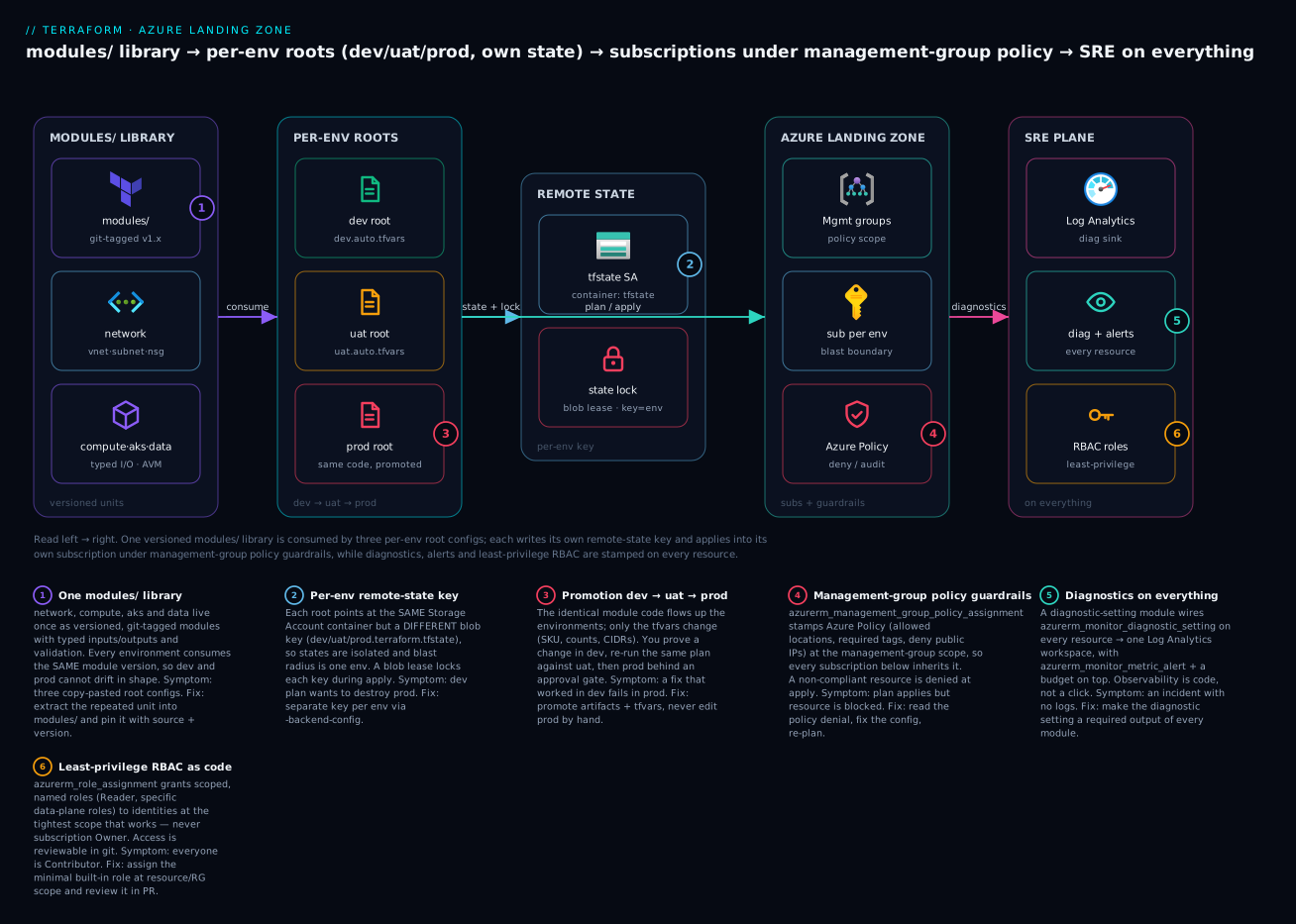
The diagram traces the whole platform left to right: the modules/ library on the left is consumed by three per-environment roots, each of which writes its own state key (with a blob lease as the lock) and applies into its own subscription under management-group policy, while the SRE plane — diagnostics to Log Analytics, alerts, and least-privilege RBAC — is stamped across everything. The six badges are the six load-bearing decisions of the lesson.
The modules library: network, compute, aks, data
A landing-zone module is not “a wrapper around one resource”. It is a coherent, named unit of infrastructure with a contract: typed inputs, validated where it matters, sensitive outputs where secrets flow, a README, and — the Contoso house rule — a diagnostic setting it creates for itself so that consuming the module automatically means the resource is observable. The library is versioned (git tags, or published to a private registry) so an environment pins network v1.4.0 and upgrades on its own schedule; dev can trial v1.5.0 while prod stays on v1.4.0, and because they share the module’s shape, the upgrade is a reviewable diff, not a rewrite.
Here is the network module — small enough to read, real enough to run. Note the for_each over a subnets map (so one module makes any number of subnets), the validation on address_space, and the self-contained diagnostic setting keyed off a log_analytics_workspace_id input:
# modules/network/variables.tf
variable "name_prefix"         { type = string }
variable "location"            { type = string }
variable "resource_group_name" { type = string }

variable "address_space" {
  type = list(string)
  validation {
    condition     = length(var.address_space) > 0
    error_message = "Provide at least one CIDR for the VNet address space."
  }
}

variable "subnets" {
  type = map(object({
    address_prefixes = list(string)
  }))
}

variable "log_analytics_workspace_id" {
  type        = string
  description = "LAW to send this VNet's diagnostics to — makes observability a module property."
}

variable "tags" {
  type    = map(string)
  default = {}
}
# modules/network/main.tf
resource "azurerm_virtual_network" "this" {
  name                = "vnet-${var.name_prefix}"
  location            = var.location
  resource_group_name = var.resource_group_name
  address_space       = var.address_space
  tags                = var.tags
}

resource "azurerm_subnet" "this" {
  for_each             = var.subnets
  name                 = "snet-${each.key}"
  resource_group_name  = var.resource_group_name
  virtual_network_name = azurerm_virtual_network.this.name
  address_prefixes     = each.value.address_prefixes
}

# Observability is a property of the module, not a later chore.
resource "azurerm_monitor_diagnostic_setting" "vnet" {
  name                       = "diag-vnet-to-law"
  target_resource_id         = azurerm_virtual_network.this.id
  log_analytics_workspace_id = var.log_analytics_workspace_id

  enabled_log { category_group = "allLogs" }
  metric      { category = "AllMetrics" }
}
# modules/network/outputs.tf
output "vnet_id" {
  value = azurerm_virtual_network.this.id
}

output "subnet_ids" {
  description = "Map of subnet name → resource ID, for consumers (compute, aks)."
  value       = { for k, s in azurerm_subnet.this : k => s.id }
}
That is the shape every module in the library follows. The catalogue below is the library contract at a glance — what each module wraps, its key inputs, and the outputs downstream modules consume:
| Module | Wraps (azurerm_*) |
Key inputs | Key outputs (consumed by) |
|---|---|---|---|
network |
virtual_network, subnet, network_security_group |
address_space, subnets, log_analytics_workspace_id |
vnet_id, subnet_ids → compute, aks |
compute |
linux_virtual_machine_scale_set / app_service |
subnet_id, sku, instance_count, law_id |
app_id, principal_id → data (RBAC) |
aks |
kubernetes_cluster, role_assignment |
subnet_id, node_pools, law_id |
kubelet_identity, oidc_issuer_url |
data |
storage_account / mssql_* |
replication_type, subnet_id, law_id |
storage_account_id, primary_blob_endpoint |
monitoring |
log_analytics_workspace, monitor_action_group |
retention_days, daily_quota_gb, oncall_email |
log_analytics_workspace_id, action_group_id → all |
The load-bearing idea is composition by output passing. A root doesn’t just instantiate modules side by side; it wires them — the monitoring module’s log_analytics_workspace_id output feeds every other module’s diagnostic input, and the network module’s subnet_ids feed compute and aks. That wiring is also the dependency graph: Terraform sees that network references monitoring’s output and orders them automatically — no depends_on needed. This table is the wiring map you keep in your head:
| Producer module → output | Consumer module ← input | Why (and the ordering it forces) |
|---|---|---|
monitoring.log_analytics_workspace_id |
network, compute, aks, data .log_analytics_workspace_id |
Diagnostics on everything; forces monitoring first |
network.subnet_ids["app"] |
compute.subnet_id |
Place VMs in the app subnet; forces network before compute |
network.subnet_ids["aks"] |
aks.subnet_id |
CNI needs the subnet; forces network before aks |
compute.principal_id |
data role assignment principal_id |
Grant the app read access; forces compute before the grant |
monitoring.action_group_id |
root azurerm_monitor_metric_alert.action |
Alerts page the on-call group |
How a root references a module — its source and version pin — is the other half of “versioned library”. The four forms, and when each is right:
source form |
Example | Pin with | Use when |
|---|---|---|---|
| Local path | ../../modules/network |
the repo’s own git tag | Monorepo: library + roots evolve together |
| Git ref | git::https://git/modules//network?ref=v1.4.0 |
?ref=<tag> |
Library in its own repo; explicit per-env version |
| Private registry | app.terraform.io/contoso/network/azurerm |
version = "~> 1.4" |
Published, semver-resolved internal modules |
| Public registry (AVM) | Azure/avm-res-network-virtualnetwork/azurerm |
version = "~> 0.8" |
Hardened Microsoft-maintained building blocks |
The rule that makes upgrades safe: always pin (a ?ref tag or a version constraint), and let dev adopt a new module version before uat and prod — the same promotion flow you use for infrastructure applies to the library itself.
For the deep mechanics of module contracts — semver, optional() object attributes, sensitive propagation, publishing to a registry — see the authoring reusable modules lesson; here the point is how the library is consumed and wired into a landing zone.
Multi-environment: tfvars-per-env vs Terragrunt
You now have a library and a single root that composes it. The multi-environment problem is: how do you get dev, uat and prod from that root without duplicating the composition three times and without their states ever colliding? There are two mainstream answers, and choosing between them is the central decision of this section.
Answer 1 — tfvars-per-env (native Terraform). Keep a full root config per environment folder (they are near-identical), and drive the differences with a per-env *.auto.tfvars and a per-env partial backend config. The backend block is left empty in code and completed at init time with a -backend-config file, so each environment gets the same container but a different key:
# environments/dev/versions.tf
terraform {
  required_version = ">= 1.6.0"
  required_providers {
    azurerm = {
      source  = "hashicorp/azurerm"
      version = "~> 4.0"
    }
  }
  backend "azurerm" {}          # ← empty: completed by -backend-config at init
}

provider "azurerm" {
  features {}
  subscription_id = var.subscription_id   # required in azurerm 4.x
}
# environments/dev/backend.hcl  →  terraform init -backend-config=backend.hcl
resource_group_name  = "rg-tfstate-platform"
storage_account_name = "sttfstateplatform001"
container_name       = "tfstate"
key                  = "dev.terraform.tfstate"   # uat/prod differ ONLY here
use_azuread_auth     = true                        # AAD auth, no storage keys
# environments/dev/dev.auto.tfvars
subscription_id          = "00000000-dev-0000-0000-000000000000"
location                 = "australiaeast"
vnet_address_space       = ["10.10.0.0/16"]
subnets                  = { app = { address_prefixes = ["10.10.1.0/24"] }, aks = { address_prefixes = ["10.10.16.0/20"] } }
storage_replication_type = "LRS"      # prod would be "GZRS"
log_retention_days       = 30         # prod would be 90
monthly_budget           = 500        # prod would be larger
The strength is that it is just Terraform — no extra tool, every environment folder is self-contained and reviewable, and juniors already understand it. The weakness is repetition: the versions.tf, provider block and main.tf composition are copy-pasted across dev/, uat/ and prod/, so a change to the composition is a three-place edit, and it is easy for the folders to drift.
Answer 2 — Terragrunt (DRY). Terragrunt keeps the composition in one place and generates the backend and provider per environment, so the only thing that lives in each env folder is its inputs. A root terragrunt.hcl defines the backend once (with a per-env key derived from the path) and generates the provider; each child terragrunt.hcl includes it, points at a module, declares its dependency on other units, and supplies inputs:
# live/terragrunt.hcl  (root — defined ONCE)
remote_state {
  backend = "azurerm"
  generate = { path = "backend.tf", if_exists = "overwrite_terragrunt" }
  config = {
    resource_group_name  = "rg-tfstate-platform"
    storage_account_name = "sttfstateplatform001"
    container_name       = "tfstate"
    key                  = "${path_relative_to_include()}/terraform.tfstate"  # per-unit key
    use_azuread_auth     = true
  }
}

generate "provider" {
  path      = "provider.tf"
  if_exists = "overwrite_terragrunt"
  contents  = <<EOF
provider "azurerm" {
  features {}
  subscription_id = "${local.env.locals.subscription_id}"
}
EOF
}

locals {
  env = read_terragrunt_config(find_in_parent_folders("env.hcl"))
}
# live/dev/network/terragrunt.hcl  (a unit)
include "root" { path = find_in_parent_folders() }

terraform { source = "${get_repo_root()}/modules//network" }

dependency "monitoring" {
  config_path = "../monitoring"
  mock_outputs = {                         # lets `plan` run before monitoring exists
    log_analytics_workspace_id = "/subscriptions/0/resourceGroups/m/providers/Microsoft.OperationalInsights/workspaces/m"
  }
}

inputs = {
  name_prefix                = "contoso-platform-dev"
  address_space              = ["10.10.0.0/16"]
  subnets                    = { app = { address_prefixes = ["10.10.1.0/24"] } }
  log_analytics_workspace_id = dependency.monitoring.outputs.log_analytics_workspace_id
}
Now dev/uat/prod differ only in their env.hcl and unit inputs; the backend, provider and module source are DRY. The cost is the extra tool, the wrapper indirection when debugging, and a dependency/mock_outputs model you must understand. The Terragrunt mechanics — generate, dependency, run-all, mocks — are covered in depth in Terragrunt fundamentals and applied with approval gates in the multi-environment 3-tier lesson.
Choose with this matrix, not by fashion:
| Axis | tfvars-per-env (native) | Terragrunt |
|---|---|---|
| Extra tooling | None — plain Terraform | Terragrunt binary + wrapper model |
| DRY of composition | Low — root copied per env | High — composition defined once |
| Backend/key management | Manual backend.hcl per env |
Generated from path (path_relative_to_include) |
| Cross-stack wiring | terraform_remote_state data source |
First-class dependency blocks + mocks |
| Run many stacks at once | Scripted loop | terragrunt run-all plan/apply |
| Onboarding difficulty | Low | Medium |
| Best when | ≤3 envs, one team, few stacks | Many envs/accounts, many stacks, drift-prone folders |
| Blast-radius story | Explicit key per folder |
Automatic per-unit key |
The decision rule Contoso used: start native while there are three environments and one platform team; adopt Terragrunt when the number of (environment × stack) combinations makes the copy-paste unmanageable or when you split into per-team subscriptions and need generated per-account backends — the situation the DRY multi-account lesson is written for.
Either way, remote state is per-environment. This is the isolation that makes the platform safe, and it is worth stating as a table because getting the key scheme right is what stops a dev apply from planning to destroy prod:
| Environment | Storage Account | Container | Blob key | Lock |
|---|---|---|---|---|
| dev | sttfstateplatform001 |
tfstate |
dev.terraform.tfstate |
Blob lease (per key) |
| uat | sttfstateplatform001 |
tfstate |
uat.terraform.tfstate |
Blob lease (per key) |
| prod | sttfstateplatform001 |
tfstate |
prod.terraform.tfstate |
Blob lease (per key) |
| platform/mg | sttfstateplatform001 |
tfstate |
platform-mg.terraform.tfstate |
Blob lease (per key) |
The azurerm backend takes a blob lease on the specific blob during an operation, so locking is per-key: dev and prod can apply concurrently because they lease different blobs. (For real isolation many teams go further and put each environment’s state in a separate subscription’s Storage Account, so even the backend is a blast boundary — but one account with per-env keys is the pragmatic default.)
Promotion — dev → uat → prod. The point of shared modules and per-env tfvars is that a change is promoted, not rewritten. You prove it in dev, then run the same module code against uat with uat’s tfvars, then prod behind an approval. Nothing about the resources is hand-edited between environments; only the tfvars (SKU, counts, CIDRs, replication) change.
| Stage | What runs | Gate before it | What differs (tfvars) |
|---|---|---|---|
| dev | plan + apply on merge to main |
PR review | Small SKUs, LRS, 30-day logs, low budget |
| uat | plan + apply |
dev apply green + QA sign-off | Prod-like SKUs, prod-like data shape |
| prod | plan (posted) then apply |
Manual approval on the plan | GZRS, 90-day logs, HA counts, real budget |
The mechanics of the gates — plan/apply separation, storing the plan artifact, requiring an environment approval — belong to your CI system (Azure Pipelines environments or GitHub Actions environments with required reviewers). That CI/CD wiring for Terraform on Azure DevOps pipelines is a lesson in its own right; conceptually it is: plan in CI, publish the plan, require an approval on prod, apply the approved plan (never re-plan at apply time).
Azure landing zones: management groups, subscriptions & policy
Everything so far governs resources. A landing zone also governs the containers those resources live in — the management-group hierarchy and subscriptions — and stamps Azure Policy as guardrails so that non-compliant resources are denied or flagged regardless of who applies what. This is the governance plane, and in the Contoso repo it lives in platform/management-groups/ as its own root with its own state, because its blast radius is the whole tenant.
The mental model: management groups are a tree above subscriptions; a policy or RBAC assignment at a management group is inherited by every subscription beneath it. Subscriptions are the hard boundary — for billing, for quota, and (the reason we care) for blast radius: putting dev, uat and prod in separate subscriptions means a runaway apply, a compromised credential, or a policy mistake is contained to one environment. The landing-zone pattern is a small management-group hierarchy (a platform group for shared services, a landing-zones group for workloads) with policy assigned high and subscriptions slotted underneath.
The Contoso hierarchy follows the CAF enterprise-scale archetype — a small, legible tree where policy lives high and workloads slot in per environment:
| Level | Management group | Contains | Assigned here |
|---|---|---|---|
| Tenant root | Tenant Root Group | everything | Org non-negotiables (allowed locations) |
| Platform | mg-platform |
identity / management / connectivity subs | Required tags, diagnostics-to-LAW policy |
| Landing zones | mg-landingzones |
workload subscriptions | Allowed SKUs, enforce HTTPS |
| ├ Corp | mg-corp |
internal workloads | Deny public IP on NICs |
| └ Online | mg-online |
internet-facing workloads | WAF + HTTPS enforced |
| (per env) | subscription (dev/uat/prod) | the resources this course builds | Env quota + rare exceptions |
Here is a real management-group policy assignment. It uses azurerm_management_group_policy_assignment to bind two built-in Azure Policies at a management-group scope — “Allowed locations” (deny anything outside the approved regions) and a required-tag policy — looked up by name via a data source so you never hardcode a policy GUID wrong:
# platform/management-groups/main.tf
data "azurerm_policy_definition" "allowed_locations" {
  display_name = "Allowed locations"
}

resource "azurerm_management_group_policy_assignment" "allowed_locations" {
  name                 = "allowed-locations"
  management_group_id  = var.platform_mg_id
  policy_definition_id = data.azurerm_policy_definition.allowed_locations.id
  description          = "Deny resource creation outside approved Australian regions."

  parameters = jsonencode({
    listOfAllowedLocations = {
      value = ["australiaeast", "australiasoutheast"]
    }
  })
}

data "azurerm_policy_definition" "require_tag" {
  display_name = "Require a tag on resources"
}

resource "azurerm_management_group_policy_assignment" "require_cost_center" {
  name                 = "require-cost-center-tag"
  management_group_id  = var.platform_mg_id
  policy_definition_id = data.azurerm_policy_definition.require_tag.id
  parameters           = jsonencode({ tagName = { value = "cost_center" } })
}
Assign these once, high in the tree, and every subscription below inherits them: a deny policy makes a non-compliant terraform apply fail at apply time with a clear policy reason, which is exactly the guardrail you want — the platform enforces the rule, not a code reviewer’s memory. Where to put what:
| Scope | What to assign here | Example |
|---|---|---|
| Tenant root MG | Organisation-wide non-negotiables | Allowed locations, deny public IP on NICs |
| Platform MG | Shared-services standards | Required tags, diagnostic-settings-to-LAW policy |
| Landing-zones MG | Workload guardrails | Allowed VM SKUs, enforce HTTPS, deny classic resources |
| Per-env subscription | Env-specific quota/exception | Larger SKUs allowed in prod; sandbox exceptions in dev |
| Resource group | Fine-grained, rare | A one-off exemption with an audit trail |
When to build this yourself vs adopt a module. You can hand-roll the whole hierarchy, but Microsoft ships two heavyweight options, and the decision of when to reach for them matters. The CAF enterprise-scale ALZ module (Azure/caf-enterprise-scale/azurerm) deploys an opinionated entire landing zone — management-group tree, policies, RBAC, and platform subscriptions — in one module; it is powerful and correct but large and opinionated. Azure Verified Modules (AVM) are Microsoft’s newer, supported, per-resource and per-pattern modules: Azure/avm-res-* for single resources (e.g. Azure/avm-res-network-virtualnetwork/azurerm) and Azure/avm-ptn-* for patterns (including an ALZ pattern module). Here is the grid:
| Option | Source | What it gives you | Reach for it when… |
|---|---|---|---|
| Roll your own | your modules/ |
Full control, minimal surface, you understand every line | Small/medium estate; you want to learn/own the hierarchy |
| AVM resource module | Azure/avm-res-*/azurerm |
A single resource done to Microsoft’s spec (security, diag defaults) | You want a hardened building block without maintaining it |
| AVM pattern module | Azure/avm-ptn-*/azurerm |
A composed pattern (e.g. hub-spoke, ALZ) | You want a blessed pattern but composability with your own code |
| CAF enterprise-scale | Azure/caf-enterprise-scale/azurerm |
The whole ALZ: MG tree + policy + RBAC + platform subs | Greenfield enterprise ALZ, you accept its opinions wholesale |
Using an AVM resource module is a one-liner swap for your own — same composition, someone else maintains the hardening:
module "vnet" {
  source              = "Azure/avm-res-network-virtualnetwork/azurerm"
  version             = "~> 0.8"
  name                = "vnet-${local.name_prefix}"
  resource_group_name = azurerm_resource_group.this.name
  location            = var.location
  address_space       = var.vnet_address_space
  # AVM modules bundle sensible diagnostic + private-endpoint defaults
}
The Contoso rule of thumb: roll your own while you are learning the estate and it is small; adopt AVM resource/pattern modules for hardened building blocks as you scale; reach for CAF enterprise-scale only for a true greenfield enterprise ALZ where you accept its opinions. Mixing is fine and common — your own composition, AVM leaves.
SRE as code: tags, diagnostics, alerts, RBAC & drift
The difference between infrastructure and a platform is that reliability is a property of every resource, guaranteed by the code, not something SRE bolts on after the first incident. This section is the SRE plane, and it is the densest part of the lesson because there are several controls and each is a small, standard pattern you apply everywhere.
Standardised tags and names. One locals block defines the naming convention and the common_tags map, merged into every resource via tags = local.common_tags. This is what makes cost allocation, ownership and incident routing possible — and a management-group policy (above) requires the tags so nobody can skip them:
# environments/dev/locals.tf
locals {
  environment = "dev"
  workload    = "contoso-platform"
  name_prefix = "${local.workload}-${local.environment}"   # e.g. contoso-platform-dev

  common_tags = {
    environment = local.environment
    workload    = local.workload
    managed_by  = "terraform"
    cost_center = var.cost_center
    owner       = var.owner_email
    repo        = "contoso/landing-zone"
  }
}
| Convention | Rule | Enforced by |
|---|---|---|
| Resource name | <type>-<workload>-<env>[-<n>], e.g. vnet-contoso-platform-dev |
local.name_prefix in modules |
| Storage account name | st + lowercased, no dashes, ≤24 chars |
substr(replace(...),0,24) in data module |
environment tag |
one of dev/uat/prod |
local.common_tags + Policy Require a tag |
cost_center tag |
valid cost centre code | Azure Policy deny if missing |
managed_by tag |
always terraform |
common_tags (signals “don’t hand-edit”) |
Diagnostic settings on every resource. We already saw the network module create its own azurerm_monitor_diagnostic_setting → Log Analytics. That is the pattern everywhere: each module takes a log_analytics_workspace_id and wires its resource’s logs and metrics to it. The monitoring module owns the workspace and the on-call action group:
# modules/monitoring/main.tf
resource "azurerm_log_analytics_workspace" "this" {
  name                = "law-${var.name_prefix}"
  location            = var.location
  resource_group_name = var.resource_group_name
  sku                 = "PerGB2018"
  retention_in_days   = var.retention_days
  daily_quota_gb      = var.daily_quota_gb     # cost guardrail on ingestion
  tags                = var.tags
}

resource "azurerm_monitor_action_group" "oncall" {
  name                = "ag-${var.name_prefix}-oncall"
  resource_group_name = var.resource_group_name
  short_name          = "oncall"
  email_receiver {
    name          = "platform-oncall"
    email_address = var.oncall_email
  }
}
Alerts and budgets. Alerts (azurerm_monitor_metric_alert) fire on resource signals and page the action group; budgets (azurerm_consumption_budget_resource_group) fire on spend. Both are code:
# environments/dev/main.tf (excerpt) — an alert wired to the action group
resource "azurerm_monitor_metric_alert" "storage_availability" {
  name                = "alert-${local.name_prefix}-stg-avail"
  resource_group_name = azurerm_resource_group.this.name
  scopes              = [module.data.storage_account_id]
  description         = "Storage availability dropped below 99%."
  severity            = 1

  criteria {
    metric_namespace = "Microsoft.Storage/storageAccounts"
    metric_name      = "Availability"
    aggregation      = "Average"
    operator         = "LessThan"
    threshold        = 99
  }

  action { action_group_id = module.monitoring.action_group_id }
}

# A cost guardrail: budget with alerts at 80% actual and 100% forecast
resource "azurerm_consumption_budget_resource_group" "this" {
  name              = "budget-${local.name_prefix}"
  resource_group_id = azurerm_resource_group.this.id
  amount            = var.monthly_budget
  time_grain        = "Monthly"

  time_period { start_date = var.budget_start_date }   # first of a month, RFC3339

  notification {
    enabled        = true
    threshold      = 80
    operator       = "GreaterThanOrEqualTo"
    threshold_type = "Actual"
    contact_emails = [var.oncall_email]
  }
  notification {
    enabled        = true
    threshold      = 100
    operator       = "GreaterThanOrEqualTo"
    threshold_type = "Forecasted"
    contact_emails = [var.oncall_email]
  }
}
Least-privilege RBAC. Access is azurerm_role_assignment at the tightest scope that works — a built-in role at a resource group or single resource, never subscription Owner handed out casually. Because it is code, access is reviewable in a PR and diffable over time:
resource "azurerm_role_assignment" "app_reads_blob" {
  scope                = module.data.storage_account_id           # resource scope, not sub
  role_definition_name = "Storage Blob Data Reader"               # data-plane, read-only
  principal_id         = module.compute.principal_id              # the app's managed identity
}
“Least-privilege” is only real if you reach for the narrowest built-in role that works — a data-plane role at a resource beats Contributor at a subscription every time. The catalogue you assign from most:
| Built-in role | Grants | Assign at | Instead of |
|---|---|---|---|
| Reader | Read-only, control-plane | RG / sub for auditors, on-call | any write role |
| Contributor | Manage all except RBAC | one RG for a workload team | subscription-wide Contributor |
| Storage Blob Data Reader | Read blob data | the storage account | broad Contributor |
| Storage Blob Data Contributor | Read/write blob data | container / account | account key sharing |
| Key Vault Secrets User | Read secrets (data-plane) | the key vault | Key Vault Contributor for reads |
| Monitoring Reader | Read monitoring data | sub, for on-call | any write role |
| User Access Administrator | Manage RBAC assignments | platform team, sparingly | handing out Owner |
| Owner | Full control + RBAC | almost never | routine grants |
| SRE control | Terraform resource | Standard we enforce |
|---|---|---|
| Tagging | tags = local.common_tags on every resource |
6 mandatory tags; Policy denies missing cost_center |
| Naming | local.name_prefix in modules |
<type>-<workload>-<env> everywhere |
| Diagnostics | azurerm_monitor_diagnostic_setting per module |
allLogs + AllMetrics → one LAW |
| Log retention/cost | retention_in_days, daily_quota_gb |
30d dev / 90d prod; daily cap set |
| Alerts | azurerm_monitor_metric_alert → action group |
Sev1 on availability/error signals |
| Cost | azurerm_consumption_budget_resource_group |
80% actual + 100% forecast notifications |
| RBAC | azurerm_role_assignment |
Least-priv built-in role at tightest scope |
| Drift | terraform plan in CI on schedule |
Nightly plan; non-empty diff = alert |
| Blast radius | separate state key per env/layer | dev cannot plan prod; MG layer isolated |
Drift detection and state hygiene. Drift is when the real world diverges from state — someone hotfixes in the portal, or an Azure-side change mutates a field. The SRE practice is a scheduled terraform plan (per environment) in CI: an empty plan means no drift; a non-empty plan is an alert to investigate and reconcile (re-apply to correct, or import/moved/update code to accept the change). State hygiene is the discipline around it: state is remote, locked, versioned and encrypted (the Storage Account gives you soft-delete/versioning); secrets in state are treated as secret (the blob is access-controlled and AAD-authenticated); and you never hand-edit state — you use terraform state mv, import, and moved {}/removed {} blocks. The blast-radius rule ties it together: one state per environment per layer means a corrupt or lost state costs you one environment’s one layer, never the estate.
Hands-on: build it with Terraform
Now assemble a minimal but real slice of the platform end to end: a dev root that composes three modules — monitoring (Log Analytics + action group), network (VNet + subnet + its diagnostic setting), and data (a hardened Storage Account + its diagnostic setting) — plus a least-privilege role assignment, a budget, and a metric alert, all with standard tags and per-env remote state. This is the composition, the output-passing, the remote state, the tags, a diagnostic setting and the SRE wiring in one runnable stack. ⚠️ This creates real Azure resources; a Storage Account and Log Analytics ingestion cost money. Destroy at the end.
Step 0 — one-time state backend (bootstrap). The backend Storage Account must exist before any root can use it. Create it once by hand (it is the one thing you can’t Terraform-with-Terraform on day one):
az group create -n rg-tfstate-platform -l australiaeast
az storage account create -n sttfstateplatform001 -g rg-tfstate-platform \
  -l australiaeast --sku Standard_LRS --min-tls-version TLS1_2 \
  --allow-blob-public-access false
az storage container create -n tfstate --account-name sttfstateplatform001 --auth-mode login
Step 1 — the module files. Create modules/monitoring, modules/network (shown earlier) and modules/data. The data module hardens the Storage Account and emits its own diagnostic setting and storage_account_id output:
# modules/data/main.tf
resource "azurerm_storage_account" "this" {
  name                            = substr(lower(replace("st${var.name_prefix}", "-", "")), 0, 24)
  location                        = var.location
  resource_group_name             = var.resource_group_name
  account_tier                    = "Standard"
  account_replication_type        = var.replication_type
  min_tls_version                 = "TLS1_2"
  public_network_access_enabled   = false
  allow_nested_items_to_be_public = false
  tags                            = var.tags
}

resource "azurerm_monitor_diagnostic_setting" "storage" {
  name                       = "diag-storage-to-law"
  target_resource_id         = "${azurerm_storage_account.this.id}/blobServices/default"
  log_analytics_workspace_id = var.log_analytics_workspace_id
  enabled_log { category_group = "allLogs" }
  metric      { category = "Transaction" }
}

output "storage_account_id" { value = azurerm_storage_account.this.id }
Step 2 — the dev root composition. This is the heart: it creates the resource group, then composes the three modules, passing monitoring’s workspace ID into network and data, and adds the RBAC/budget/alert SRE resources. (main.tf shown; variables.tf, outputs.tf, locals.tf and versions.tf as earlier.)
# environments/dev/main.tf
resource "azurerm_resource_group" "this" {
  name     = "rg-${local.name_prefix}"
  location = var.location
  tags     = local.common_tags
}

module "monitoring" {
  source              = "../../modules/monitoring"
  name_prefix         = local.name_prefix
  location            = var.location
  resource_group_name = azurerm_resource_group.this.name
  retention_days      = var.log_retention_days
  daily_quota_gb      = var.log_daily_quota_gb
  oncall_email        = var.oncall_email
  tags                = local.common_tags
}

module "network" {
  source                     = "../../modules/network"
  name_prefix                = local.name_prefix
  location                   = var.location
  resource_group_name        = azurerm_resource_group.this.name
  address_space              = var.vnet_address_space
  subnets                    = var.subnets
  log_analytics_workspace_id = module.monitoring.log_analytics_workspace_id   # ← output passing
  tags                       = local.common_tags
}

module "data" {
  source                     = "../../modules/data"
  name_prefix                = local.name_prefix
  location                   = var.location
  resource_group_name        = azurerm_resource_group.this.name
  replication_type           = var.storage_replication_type
  log_analytics_workspace_id = module.monitoring.log_analytics_workspace_id   # ← output passing
  tags                       = local.common_tags
}

resource "azurerm_role_assignment" "platform_reader" {
  scope                = azurerm_resource_group.this.id
  role_definition_name = "Reader"
  principal_id         = var.platform_team_object_id
}
# (+ azurerm_consumption_budget_resource_group and azurerm_monitor_metric_alert as shown above)
Every resource that gets created, which module owns it, and why:
| Resource | Owned by | Purpose |
|---|---|---|
azurerm_resource_group.this |
root | The env’s container; carries common_tags |
azurerm_log_analytics_workspace |
monitoring |
Single diagnostics sink for the env |
azurerm_monitor_action_group |
monitoring |
On-call target for alerts |
azurerm_virtual_network + subnet |
network |
The env’s network, tagged and named by convention |
azurerm_monitor_diagnostic_setting (vnet) |
network |
VNet logs/metrics → LAW (observability by default) |
azurerm_storage_account |
data |
Hardened data store (TLS1.2, no public access) |
azurerm_monitor_diagnostic_setting (storage) |
data |
Storage logs/metrics → LAW |
azurerm_role_assignment |
root | Least-priv Reader for the platform team |
azurerm_consumption_budget_resource_group |
root | Cost guardrail (80%/100% alerts) |
azurerm_monitor_metric_alert |
root | Sev1 on storage availability |
The variables that carry the environment differences — the only things that change between dev and prod, because the module code is identical — make the promotion story concrete:
| Variable | Type | dev value | prod value |
|---|---|---|---|
location |
string |
australiaeast |
australiaeast |
vnet_address_space |
list(string) |
["10.10.0.0/16"] |
["10.30.0.0/16"] |
storage_replication_type |
string |
LRS |
GZRS |
log_retention_days |
number |
30 |
90 |
log_daily_quota_gb |
number |
1 |
10 |
monthly_budget |
number |
500 |
8000 |
platform_team_object_id |
string |
dev AAD group | prod AAD group |
Step 3 — init, plan, apply for dev. From environments/dev/, initialise with the per-env backend config, then plan and apply:
cd environments/dev
terraform init -backend-config=backend.hcl        # binds state key = dev.terraform.tfstate
terraform fmt -check && terraform validate         # cheap gates first
terraform plan  -out=dev.tfplan
terraform apply dev.tfplan
Representative plan output — note the module addressing and that Terraform ordered monitoring before network/data on its own because of the workspace-ID reference:
Terraform will perform the following actions:

  # azurerm_resource_group.this will be created
  # module.monitoring.azurerm_log_analytics_workspace.this will be created
  # module.monitoring.azurerm_monitor_action_group.oncall will be created
  # module.network.azurerm_virtual_network.this will be created
  # module.network.azurerm_subnet.this["app"] will be created
  # module.network.azurerm_monitor_diagnostic_setting.vnet will be created
  # module.data.azurerm_storage_account.this will be created
  # module.data.azurerm_monitor_diagnostic_setting.storage will be created
  # azurerm_role_assignment.platform_reader will be created
  # azurerm_consumption_budget_resource_group.this will be created
  # azurerm_monitor_metric_alert.storage_availability will be created

Plan: 11 to add, 0 to change, 0 to destroy.
Step 4 — verify. Confirm the platform properties, not just that resources exist: that the tags landed, that the diagnostic setting is wired, and that state went to the right key:
# tags present on the RG?
az group show -n rg-contoso-platform-dev --query tags

# diagnostic setting on the VNet points at the workspace?
az monitor diagnostic-settings list \
  --resource $(terraform output -raw vnet_id) --query "[].name"

# state landed on the dev key?
az storage blob list -c tfstate --account-name sttfstateplatform001 \
  --auth-mode login --query "[].name"    # → dev.terraform.tfstate
Step 5 — promote to uat/prod (conceptual). The identical module code now runs for the next environment; you change directory, init with that env’s backend config (a different key), and apply with that env’s tfvars. Nothing in modules/ or the composition changes:
cd ../uat
terraform init -backend-config=backend.hcl   # key = uat.terraform.tfstate
terraform plan -out=uat.tfplan               # same modules, uat.auto.tfvars values
terraform apply uat.tfplan
In real life the uat and prod applies run in CI behind the approval gate from the promotion table — prod applies the already-approved plan artifact, it does not re-plan.
Step 6 — destroy and clean up. ⚠️ Tear down each environment you stood up, then (optionally) the bootstrap backend:
cd environments/dev && terraform destroy    # repeat per env you applied
# only if you are fully done with the backend:
az group delete -n rg-tfstate-platform --yes --no-wait
Testing the modules: fmt, validate, tflint, checkov, terraform test
A module library that many environments depend on must be tested before it ships, or a bad v1.5.0 breaks every environment that bumps to it. The testing ladder runs cheapest-first, and all of it belongs in CI on every PR to modules/:
terraform fmt -check -recursive        # style: fails if any file isn't canonical
terraform validate                     # syntax + internal consistency (needs init)
tflint --recursive                     # lint: azurerm ruleset — deprecated args, bad names
checkov -d . --framework terraform     # security: public storage, missing TLS, open NSGs
terraform test                         # behaviour: assertions on planned/applied values
Native terraform test is the one that proves behaviour. A *.tftest.hcl file sets inputs and asserts on the result of a plan (no cloud needed) or an apply (real, ephemeral resources). This test proves the network module’s naming and subnet-count contract:
# tests/network.tftest.hcl
variables {
  name_prefix                = "test-net"
  location                   = "australiaeast"
  resource_group_name        = "rg-test"
  address_space              = ["10.99.0.0/16"]
  subnets                    = { app = { address_prefixes = ["10.99.1.0/24"] } }
  log_analytics_workspace_id = "/subscriptions/x/resourceGroups/y/providers/Microsoft.OperationalInsights/workspaces/z"
}

run "vnet_named_by_convention" {
  command = plan
  assert {
    condition     = azurerm_virtual_network.this.name == "vnet-test-net"
    error_message = "VNet name did not follow the vnet-<prefix> convention"
  }
}

run "exactly_one_subnet" {
  command = plan
  assert {
    condition     = length(azurerm_subnet.this) == 1
    error_message = "Expected exactly one subnet from the test inputs"
  }
}
| Tool | Layer it checks | Catches | Command |
|---|---|---|---|
terraform fmt |
Style | Non-canonical formatting | fmt -check -recursive |
terraform validate |
Syntax/consistency | Bad refs, wrong types, missing required args | validate |
tflint (+azurerm) |
Lint / best-practice | Deprecated args, invalid instance types, naming | tflint --recursive |
checkov / tfsec |
Security / compliance | Public storage, no TLS, open NSG, no encryption | checkov -d . |
terraform test |
Behaviour | Contract regressions (names, counts, wiring) | test |
The command = plan tests run without Azure credentials for the assertions on planned values, so they are fast CI gates; use command = apply (against a sandbox subscription) only for the few tests that must observe real API behaviour. Run the security scan (checkov) as a required status check so a module can never merge with a regressed control — a public Storage Account should fail the PR, not the production incident.
Variables, outputs & making it reusable
The whole lesson has been about reuse, so this section is about the last mile: parameterising cleanly and knowing when to stop rolling your own. The environments already share modules and differ only by tfvars — that is the for_each-over-environments idea expressed as folders. If you truly have many near-identical environments, you can even drive them from a single map and for_each a wrapper module, but for a landing zone the explicit folder-per-env is usually clearer and safer than a clever loop, because each env stays independently reviewable and independently applied.
The reuse decision that matters most at scale is your module vs a registry module (AVM). Your own module is right while you are learning the estate, need full control, or have a shape no registry module fits; an AVM resource module is right when you want a hardened, Microsoft-maintained building block and are happy to consume its interface. The tell is maintenance burden: if you find yourself re-implementing security defaults (private endpoints, diagnostic categories, TLS floors) that AVM already ships, swap to AVM and spend your effort on the composition that is actually yours.
| Question | Roll your own module | Use AVM (Azure/avm-res-*) |
|---|---|---|
| Do you need full control of every argument? | Yes → own it | No → AVM’s interface is fine |
| Is the resource shape unusual/bespoke? | Yes → own it | No → AVM covers the common shape |
| Who maintains security hardening? | You | Microsoft (AVM defaults) |
| Learning value? | High (you write it) | Lower (you consume it) |
| Upgrade cadence | Your git tags | AVM semver (~>) |
| Best for | Bespoke, small estate, learning | Hardened building blocks at scale |
Keep the module interface stable even when you swap the implementation: if network exposes vnet_id and subnet_ids, environments consuming it don’t care whether inside it is your azurerm_virtual_network or an AVM module — which is exactly why a good output contract is the most valuable thing in the library.
Going deeper
The lesson so far consumed a management group, assigned two built-in policies, and treated connectivity and identity as background. A real landing zone builds the tree itself, writes its own policy, vends subscriptions, picks a network topology and pins an identity baseline — the advanced ground the capstone stands on.
The management-group tree, the platform/application split, and subscription vending
In a greenfield tenant you build the tree with azurerm_management_group, parenting each level off the tenant root group — which you read, never create — and slotting subscriptions underneath:
# platform/management-groups/main.tf
data "azurerm_management_group" "root" {
  name = var.tenant_root_group_id            # the root MG id (often the tenant GUID)
}

resource "azurerm_management_group" "platform" {
  display_name               = "Platform"
  parent_management_group_id = data.azurerm_management_group.root.id
}

resource "azurerm_management_group" "landing_zones" {
  display_name               = "Landing Zones"
  parent_management_group_id = data.azurerm_management_group.root.id
}

resource "azurerm_management_group" "corp" {
  display_name               = "Corp"
  parent_management_group_id = azurerm_management_group.landing_zones.id
}

# slot an existing subscription under a management group
resource "azurerm_management_group_subscription_association" "prod" {
  management_group_id = azurerm_management_group.corp.id
  subscription_id     = "/subscriptions/${var.prod_subscription_id}"
}
That tree is the CAF enterprise-scale archetype in HCL, and it encodes the platform vs application landing-zone split: the Platform group holds the shared-services subscriptions the platform team owns (identity, management, connectivity), while Landing Zones holds the per-workload application landing zones where app teams deploy on inherited policy, RBAC and networking. The platform team owns the foundations; app teams own the plots.
Giving an app team a new, already-governed subscription on demand — instead of a two-week ticket — is subscription vending. AVM ships a pattern module that mints the subscription, associates it to a management group, lays a spoke network and sets a budget in one call:
module "app_landing_zone" {
  source  = "Azure/avm-ptn-lz-vending/azurerm"
  version = "~> 0.x"        # fast-moving — check the registry for the current major

  subscription_alias_enabled                        = true
  subscription_display_name                         = "contoso-payments-prod"
  subscription_billing_scope                        = var.billing_scope_id   # EA/MCA/MPA scope
  subscription_management_group_association_enabled  = true
  subscription_management_group_id                   = azurerm_management_group.corp.name
  # the module also wires a virtual_network, role_assignments and a budget in the same call
}
The subscription is an azurerm_subscription alias created against an Enterprise Agreement / MCA billing scope you must own. Vending is where “landing zone” stops being a diagram and becomes a factory: every new subscription is born compliant.
Policy-as-code: custom definitions, initiatives and self-healing remediation
Beyond assigning built-ins, real policy-as-code writes its own definitions and groups them into an initiative (azurerm_policy_set_definition) assigned as one unit. A custom definition is a small JSON rule wrapped in HCL:
resource "azurerm_policy_definition" "deny_public_blob" {
  name                = "deny-public-blob"
  policy_type         = "Custom"
  mode                = "All"
  display_name        = "Deny public blob access on storage accounts"
  management_group_id = azurerm_management_group.landing_zones.id
  policy_rule = jsonencode({
    if = {
      allOf = [
        { field = "type", equals = "Microsoft.Storage/storageAccounts" },
        { field = "Microsoft.Storage/storageAccounts/allowBlobPublicAccess", equals = true }
      ]
    }
    then = { effect = "deny" }
  })
}

resource "azurerm_policy_set_definition" "contoso_baseline" {
  name                = "contoso-baseline"
  policy_type         = "Custom"
  display_name        = "Contoso security baseline"
  management_group_id = azurerm_management_group.landing_zones.id

  policy_definition_reference {
    policy_definition_id = azurerm_policy_definition.deny_public_blob.id
  }
  policy_definition_reference {
    policy_definition_id = data.azurerm_policy_definition.allowed_locations.id
    parameter_values     = jsonencode({ listOfAllowedLocations = { value = ["australiaeast"] } })
  }
}
The deeper lever is the policy effect. audit and deny only observe or block a request and need nothing else; deployIfNotExists and modify change the world (deploy a diagnostic setting, add a tag), so the assignment needs a managed identity and a remediation task to sweep resources that predate the policy:
resource "azurerm_management_group_policy_assignment" "diag_to_law" {
  name                 = "diag-to-law"
  management_group_id  = azurerm_management_group.platform.id
  policy_definition_id = "/providers/Microsoft.Authorization/policyDefinitions/PLACEHOLDER-GUID"
  location             = "australiaeast"       # required whenever an identity is set
  identity { type = "SystemAssigned" }         # the identity that will deploy the fix
}

resource "azurerm_management_group_policy_remediation" "diag_to_law" {
  name                 = "remediate-diag-to-law"
  management_group_id  = azurerm_management_group.platform.id
  policy_assignment_id = azurerm_management_group_policy_assignment.diag_to_law.id
}
| Effect | What it does | Needs an identity? | Reach for it when |
|---|---|---|---|
audit |
Flags non-compliance, allows the request | No | Rolling a rule out; visibility before enforcement |
deny |
Blocks the request at apply time |
No | Hard guardrails (region, public storage, tag) |
append / modify |
Adds or changes a field on the resource | modify: yes |
Auto-tagging, enforcing a TLS floor |
deployIfNotExists |
Deploys a missing sub-resource | Yes | Self-healing baselines (diagnostics on everything) |
deployIfNotExists is what turns a landing zone from detective to self-healing: a resource created without a diagnostic setting gets one deployed for it, no human in the loop.
Connectivity: hub-spoke vs Virtual WAN
The connectivity subscription runs one of two topologies, and the choice is architectural. Hub-spoke is a hub VNet you build and own — firewall, gateway, DNS — with workload VNets peered in; full control, full operational burden. Virtual WAN swaps the hand-built hub for a Microsoft-managed one (azurerm_virtual_hub inside an azurerm_virtual_wan) that handles routing and branch/point-to-site/site-to-site connectivity at scale.
| Axis | Hub-spoke | Virtual WAN |
|---|---|---|
| The hub | You build and operate it | Microsoft-managed |
| Routing | Manual peering + UDRs | Managed hub routing |
| Best for | Few regions, full control, cost sensitivity | Many regions/branches, global scale |
Key azurerm_* |
virtual_network(_peering), firewall, virtual_network_gateway |
virtual_wan, virtual_hub, vpn_gateway, virtual_hub_connection |
Rule: hub-spoke while there is one region and one hub to reason about; Virtual WAN when hand-managed routing across regions becomes the bottleneck.
The ALZ module landscape: hand-roll, caf-enterprise-scale, or the ALZ provider + AVM
The ALZ tooling itself has forked, and picking correctly saves a migration. Azure/caf-enterprise-scale/azurerm is the mature incumbent — the entire opinionated landing zone from one heavyweight, JSON-driven module; correct and supported but a big surface to adopt or partially override. Microsoft’s newer path decouples the opinion from the deployment: the ALZ provider (azure/alz) reads a versioned ALZ Library of archetypes via an alz_architecture data source, and the AVM ALZ pattern module (Azure/avm-ptn-alz/azurerm) turns that data into ordinary policy resources a plan can explain:
# illustrative — the alz provider and its schema are evolving; check the current docs before pinning
provider "alz" {
  library_references = [{
    path = "platform/alz"
    ref  = "2025.02.0"       # a pinned ALZ Library release — upgrade like a dependency
  }]
}

data "alz_architecture" "contoso" {
  name                     = "contoso"
  root_management_group_id = data.azurerm_management_group.root.id
  location                 = "australiaeast"
}
The win of the new path: you upgrade the baseline (the library release) like a module version, and every policy lands as a resource in your state. Flag for upgraders: these module and provider names and versions move fast — treat any pin as something to re-verify against the registry, never copied from a blog. Rule: hand-roll while the estate is small and you are learning it; adopt the ALZ provider + AVM pattern for a new enterprise ALZ you want to own and upgrade cleanly; expect to inherit caf-enterprise-scale on an existing estate.
Identity baseline: PIM, RBAC and break-glass
The SRE section made access least-privilege with azurerm_role_assignment. A landing-zone identity baseline adds two things. PIM (Privileged Identity Management) hands privileged roles out as eligible, not active, so an engineer activates just-in-time with MFA/approval and an expiry — azurerm_pim_eligible_role_assignment (needs Entra ID P2):
data "azurerm_role_definition" "owner" {
  name  = "Owner"
  scope = azurerm_management_group.platform.id   # scoping the lookup makes .id the fully-qualified role-def ID
}

resource "azurerm_pim_eligible_role_assignment" "platform_owner_jit" {
  scope              = azurerm_management_group.platform.id
  role_definition_id = data.azurerm_role_definition.owner.id
  principal_id       = var.platform_admins_group_object_id
  justification      = "JIT platform Owner — activate with approval + MFA"
  schedule { expiration { duration_days = 180 } }
}
Second, break-glass accounts: two cloud-only emergency admins, excluded from Conditional Access and independent of PIM/SSO/automation — the guaranteed way back in when the governance that runs everything else is itself broken. They sit in a monitored group with sealed credentials and alarm on any sign-in: part Terraform (the group, the CA exclusion), part runbook, and the deliberate exception to a platform whose whole point is that nobody holds standing god-rights.
Composition at scale: Terragrunt units and Terraform Stacks
Folder-per-environment plus Terragrunt is today’s mainstream answer, and the Terragrunt stacks/units deep-dive takes the dependency/generate model further. The emerging native answer is Terraform Stacks (HCP Terraform): a *.tfstack.hcl file declares your components once, and a *.tfdeploy.hcl declares the deployments — dev/uat/prod — each with its own inputs. It is the directory pattern this lesson taught, lifted into the language:
# deployments.tfdeploy.hcl (illustrative)
deployment "dev"  { inputs = { location = "australiaeast", storage_replication_type = "LRS"  } }
deployment "prod" { inputs = { location = "australiaeast", storage_replication_type = "GZRS" } }
Flag the maturity: Stacks is GA-ing through 2025–2026 and has no OpenTofu equivalent yet, so it is a “pilot”, not a swap for the directory pattern; the Terraform Stacks lesson covers its model in full.
The SRE lens: guardrails, drift-as-a-signal, blast radius, break-glass
The governance and SRE planes are one system with four jobs: guardrails (deny) stop bad state ever being created; self-healing (deployIfNotExists remediation) repairs what slips through; drift detection surfaces what changed out of band; blast radius (per-env state, per-env subscription) limits the damage, while PIM + break-glass limit who can cause it. Wire drift as a concrete CI signal rather than a good intention — a scheduled terraform plan -detailed-exitcode per environment whose exit code is the alert:
# .github/workflows/drift.yml — nightly per-environment drift detection
name: drift-detection
on:
  schedule:
    - cron: "0 17 * * *"        # 03:00 AEST daily
  workflow_dispatch: {}
permissions:
  id-token: write               # OIDC to Azure — no stored secrets
  contents: read
jobs:
  plan:
    strategy:
      matrix:
        env: [dev, uat, prod]
    runs-on: ubuntu-latest
    defaults:
      run:
        working-directory: environments/${{ matrix.env }}
    steps:
      - uses: actions/checkout@v4
      - uses: hashicorp/setup-terraform@v3
      - name: Azure login (OIDC)
        uses: azure/login@v2
        with:
          client-id: ${{ vars.AZURE_CLIENT_ID }}
          tenant-id: ${{ vars.AZURE_TENANT_ID }}
          subscription-id: ${{ vars.AZURE_SUBSCRIPTION_ID }}
      - run: terraform init -backend-config=backend.hcl
      - name: Detect drift
        run: terraform plan -detailed-exitcode -lock=false
        # exit 0 = no drift · 2 = drift (alert + investigate) · 1 = error
-detailed-exitcode returns 2 on a diff, so a non-empty plan becomes a red build you triage, not a report nobody reads. Reconciliation — re-apply to restore code-as-truth, or import/moved to accept reality — is the subject of the drift detection and reconciliation lesson; the landing-zone point is that drift shows up per environment, because each env has its own state, so you always know which plot got hand-touched.
Common mistakes and troubleshooting
The failures on a platform are different from the failures on a single config — they cluster around cross-module wiring, per-env state, policy denies, and drift across environments. This is the map:
| Symptom | Likely cause | Fix |
|---|---|---|
dev plan wants to create/destroy everything |
init bound an empty/wrong state key |
Re-init -backend-config=backend.hcl; confirm the key; never apply a full-create plan |
dev plan proposes to destroy prod resources |
Two envs share one state key | Give each env a distinct blob key; one state per env |
Reference to undeclared output between modules |
Consuming an output the module doesn’t declare | Add the output to the producer module; check the exact name |
| Cycle / wrong order between modules | A depends_on fighting the implicit graph, or circular output refs |
Remove manual depends_on; let output references order it; break the cycle |
apply fails: RequestDisallowedByPolicy |
A management-group deny policy blocked the resource |
Read the policy name in the error; fix the config (region/tag/SKU) and re-plan — the guardrail worked |
Error acquiring the state lock |
A dead run or teammate holds the blob lease | Ensure no live apply, then terraform force-unlock <ID>; never auto-retry in CI |
| Storage account name invalid | >24 chars or has dashes/uppercase |
substr(lower(replace(name,"-","")),0,24); use a short workload token |
subscription_id is required at plan |
azurerm 4.x needs it on the provider | Set subscription_id on provider "azurerm" or ARM_SUBSCRIPTION_ID |
| Diagnostic setting: category not supported | Wrong category/category_group for that resource |
Use category_group = "allLogs"; check the resource’s supported metric categories |
| Nightly plan shows drift in one env only | Someone hotfixed that env in the portal | Reconcile: re-apply to correct, or import/update code to accept it; find who and why |
terraform test fails only in CI |
Missing provider config or credentials for apply tests |
Use command = plan for value assertions; reserve apply tests for a sandbox sub |
| Module upgrade broke one env | Env pinned a new module version with a breaking change | Pin source+version; upgrade dev first; read the module CHANGELOG |
Four gotchas deserve prose because they are the ones that cost hours:
Cross-module dependencies are implicit — trust the graph. New platform engineers reflexively add depends_on between modules “to be safe”. Don’t. When module.network takes module.monitoring.log_analytics_workspace_id, Terraform already knows monitoring must come first; adding depends_on on top can create false ordering or cycles. Wire modules by passing outputs, and let the reference be the dependency. Reserve depends_on for genuinely hidden dependencies (e.g. an RBAC assignment that must exist before a data-plane call the provider makes).
State-per-env is a discipline, not a default. The single most dangerous moment on a platform is terraform init binding to the wrong state. If two environment folders ever init with the same key, they share a state and the second apply will plan to destroy the first’s resources. Make the key explicit per folder (backend.hcl), and make “confirm the key in the plan header” a step in your runbook. In CI, template the key from the environment name so it cannot be wrong by hand.
A policy deny is the guardrail working, not a Terraform bug. When apply fails with RequestDisallowedByPolicy, the platform just stopped a non-compliant resource — a VM in a banned region, an untagged resource group, a public Storage Account. The fix is never to remove the policy; it is to read the named policy in the error and fix the config (add the tag, change the region, set the SKU) and re-plan. This is the entire point of putting guardrails at the management group.
Drift across environments is normal signal — reconcile deliberately. Because each env has its own state, drift shows up per environment, and it is usually one env that got hand-touched (a dev hotfix in the portal that never made it to code, or a prod emergency change). The scheduled terraform plan per env surfaces it; the discipline is to reconcile — either re-apply to bring reality back to code, or bring code up to reality with import/moved/an edit — and to trace who changed it out of band, because unmanaged change is the thing a landing zone exists to eliminate.
Common beginner mistakes
These are misconceptions rather than error messages — the wrong mental model that sends people down an expensive path. Each is paired with the model that actually holds on a platform. (For symptom-to-fix errors, use the troubleshooting map above.)
“A landing zone is basically the networking.” Networking is one plane of four. A landing zone is governance (management groups + policy), identity (RBAC, PIM, break-glass), management (state, observability) and connectivity — assembled so workloads land on prepared ground. Right model: the neighbourhood foundations include the zoning rules and the utilities, not just the roads. If your “landing zone” is a hub VNet and nothing else, you have built a fraction of one.
“I’ll add tags, diagnostics and policy later, once things work.” Retrofitting governance across a live estate is the single most expensive thing you can do — you are now editing hundreds of running resources and arguing with owners. Right model: governance and observability are properties of the module and the policy, present from the first apply. A resource with no diagnostic setting or no cost_center tag should be impossible to create, not a cleanup ticket.
“Environments should be Terraform workspaces.” Workspaces share one configuration and one backend and switch state with terraform.workspace interpolation you must reason about under pressure — fine for short-lived identical copies, weak for a governed estate. Right model: directory-per-environment with an explicit key per folder, so each env is an independently reviewable, independently applied unit whose state target you can read in backend.hcl.
“Handing out Owner (or subscription Contributor) means fewer access tickets.” Broad standing roles are the blast radius — one compromised credential or fat-fingered apply now reaches everything. Right model: the narrowest built-in role at the tightest scope that works (a data-plane role at one resource beats Contributor at a subscription), and PIM for the rare privileged need so even that is just-in-time and expires. Convenience today is the incident tomorrow.
“Adopting caf-enterprise-scale (or the ALZ module) means the tool designs the landing zone for me.” The module deploys a hierarchy; it does not make the decisions — which environments, which subscriptions, which policies, which exceptions — those are still yours. Right model: the module is a power tool, not an architect. Adopting a heavyweight ALZ module you don’t understand leaves you unable to explain a RequestDisallowedByPolicy at 2 a.m., which is exactly when you need to.
“One state file for the whole platform is simpler.” It is simpler right up to the moment it is catastrophic: a single state is a single failure domain, so corrupting or losing it costs you the entire estate, and every apply touches everything. Right model: one state per environment per layer, with the tenant-wide management-group/policy layer isolated in its own state (and often a different team’s hands). Blast radius is a design decision you make in the folder tree, before anything breaks.
Practice challenges
Six exercises that escalate from reading the platform to extending it. Try each before opening the solution; the one-line why is the point, not just the answer.
1 (Beginner) — Read the tree by state boundaries. Given the canonical repo layout, list which directories have their own state and get applied, and which never get terraform apply run in them at all.
<details><summary>Solution</summary>
Every leaf under environments/ (dev, uat, prod) and under platform/ (management-groups) is a root module with its own state key and is applied. Everything under modules/ (network, compute, aks, data, monitoring) has no state of its own and is never applied directly — it is library code consumed via source.
Why: the state boundary is the unit of plan/apply and of blast radius; “never apply inside modules/” is the rule that keeps the library reusable.
</details>
2 (Beginner) — Write the uat backend so it cannot collide. Write environments/uat/backend.hcl so uat shares the bootstrap Storage Account but can never plan over dev or prod.
<details><summary>Solution</summary>
resource_group_name  = "rg-tfstate-platform"
storage_account_name = "sttfstateplatform001"
container_name       = "tfstate"
key                  = "uat.terraform.tfstate"   # the ONLY line that differs from dev/prod
use_azuread_auth     = true
Why: the azurerm backend takes a blob lease on the specific key, so a distinct key per env gives per-environment locking and isolation; only the key changes between environments.
</details>
3 (Intermediate) — Wire diagnostics without depends_on. In the dev root, make the network module send its diagnostics to the workspace the monitoring module creates, and guarantee monitoring is created first — without writing any depends_on.
<details><summary>Solution</summary>
module "network" {
  source                     = "../../modules/network"
  # ...
  log_analytics_workspace_id = module.monitoring.log_analytics_workspace_id   # the reference IS the dependency
}
Why: passing an output is declaring the dependency — Terraform’s graph sees network reads monitoring’s output and orders them automatically; an added depends_on is redundant and can create cycles.
</details>
4 (Intermediate) — Assign a built-in guardrail at a management group. Restrict everything under mg-landingzones to australiaeast using the built-in “Allowed locations” policy, in HCL, without hardcoding a policy GUID.
<details><summary>Solution</summary>
data "azurerm_policy_definition" "allowed_locations" {
  display_name = "Allowed locations"
}

resource "azurerm_management_group_policy_assignment" "allowed_locations" {
  name                 = "allowed-locations"
  management_group_id  = azurerm_management_group.landing_zones.id
  policy_definition_id = data.azurerm_policy_definition.allowed_locations.id
  parameters = jsonencode({
    listOfAllowedLocations = { value = ["australiaeast"] }
  })
}
Why: assigned high in the tree, the policy is inherited by every subscription below, and the data-source lookup by display_name means you never risk a wrong hardcoded GUID.
</details>
5 (Advanced) — Turn an audit rule into a self-healing one. You have a policy that audits whether resources have a diagnostic setting. Change the design so the platform deploys the missing setting itself, including any resources that predate the policy.
<details><summary>Solution</summary>
Use a deployIfNotExists policy (not audit), give the assignment a managed identity and a location, grant that identity rights on the target scope, and create a remediation task to sweep existing resources:
resource "azurerm_management_group_policy_assignment" "diag" {
  name                 = "diag-to-law"
  management_group_id  = azurerm_management_group.platform.id
  policy_definition_id = "/providers/Microsoft.Authorization/policyDefinitions/PLACEHOLDER-GUID"
  location             = "australiaeast"
  identity { type = "SystemAssigned" }
}

resource "azurerm_management_group_policy_remediation" "diag" {
  name                 = "remediate-diag"
  management_group_id  = azurerm_management_group.platform.id
  policy_assignment_id = azurerm_management_group_policy_assignment.diag.id
}
Why: deployIfNotExists/modify effects change the world, so they need an identity with rights; the assignment only governs new resources — a remediation task is what fixes the ones that already existed.
</details>
6 (Advanced) — Promote a module upgrade to prod, then prove no drift. Design the rollout of aks module v1.5.0 to production without hand-editing prod, and the check that confirms nothing drifted afterwards.
<details><summary>Solution</summary>
Pin source and version; bump dev to v1.5.0 first and prove it; promote the same pin through uat; in prod, plan in CI, publish the plan, require a manual approval, and apply the approved plan artifact (never re-plan at apply). Then add a scheduled terraform plan -detailed-exitcode per environment — exit code 2 means drift and fails the build.
terraform plan -detailed-exitcode # 0 = clean · 2 = drift → alert · 1 = error
Why: the same versioned code walks dev → uat → prod, so the upgrade is a reviewable promotion, not a prod edit; the per-env drift plan is the safety net that catches any out-of-band change afterwards. </details>
Cost, cleanup & production notes
The hands-on slice is cheap but not free. The rough monthly cost if you leave it running, and how to kill it:
| Resource | Cost driver | Rough monthly (dev) | Notes |
|---|---|---|---|
| Log Analytics workspace | Ingestion + retention (per GB) | A few ₹100s–₹1000s | The main cost; set daily_quota_gb to cap it |
| Storage account | Capacity + transactions | Cents–₹100s | Empty account is near-free |
| VNet / subnet / NSG | — | Free | No hourly charge for the network objects |
| Diagnostic settings | Charged via LAW ingestion | (in LAW cost) | Volume depends on what you log |
| Metric alert / action group | Per alert rule + notifications | Tens of ₹ | Cheap; email notifications negligible |
| Budget | — | Free | azurerm_consumption_budget_* costs nothing |
| Backend Storage Account | State blobs | Cents | Keep it; it is your platform’s memory |
The dominant cost is Log Analytics ingestion, which is exactly why daily_quota_gb is set on the workspace and a budget guards the resource group — both are SRE-as-code controls, not afterthoughts. Destroy each environment with terraform destroy in its folder; keep the bootstrap backend unless you are fully finished.
Five production-hardening notes to carry beyond the demo:
- State is the crown jewels — remote, locked (blob lease), versioned and soft-deleted, AAD-authenticated (
use_azuread_auth = true, no storage keys), and access-controlled. One state per env per layer keeps a loss to one blast radius. - Separate subscriptions per environment where you can — the hardest blast boundary Azure offers, and it makes the per-env state and per-env policy exceptions natural.
- Guardrails high, exceptions low — assign deny/audit policies at the management group so every subscription inherits them; put the rare exception at a subscription or RG with an audit trail.
- Observability is a module property — every module emits its diagnostic setting; a resource with no logs should be impossible to create, not a thing you discover mid-incident.
- Promote, never hand-edit prod — the same module code walks dev → uat → prod; prod applies an approved plan artifact from CI. The day someone fixes prod in the portal is the day drift begins.
Cheat-sheet
The dense quick-reference for building an Azure landing zone with Terraform.
Core resources
| Resource | Purpose |
|---|---|
azurerm_resource_group |
Per-env container; carries common_tags |
azurerm_virtual_network / azurerm_subnet |
Network module core |
azurerm_log_analytics_workspace |
Diagnostics sink (one per env) |
azurerm_monitor_diagnostic_setting |
Wire a resource’s logs/metrics → LAW |
azurerm_monitor_metric_alert / azurerm_monitor_action_group |
Alert + on-call target |
azurerm_consumption_budget_resource_group |
Cost guardrail |
azurerm_role_assignment |
Least-privilege RBAC at tightest scope |
azurerm_management_group_policy_assignment |
Policy guardrail inherited by subscriptions |
azurerm_storage_account |
Hardened data store |
Backend & state (azurerm)
| Setting | Value |
|---|---|
| Backend block | backend "azurerm" {} (empty; partial config at init) |
| Init command | terraform init -backend-config=backend.hcl |
| Per-env isolation | same container, key = "<env>.terraform.tfstate" |
| Locking | blob lease (per key) — force-unlock <ID> if stuck |
| Auth | use_azuread_auth = true (no storage keys) |
Commands
| Command | Use |
|---|---|
terraform init -backend-config=backend.hcl |
Bind the env’s state key |
terraform plan -out=env.tfplan |
Save a plan for gated apply |
terraform apply env.tfplan |
Apply the approved plan (no re-plan) |
terraform fmt -check -recursive / validate |
Cheap CI gates |
tflint --recursive / checkov -d . |
Lint + security scan |
terraform test |
Behavioural module tests |
terragrunt run-all plan |
Plan every unit (Terragrunt) |
terraform force-unlock <ID> |
Release a stuck blob lease |
Registry modules
| Module | What |
|---|---|
Azure/avm-res-*/azurerm |
AVM per-resource (hardened building blocks) |
Azure/avm-ptn-*/azurerm |
AVM patterns (hub-spoke, ALZ) |
Azure/caf-enterprise-scale/azurerm |
Whole enterprise-scale ALZ |
Azure/naming/azurerm |
Consistent resource naming |
Interview and exam questions
1. Why put each environment’s state under a different key rather than a different workspace?
Directory-per-env with an explicit key makes each environment an independently reviewable folder whose state target is readable in backend.hcl, avoids terraform.workspace interpolation you must reason about under pressure, and lets environments differ structurally when they must. Workspaces share one config and backend — fine for identical short-lived copies, weaker for a governed landing zone.
2. How does a root config order module creation without depends_on?
By reference: when module.network uses module.monitoring.log_analytics_workspace_id, Terraform’s dependency graph orders monitoring first automatically. Passing outputs is declaring the dependency; explicit depends_on between modules is usually wrong and can create cycles.
3. What does azurerm_management_group_policy_assignment buy you over per-resource checks?
Inheritance and enforcement: a policy assigned at a management group applies to every subscription and resource beneath it, and a deny effect blocks non-compliance at apply time regardless of who applies. It moves a rule from “reviewer’s memory” to “platform-enforced guardrail”.
4. tfvars-per-env vs Terragrunt — when do you switch?
Start native (tfvars + partial backend) for ≤3 environments and one team. Switch to Terragrunt when the (env × stack) count makes copy-paste unmanageable, when you need generated per-account backends, or when you want first-class dependency wiring and run-all across many units.
5. What makes observability “a module property” and why does it matter?
Each module takes a log_analytics_workspace_id and creates its own azurerm_monitor_diagnostic_setting, so consuming the module is enabling diagnostics. It matters because it makes “a resource with no logs” impossible to create — you never discover missing telemetry mid-incident.
6. Your dev plan proposes to destroy prod resources. Diagnose.
The two environments are sharing a state key — dev init’d against prod’s key (or they were never separated). Stop, do not apply, fix the key per environment, re-init, and confirm the plan header points at the right state.
7. An apply fails with RequestDisallowedByPolicy. Is Terraform broken?
No — a guardrail worked. A management-group policy denied a non-compliant resource (banned region, missing required tag, public storage). Read the named policy in the error, fix the config, re-plan. Don’t remove the policy.
8. What is the blast-radius argument for separate state per env and a separate platform state? State is the failure domain: corrupting or losing one state costs exactly what that state manages. Per-env state contains a mistake to one env; putting the tenant-wide management-group/policy layer in its own state (and often a different team’s hands) keeps a routine env apply from ever touching org-wide guardrails.
9. (Associate-style) The azurerm backend block references a var for the key. What happens?
It fails at init — the backend is read before variables/locals are evaluated, so no interpolation is allowed there. Move the key to partial config: terraform init -backend-config=backend.hcl (or -backend-config="key=dev.terraform.tfstate").
10. (Associate-style) You bumped a module’s version and only prod broke. Why, and the safe process?
prod pinned a version with a breaking interface change while dev/uat were still on the old pin (or vice-versa). Pin source and version, upgrade dev first, read the module CHANGELOG, promote the upgrade through uat to prod like any other change — never bump prod’s pin in isolation.
11. When would you adopt Azure/caf-enterprise-scale instead of your own modules?
For a greenfield enterprise ALZ where you want the whole opinionated management-group tree, policies and platform subscriptions in one supported module and you accept its opinions. For an existing/small estate, roll your own or compose AVM resource modules — CAF enterprise-scale is a large surface to adopt wholesale.
12. How do you detect and handle drift across a multi-env estate?
Run a scheduled terraform plan per environment in CI; an empty plan means no drift, a non-empty plan is an alert. Reconcile deliberately — re-apply to restore code-as-truth, or bring code to reality via import/moved/an edit — and trace the out-of-band change so it stops recurring.
Glossary
- Landing zone — the pre-built, governed foundation (management groups, policy, networking, identity, observability) that workloads deploy onto, so every deployment lands on prepared ground rather than an empty subscription.
- CAF — Microsoft’s Cloud Adoption Framework: the guidance a landing zone implements. ALZ (Azure Landing Zones) is its reference architecture for the platform foundation.
- Management group — a container that sits above subscriptions in a tree; a policy or role assigned at a management group is inherited by every subscription beneath it.
- Subscription — Azure’s hard boundary for billing, quota and (the reason a platform cares) blast radius; separate subscriptions per environment contain a mistake to one environment.
- Subscription vending — the automated factory that mints a new, already-governed subscription (network, RBAC, budget, tags) on request instead of a manual ticket; AVM ships
Azure/avm-ptn-lz-vending. - Platform vs application landing zone — the split between shared-services subscriptions the platform team owns (identity, management, connectivity) and per-workload subscriptions where app teams deploy.
- Azure Policy — the rules engine. A definition is a single rule, an initiative (
policy_set_definition) is a bundle of rules assigned as one, and an assignment binds a definition/initiative to a scope. - Policy effect — what a policy does:
audit(flag),deny(block at apply),modify/append(change a field),deployIfNotExists(deploy a missing sub-resource). The last two need a managed identity. - Remediation — a task that applies a
deployIfNotExists/modifypolicy to resources that already existed before the policy did, so the estate becomes self-healing. - AVM — Azure Verified Modules: Microsoft-maintained, hardened Terraform modules —
avm-res-*for one resource,avm-ptn-*for a pattern (hub-spoke, ALZ, vending). - caf-enterprise-scale — the mature, heavyweight module (
Azure/caf-enterprise-scale/azurerm) that deploys an entire opinionated ALZ from JSON config in one call. - ALZ provider / ALZ Library — the newer path (
azure/alzprovider +avm-ptn-alz) that reads a versioned library of archetypes and emits ordinary policy resources, so you upgrade the baseline like a dependency. - Hub-spoke — a connectivity topology where you build and own a central hub VNet (firewall, gateway, DNS) with workload VNets peered to it.
- Virtual WAN — a Microsoft-managed hub topology for global/multi-branch connectivity, replacing the hand-built hub.
- Remote state / state key — Terraform’s record of what it manages, stored in an Azure Storage Account blob; the key is the blob name (one per environment isolates them), and the backend takes a per-key blob lease as the lock.
- Blast radius — how much a single failure, mistake or compromised credential can reach; shrunk by per-env state and per-env subscriptions.
- Diagnostic setting — the resource (
azurerm_monitor_diagnostic_setting) that pipes another resource’s logs and metrics to a Log Analytics workspace (the diagnostics sink). - RBAC / role assignment / least privilege — granting access with
azurerm_role_assignment, using the narrowest built-in role at the tightest scope that works, never broad standing Owner. - PIM — Privileged Identity Management: privileged roles handed out as eligible not active, activated just-in-time with MFA/approval and an expiry (
azurerm_pim_eligible_role_assignment). - Break-glass — two cloud-only emergency admin accounts, excluded from Conditional Access and independent of PIM/SSO/automation, alarmed on use — the guaranteed way back in when governance itself breaks.
- Drift — divergence between real infrastructure and state (a portal hotfix, an Azure-side change), surfaced by a scheduled
terraform planand reconciled deliberately. Promotion is the opposite discipline: running the same module code through dev → uat → prod, changing only tfvars, never hand-editing prod. - Terraform Stacks — HCP Terraform’s native multi-environment orchestration: components declared once in
*.tfstack.hcl, deployments (dev/uat/prod) in*.tfdeploy.hcl.
Key takeaways
- A platform is reuse plus isolation. One versioned
modules/library (network/compute/aks/data) consumed by per-environment roots, each with its own remote-state key — that combination is the whole game. - Compose by passing outputs. The root wires modules (monitoring’s workspace ID into everything, network’s subnets into compute/aks); the reference is the dependency, so skip
depends_on. - Isolate environments deliberately — tfvars-per-env for a small estate, Terragrunt when
(env × stack)grows — and promote the same code dev → uat → prod, never hand-editing prod. - Guardrails high, exceptions low. Management-group Azure Policy (
azurerm_management_group_policy_assignment) makes non-compliance fail at apply; subscriptions are your hard blast boundary. - Adopt AVM/CAF when maintenance outweighs control — hardened building blocks (
Azure/avm-res-*) or a full ALZ (Azure/caf-enterprise-scale) — but keep your module interfaces stable when you swap implementations. - SRE is code, on every resource — standard tags/names, a diagnostic setting to Log Analytics, alerts, budgets, least-privilege
azurerm_role_assignment, and a scheduled drift plan. - Test the library before it ships —
fmt→validate→tflint→checkov→terraform test, as required CI gates, so a bad module version can never reach an environment. - Blast radius is designed in the folder tree — one state per env per layer, the governance plane isolated in its own state, so no single failure or mistake can reach the whole estate.